Best Wireless Pocket Microscope for Phone Field Use

Six pocket microscopes, three that actually go wireless to a phone, and one clear winner for anyone who wants to shoot through the screen instead of the eyepiece.

By Sam BaileyUpdated 16 min read
On this page
- How I cut a long list down to six
- Best wireless pocket microscope at a glance
- Wireless, optical or clip-on: which one is a pocket microscope?
- 1. SKYBASIC Wireless Digital Microscope — Best overall
- 2. Jiusion 4K 50-1000x WiFi USB Digital Handheld Microscope — Best premium
- 3. mafiti Handheld Digital Microscope Wireless Portable — Best for heavy use
- 4. Carson MicroFlip 100x-250x — Most versatile
- 5. Carson MicroBrite Plus 60x-120x — Best for families
- 6. foreverLily Wireless Scalp Camera Handheld Microscope — Best budget pick
- What the magnification number does not tell you
- How to judge a wireless pocket microscope the listing did not mention
- Head-to-head: Skybasic against Jiusion
- Who should skip a wireless pocket microscope entirely?
- The verdict
- FAQ
The best wireless pocket microscope is the SKYBASIC Wireless Digital Microscope, a Wi-Fi handheld unit that streams 1920x1080 video to a phone at a claimed 50x to 1000x range with eight adjustable LEDs. If you would rather push resolution higher and are willing to carry 7.05 oz, the Jiusion 4K 50-1000x WiFi USB Digital Handheld Microscope is the better buy, claiming a 3840x2160P feed and backed by a lifetime warranty.
How I cut a long list down to six
I started with what a wireless pocket microscope actually has to do: connect to a phone without a cable, fit in a jacket pocket, and put a magnified image on the screen without the reader needing a laptop. Then I lined the candidates up against the published specifications in each listing and cut anything that failed one of three tests.
The criteria, in the order they mattered:
- Wireless capability, weighted heaviest. A pocket microscope that only outputs over USB is not what the keyword asks for. Three picks here stream over Wi-Fi. Three do not, and I kept those because a reader searching this term often ends up needing an optical pocket scope instead, and I would rather name the honest alternative than pretend it does not exist.
- Pocketability. Every pick weighs under 7.5 oz. The lightest is 1.28 oz, the heaviest 7.05 oz. Anything heavier than a small phone was cut.
- A published magnification figure. Every pick states a range, from 60x-120x at the low end to 50x-1000x at the top. Listings without a stated range were cut on principle: a shopper cannot compare what is not written down.
Where a specification was missing, I did not fill it in. The Carson MicroBrite Plus publishes dimensions of 3.7 x 2.3 x 1.2 in and a limited lifetime warranty; the SKYBASIC publishes neither. That gap is part of the ranking, not something I hid.
Best wireless pocket microscope at a glance
| Pick | Magnification | Weight | Price |
|---|---|---|---|
Best overall SKYBASIC Wireless Digital Microscope |
50x-1000x claim | not listed | Check Price |
| 50x-1000x claim | 7.05 oz | Check Price | |
Best for heavy use mafiti Handheld Digital Microscope Wireless Portable |
50x-1000x claim | 6.53 oz | Check Price |
Most versatile Carson MicroFlip 100x-250x |
100x-250x | 2.56 oz | Check Price |
Best for families Carson MicroBrite Plus 60x-120x |
60x-120x | 2.08 oz | Check Price |
Best budget pick foreverLily Wireless Scalp Camera Handheld Microscope |
50x-200x | 1.28 oz | Check Price |


Two things worth flagging before you dig in. First, only three of the six actually go wireless to a phone: Skybasic, Jiusion and mafiti. The two Carsons are optical pocket microscopes with a smartphone clip on the MicroFlip, not a wireless feed. Second, the manufacturer's magnification claims of "50x-1000x" are marketing figures for digital zoom on a small sensor, not calibrated optical power.
Wireless, optical or clip-on: which one is a pocket microscope?
The word "pocket microscope" covers three different tools, and the wireless qualifier only fits one of them cleanly. Here is the split, using this exact set.
- True wireless digital. SKYBASIC, Jiusion and mafiti. These have an image sensor and a Wi-Fi chip, and they push a live video feed to a phone app.
- Optical with a phone clip. The Carson MicroFlip 100x-250x. You look through the eyepiece, and a bundled clip aligns a phone camera to the eyepiece for photos. The phone is not receiving a wireless signal from the microscope.
- Optical only. The Carson MicroBrite Plus 60x-120x. Look through it with your eye, and that is it.
The keyword the reader typed says wireless, so the three Wi-Fi models take the top three places. The Carsons are here because they solve a related problem better than the digital picks do: real optical clarity in a very small package, with the MicroBrite weighing 2.08 oz and measuring 3.7 x 2.3 x 1.2 in. If you already know you want an eyepiece, jump straight to those.
1. SKYBASIC Wireless Digital Microscope — Best overall
The SKYBASIC lands first because it is a genuinely wireless phone-first microscope from a listing that sells faster than the rest of this set.
Best for: phone-first users who want on-screen images at high magnification Skip it if: you need a true optical eyepiece for classroom work
The Skybasic connects over its own Wi-Fi network to an iOS or Android app, which is what a shopper searching for a wireless pocket microscope actually needs. Skybasic says the sensor delivers 1920x1080 video, that eight LEDs light the specimen, and that the same shutter button on the barrel triggers stills or video in the app. The best wireless pocket microscope in this set does what the keyword literally asks for: it removes the cable and puts a live image on a phone.
What lifts it above the other two Wi-Fi picks is the market position. Of the six here, the Skybasic sells fastest, which matters less as social proof and more as a signal that the app pairing works consistently for enough people to keep the listing moving. It also ships with a stand, which the mafiti requires you to assemble from a 360-rotate arm and a base.
The trade-off is that the listing publishes no weight and no dimensions, where the Jiusion publishes 7.05 oz and a lifetime warranty and the Carsons publish full physical measurements. You are trusting the specification sheet less here than you would with either Carson.
Pros:
- Wi-Fi feed to iOS and Android
- Manufacturer's 1920x1080 sensor claim
- Eight adjustable LEDs on the barrel
- One-button capture through the app
- The fastest seller of the six
Cons:
- No published weight or dimensions
- Magnification range is a digital-zoom claim
- The most expensive Wi-Fi pick on this list
2. Jiusion 4K 50-1000x WiFi USB Digital Handheld Microscope — Best premium
The Jiusion is the wireless pocket microscope to buy when you want the highest sensor claim in the set and a warranty in writing.

Best for: buyers who want the highest capture resolution on the list Skip it if: you want the lightest thing in your pocket
Jiusion pushes the specifications further than any other pick here. The listing claims a 3840x2160P feed, versus Skybasic's 1920x1080, and both quote the same 50x to 1000x digital zoom range. Jiusion says the Wi-Fi chip is a new generation designed for lag-free 3840x2160P transfer to phones, and that on Windows or Mac the scope can also be used over its USB cable when the wireless feed is not needed. It publishes a weight of 7.05 oz, a lifetime warranty and a metal stand, and it is the only pick here with more than one seller listed.
The reason it does not take the top spot is weight and market signal. At 7.05 oz it is more than five times the weight of the foreverLily and roughly triple the Carson MicroFlip's 2.56 oz. The Skybasic sells faster in this category by a wide margin, which for a Wi-Fi device that has to pair reliably is a real vote of confidence.
Pros:
- Manufacturer's 3840x2160P sensor claim
- Lifetime warranty on the listing
- Metal stand included
- Wi-Fi and USB paths in one device
- Two sellers listed, unlike the rest
Cons:
- 7.05 oz, the heaviest of the six
- The most expensive pick in the set
- Zoom buttons only work on phones, not desktops
3. mafiti Handheld Digital Microscope Wireless Portable — Best for heavy use
The mafiti is the pick when you plan to spend a day away from a USB port and want the battery to carry you.

Best for: field days away from a USB port Skip it if: you want a stated warranty in writing
The mafiti is the third of the three wireless picks, and it makes its case on runtime and mount. It weighs 6.53 oz, slightly less than the Jiusion's 7.05 oz, and mafiti says it is powered by a built-in rechargeable lithium battery so you can leave the USB cable at home. The listing describes a 2MP lens and a 360-rotate stand with a separate base, which lets you tilt the scope over an odd-shaped specimen instead of pushing the specimen under it.
Where it slips against the top two is documentation and demand. The listing does not publish a warranty term or a resolution figure in pixels, and it sells much more slowly than the Skybasic. If the Skybasic is out of stock or you specifically want a battery-first design with a rotating stand, the mafiti is a clean alternative. Otherwise the Skybasic covers the same wireless job with a stronger listing.
Pros:
- Built-in rechargeable battery, no cable needed
- 6.53 oz, lighter than the Jiusion
- 360-rotate stand and separate base
- Manufacturer's 2MP capture claim
- Wireless to iOS and Android
Cons:
- No stated warranty on the listing
- No pixel resolution figure published
- USB adapter not included in the box
4. Carson MicroFlip 100x-250x — Most versatile
The MicroFlip is the pick if you want optical viewing and a phone camera path in one tool that fits a jacket pocket.
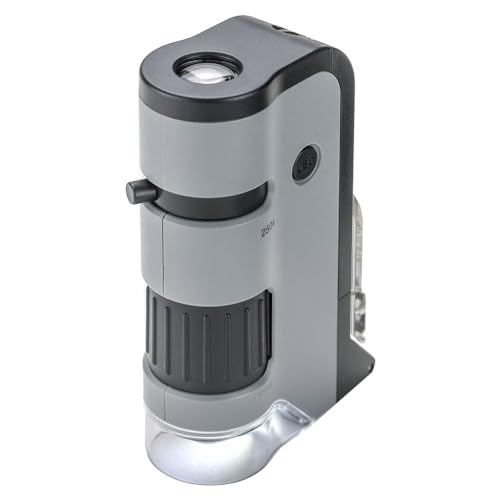
Best for: buyers who want an optical eyepiece and a phone clip in one tool Skip it if: you expect a live wireless feed on your screen
The MicroFlip is not wireless in the Wi-Fi sense. Carson bundles a smartphone digiscoping clip that aligns a phone camera to the eyepiece, so you get an image on the screen without a cable. It weighs 2.56 oz, measures 4.3 x 2.4 x 1.25 in, and runs 100x to 250x with LED and UV illumination. That is an honest optical range from a scope with a stated model number (MP-250) and a manufacturer warranty, and it is the second cheapest pick of the six.
Compared with the three wireless digitals, the MicroFlip trades the live video feed for a real lens and a much smaller body. Compared with the MicroBrite, it doubles the top-end magnification and adds a UV mode. The reason it is not higher is simple: a reader typing "wireless" wants a live phone feed, not a clip. If that reader will accept a phone-mounted lens instead, this is the sharpest small tool on the list.
Pros:
- 100x to 250x optical range
- 2.56 oz and 4.3 x 2.4 x 1.25 in
- LED and UV illumination
- Includes smartphone clip
- Manufacturer warranty stated
Cons:
- No live wireless video feed
- Zoom below the digital picks' claims
- Clip alignment takes practice
5. Carson MicroBrite Plus 60x-120x — Best for families
The MicroBrite Plus is the pick when the microscope has to survive a kid's backpack and just work when it comes out again.

Best for: kids and school kits that need something almost indestructible Skip it if: you want to record video and share it
The MicroBrite Plus is the smallest, lightest and simplest thing on the list. It weighs 2.08 oz, measures 3.7 x 2.3 x 1.2 in, and carries a limited lifetime warranty with a stated model number of MM-300. Carson quotes 60x to 120x optical zoom and a built-in LED. There is no app, no cable, no pairing, no battery to charge beyond a couple of button cells. You point it at a leaf or a beetle, press the light on, and look.
The reason it is here and not higher is the same reason a lot of families will love it: no wireless. If you want to email the picture to a teacher, this is the wrong tool. If you want a scope that a nine-year-old cannot brick by tapping the wrong app icon, and that will still be working when they hand it down to a sibling, it is easily the safest buy in the group and the second lightest at 2.08 oz.
Pros:
- Limited lifetime warranty
- 2.08 oz, second lightest of the six
- Full dimensions published
- Bright LED, no app to fight
- Model MM-300 clearly identified
Cons:
- No wireless or clip capture path
- 120x top end, well below the digital claims
- Cannot record video
6. foreverLily Wireless Scalp Camera Handheld Microscope — Best budget pick
The foreverLily is the cheapest wireless option here and the only one aimed at scalp, skin and hair rather than general specimens.

Best for: hair, scalp and skin close-ups at short working distance Skip it if: you need magnification above 200x
At 1.28 oz, the foreverLily is the lightest pick by a clear margin, and it is the cheapest of the six. foreverLily says it streams over Wi-Fi at 1080P to a phone app, offers 50x to 200x magnification with manual focus, and has dual white and UV light modes for surface work. A 400mAh battery gives about an hour of runtime per charge on the listing.
Read the product name carefully: this is marketed as a scalp camera, and the fixed-focus design is tuned for short working distances on skin and hair rather than general specimen work. That is why the top end is 200x rather than the 1000x claims further up the list, and why the accessories are what they are. If your use case is a hair salon shelf, a skincare routine, or a very cheap way to try a wireless scope before spending more, this is the honest pick. For coins, insects and plants, the Skybasic is a better fit.
Pros:
- Lightest at 1.28 oz
- Cheapest pick of the six
- Wi-Fi feed to phones at 1080P claim
- White and UV light modes
- Built-in battery for cordless use
Cons:
- Top magnification only 50x-200x
- Fixed-focus design limits general use
- Battery lasts about an hour per charge
What the magnification number does not tell you
Every listing on this page leads with a magnification range. That number is the least useful specification to compare across the six, and here is why.
On the three digital picks, "50x to 1000x" is a digital zoom range applied to a small image sensor. The optics themselves are fixed. Cropping into a 1920x1080 or 3840x2160 frame delivers more magnification only until pixel detail runs out, which happens well before 1000x. Skybasic and mafiti share the same 50x-1000x claim; Jiusion does too. That does not mean they resolve the same detail. Sensor size, lens quality and lighting decide that, and those specifications are not published.
On the two Carsons, 60x-120x and 100x-250x are optical ranges through real glass. A 120x Carson image can be sharper than a 1000x digital image because the glass is doing the work. The MicroFlip's 250x sits well below the digital claims on paper and above them in usable detail on paper too, depending on what you point it at.
The practical rule: on digital scopes, the useful magnification is closer to the middle of the range than the top. On optical scopes, the whole range is real. Do not pay a premium for a bigger top-end digital number.
How to judge a wireless pocket microscope the listing did not mention
A shopper coming to this category almost always overweights magnification and underweights the boring things. Here is the short checklist I ran the six through, and you can run any other listing through it too.
- Working distance. How close does the lens need to be to the specimen? A fixed-focus scalp camera like the foreverLily is designed to sit against skin. That is useless for a coin under a light.
- Illumination. Ring LEDs on the barrel, like the eight on the Skybasic and Jiusion, put light around the lens rather than in front of it. That matters more than the LED count.
- App quality. The wireless picks all rely on a manufacturer's phone app. The listing will not tell you if it is any good, so search the store for the app name before you buy.
- Stand. The Skybasic and Jiusion ship with stands; the mafiti's stand rotates on 360 degrees. A shaky hand at 200x is a blurred hand at 200x.
- Power. The mafiti and foreverLily are battery-powered. The Skybasic and Jiusion pull power over USB while streaming Wi-Fi, so bring a cable and a small battery pack on any long session.
None of these five points is a specification you filter on. All five decide how the scope actually works once it is in your hand.
Head-to-head: Skybasic against Jiusion
These are the two Wi-Fi picks that fight for the top spot, and the choice comes down to three tie-breakers.
- Sensor claim. Jiusion says 3840x2160P; Skybasic says 1920x1080. If you plan to crop hard into stills, Jiusion has more pixels to spend.
- Warranty. Jiusion publishes a lifetime warranty; Skybasic publishes nothing on that front. For a device with a Wi-Fi chip and a rechargeable circuit, a stated warranty is worth real money over a two-year horizon.
- Market signal. Skybasic sells much faster than Jiusion in this category. For a wireless device where app pairing is the failure mode, that is the strongest hint that the pairing actually works reliably.
The tie-breaker most readers should weight highest is the third. A better sensor claim on paper is worth less than a scope that reliably connects to your phone on the first try. That is why Skybasic is the winner and Jiusion is the pick when you already know you want the higher sensor claim and the warranty.
Who should skip a wireless pocket microscope entirely?
Three groups of buyers should ignore this whole category and go elsewhere.
- Serious biology students. A wireless pocket microscope is not a compound microscope. Slides, stains and calibrated 400x optical work belong on a lab scope with a real eyepiece.
- Anyone doing PCB inspection all day. A boom-arm digital microscope with an HDMI monitor beats a Wi-Fi pocket scope on every axis except portability. If you are sat at a bench, buy for the bench.
- Gift buyers for young children. The two Carsons, especially the MicroBrite Plus at 2.08 oz with its limited lifetime warranty, will land better than any app-driven digital.
If you fit one of those three, close this tab and search again. If you do not, the Skybasic is the right default.
The verdict
The SKYBASIC Wireless Digital Microscope is the best wireless pocket microscope in this set. It does exactly what the keyword promises: a Wi-Fi feed to a phone, an eight-LED ring on the barrel, and a 1920x1080 sensor claim from the fastest-selling listing of the six. That combination of a straightforward wireless workflow and a healthy market signal is what earns the top spot over stronger paper specifications.
Two conditions flip the recommendation. First, if you want the highest sensor claim and a lifetime warranty in writing, and you are willing to carry 7.05 oz, buy the Jiusion 4K 50-1000x WiFi USB Digital Handheld Microscope. Second, if you want an optical eyepiece rather than a live phone feed, buy the Carson MicroFlip 100x-250x for its 2.56 oz body and real 100x-250x range, or the Carson MicroBrite Plus 60x-120x if the user is a child and the priority is a limited lifetime warranty on a 2.08 oz tool.
Skip the mafiti unless you specifically need battery-powered cordless use, and skip the foreverLily unless the target is scalp, skin or hair at short working distance.
FAQ
Is a wireless pocket microscope worth it over a wired one?
A wireless pocket microscope is worth it when the phone is where you want the image to end up. If you already carry a phone into the field and want to shoot stills or video through an app, cutting the USB cable is a real win. If your workflow ends on a laptop, a wired USB microscope is cheaper and often sharper, because the image path is shorter and there is no Wi-Fi chip in the way.
What magnification does a pocket microscope actually need?
The magnification a pocket microscope actually needs depends on the specimen. Coins, insects and plant surfaces sit comfortably in the 60x to 250x range that the two Carsons cover with real optics. Cells, fibres and skin surface benefit from higher figures, though the "1000x" claims on the digital picks are digital zoom on a small sensor, not calibrated optical power. Aim for a real 100x-plus and treat higher digital numbers as a bonus.
Skybasic or Jiusion for phone photography?
Skybasic or Jiusion both stream Wi-Fi to phones, and the choice is a two-line decision. Pick the SKYBASIC Wireless Digital Microscope if reliable app pairing and market signal matter more to you than raw pixels, since it sells fastest of the six. Pick the Jiusion 4K 50-1000x WiFi USB Digital Handheld Microscope if you want the higher 3840x2160P sensor claim and a published lifetime warranty, and 7.05 oz in your bag is fine.
Will these work with an iPhone and Android?
These will work with an iPhone and Android for the three wireless picks: Skybasic, Jiusion and mafiti all state iOS and Android app support, and Jiusion adds Windows, Mac, Linux and Chrome OS over USB. The Carson MicroFlip pairs with a phone via a physical smartphone clip rather than an app, which sidesteps compatibility entirely. The Carson MicroBrite Plus is optical only and does not connect to a phone.
What is the biggest mistake buyers make in this category?
The biggest mistake buyers make in this category is chasing the largest magnification number on the box. A "1000x" digital claim on a small sensor produces a blurry, upscaled image well before it reaches that figure, while a 120x optical scope with clean glass can look sharper. Judge a wireless pocket microscope on sensor resolution, LED count, stand quality and app reliability, not on the top end of a zoom range.
If you want a wireless pocket microscope that behaves the way the search term promises, start with the Skybasic, install the app before the scope arrives, and try pairing it against a printed page under a desk lamp. That single test tells you more than any specification sheet. From there, step up to the Jiusion only if you already know you want the higher sensor claim, or sideways to a Carson if an optical eyepiece and a limited lifetime warranty matter more than a live phone feed. Buy for the workflow you actually have, and the rest of the specification sheet stops mattering very quickly.