Best Telescopes by Aperture and Mount Type

A ranked shortlist of five telescopes, matched to five very different buyers, with the deciding specifications laid out side by side so you can pick without guessing.

By Sam BaileyUpdated 14 min read
On this page
- Best telescope at a glance
- How I screened the field down to five
- 1. MEEZAA 90mm Refractor — Best overall
- 2. Celestron NexStar 8SE — Best premium
- 3. Celestron StarSense Explorer DX 130AZ — Most versatile
- 4. Celticbird 80mm Refractor — Best upgrade
- 5. Gskyer 70mm AZ Refractor — Best budget pick
- Aperture, focal length, and what actually decides the view
- Refractor, reflector, or catadioptric: which suits you?
- What the listings do not tell you about setup
- Who should skip a telescope entirely?
- The verdict
- FAQ
The best telescope in this set is the MEEZAA 90mm Refractor, because a 90 mm aperture paired with an 800 mm focal length gives you sharp Moon, planet, and bright deep-sky views without demanding electronics or a car boot to move it. If you are ready to spend more and want a computerised 8-inch aperture that finds objects for you, the Celestron NexStar 8SE is the better buy. Get either wrong and you spend a year fighting a wobbly tripod instead of looking up.
Best telescope at a glance
| Pick | Aperture / focal length | Mount | Price |
|---|---|---|---|
Best overall MEEZAA 90mm Refractor |
90 mm / 800 mm | Manual altazimuth tripod, 28 to 46 in | Check Price |
Best premium Celestron NexStar 8SE |
8 in Schmidt-Cassegrain | Computerised GoTo, 40,000+ object database claim | Check Price |
Most versatile Celestron StarSense Explorer DX 130AZ |
130 mm Newtonian reflector | Manual altazimuth, smartphone-guided | Check Price |
Best upgrade Celticbird 80mm Refractor |
80 mm / 600 mm | Manual altazimuth tripod | Check Price |
Best budget pick Gskyer 70mm AZ Refractor |
70 mm / 400 mm | Manual altazimuth tripod | Check Price |





How I screened the field down to five
I started with the criteria that actually matter to a first or second telescope purchase and weighted them in this order.
- Aperture in millimetres. Aperture is the diameter of the main lens or mirror, and it decides how much light the telescope can gather. More light means fainter objects become visible and sharp objects hold detail at higher magnification. Everything else is secondary.
- Mount type. A telescope on a shaky tripod is unusable. A computerised mount finds objects for you; a manual altazimuth mount is simpler and cheaper but demands you learn the sky.
- Focal length and included eyepieces. These set the magnification range, and the picks here bundle eyepieces so a buyer can start the first night.
- Portability. Weight and folded dimensions decide whether the scope leaves the cupboard.
Anything with an equatorial mount aimed at astrophotographers was cut, because the best telescope for a general reader is one they can actually set up alone. Two of the five picks are Celestron, which reflects how strongly that brand shows up in this category rather than a preference.
1. MEEZAA 90mm Refractor — Best overall
A 90 mm refractor with a long 800 mm focal length is the sweet spot for lunar and planetary detail in this set, without the weight or price of the premium picks.
Best for: a first serious telescope for a family that wants planets and the Moon. Skip it if: you need computerised tracking or plan to photograph deep-sky objects.
The MEEZAA earns the top spot on the specification that decides the view: 90 mm of aperture, larger than every other refractor in this set and second only to the two reflectors. Pair that with an 800 mm focal length at f/8.88 and you get the long, slow optical setup that shows Jupiter's cloud bands and the Moon's craters cleanly. MEEZAA supplies 10 mm and 25 mm eyepieces and a 3x Barlow, which the brand says covers 32X to 240X. In practice you will spend most nights between 40X and 120X, where the atmosphere lets you stay sharp. The tripod is adjustable stainless steel from 28 to 46 in, and the whole rig folds into the carry bag. The trade-off is honest: no computerised finder, no warranty published in the listing, and at 32 in long the tube is bulkier than the Celticbird 80 mm below. Compared with the 8SE, you give up light-gathering and automation. Compared with everything else here, you gain aperture and reach.
Pros:
- Largest refractor aperture in this set at 90 mm
- Long 800 mm focal length suits planets and the Moon
- Two eyepieces plus 3x Barlow included
- Height-adjustable stainless steel tripod, 28 to 46 in
- Fits in a carry bag once broken down
Cons:
- No published warranty in the listing
- Manual mount only, no tracking help
- 32 in tube is bulkier than the 80 mm and 70 mm picks
2. Celestron NexStar 8SE — Best premium
An 8 in Schmidt-Cassegrain with a computerised GoTo mount is the pick when your interest goes past the Moon and you want to chase galaxies and nebulae without hunting them by hand.

Best for: a committed hobbyist chasing galaxies, nebulae, and detailed planetary views. Skip it if: you want to grab the scope and walk to a park in under a minute.
Aperture wins in astronomy, and the 8SE brings the biggest one here: an 8 in Schmidt-Cassegrain, which folds a long optical path into a stubby tube. Celestron says the NexStar+ hand control has a database of more than 40,000 objects and that SkyAlign lets you align on any three bright points in the sky, no names required. That is the best telescope in this list for someone who wants to see the Whirlpool Galaxy without learning to star-hop. Celestron publishes a two-year warranty, which none of the refractors here match except the DX 130AZ. It weighs 24 lb and ships in a box measuring 52 x 32 x 34 in. That is the real cost: this is a two-trip setup from the car, and the fork mount needs power. The 8SE is the best telescope here on capability, but it is also the least casual. Weigh how often you will actually carry it out.
Pros:
- Largest aperture in the set at 8 in
- Computerised GoTo mount with SkyAlign, per Celestron
- Two-year warranty stated in the listing
- Compact Schmidt-Cassegrain tube for its aperture
- Long product history in Celestron's lineup since 2003
Cons:
- Heaviest pick at 24 lb
- Highest price position in this set
- Needs power for the mount, adding a battery to the kit list
3. Celestron StarSense Explorer DX 130AZ — Most versatile
A 130 mm reflector with smartphone-guided pointing is the pick when you want real aperture and modern help, without paying for a motorised mount.
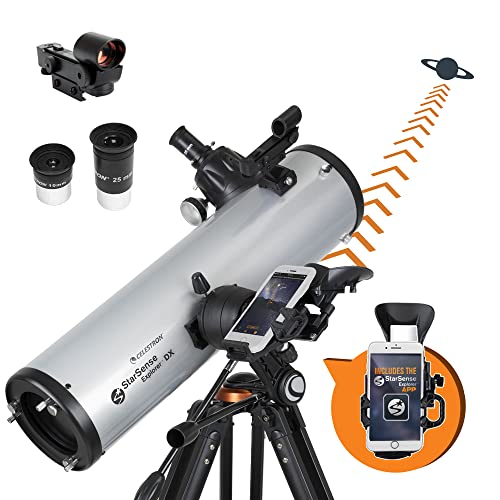
Best for: a beginner who has a smartphone and no patience for star charts. Skip it if: you observe without a phone or in areas with poor GPS signal.
The DX 130AZ splits the difference between the manual refractors and the fully computerised 8SE. You get a 130 mm Newtonian reflector, which Celestron rates with high-reflectivity coatings, and a manual altazimuth mount with dual-axis slow-motion controls. The trick is the phone dock. Celestron says the StarSense Explorer app analyses star patterns overhead and gives you on-screen arrows to nudge the scope onto a target. No GPS trilateration, no aligning on named stars. The listing also mentions a curated nightly target list. Two-year warranty is stated. At 18 lb and 39 in long it sits between the featherweight refractors and the 8SE. The trade-off is dependence on your phone: no battery, no app, no guidance, and you are back to reading a star chart with a red flashlight. If your phone is always in your pocket anyway, this is the best telescope here for exploring across categories of objects.
Pros:
- 130 mm reflector, second-largest aperture in the set
- Smartphone sky-recognition guidance, per Celestron
- Dual-axis slow-motion controls on the mount
- Two-year warranty stated in the listing
- Curated nightly targets in the app, per the listing
Cons:
- Requires a compatible smartphone to use the guidance
- 18 lb is heavier than the three small refractors
- Newtonian tube needs occasional collimation
4. Celticbird 80mm Refractor — Best upgrade
An 80 mm refractor at 600 mm focal length delivers a real step up from a starter 70 mm, in a package that still weighs under 6 lb.

Best for: a beginner ready to step past a starter 70 mm without leaving the entry tier. Skip it if: you want a computerised mount or a bigger aperture for deep-sky viewing.
The Celticbird sits in the second-cheapest slot in this set, and it targets the buyer who has outgrown a toy telescope but is not ready for the DX 130AZ or the MEEZAA. Its 80 mm aperture gathers about 30% more light than a 70 mm, which sounds small on paper and is noticeable on faint planetary detail. Focal length is 600 mm at f/6.7. The listing states 20 mm and 9 mm eyepieces for 30X and 66X, which is a modest and honest magnification range. Included: aluminium tripod, backpack, phone adapter, and a Moon filter, which cuts glare when the Moon is more than half lit. It weighs 5.8 lb, the lightest pick here, and packs to 17.5 in. The gaps to acknowledge: no published warranty, only one seller lists it, and the bundled eyepiece pair tops out at 66X unless you add a Barlow later. Against the Gskyer below, you gain aperture; against the MEEZAA above, you lose reach.
Pros:
- 80 mm aperture, larger than the entry 70 mm refractor
- Lightest pick in the set at 5.8 lb
- Backpack, phone adapter, and Moon filter included
- Compact 17.5 in stowed length
- Second-cheapest position in this shortlist
Cons:
- Bundled eyepieces only reach 66X without a Barlow
- No published warranty in the listing
- Only one seller stocks it
5. Gskyer 70mm AZ Refractor — Best budget pick
A 70 mm refractor at 400 mm focal length is the cheapest of the five and the fastest way to get a curious first-time user under the sky tonight.

Best for: a curious kid or first-time buyer who wants the Moon and Jupiter tonight. Skip it if: you already know you want to see galaxies clearly.
The Gskyer is the cheapest pick and the one buyers choose most often in this shortlist by a wide margin. That is not an accident: 70 mm at 400 mm f/5.7 is the classic "first real telescope" size, small enough to travel with and cheap enough to gift. Gskyer includes two eyepieces plus a 3x Barlow, an adjustable aluminium tripod, a phone adapter, a wireless shutter remote for phone photos, and a carry bag. The listing states a one-year warranty. Stowed dimensions are 24.8 in, and the tube packs into the bag with the tripod. The honest limitations of this format: 70 mm gathers roughly 40% less light than the 90 mm MEEZAA, deep-sky targets past bright nebulae will look faint or invisible, and the short 400 mm focal length means the Barlow does heavy lifting to get past 60X. As a start, it is the right one. As a keeper, it is the one you will outgrow first.
Pros:
- Cheapest of the five picks
- One-year warranty stated in the listing
- Two eyepieces, 3x Barlow, phone adapter, and remote bundled
- Packs into a carry bag with the tripod
- Sells faster than the rest of this set
Cons:
- Smallest aperture here at 70 mm
- Short 400 mm focal length limits high-magnification detail
- Deep-sky objects will look faint compared with the reflectors
Aperture, focal length, and what actually decides the view
Most first-time buyers compare telescopes by magnification. Magnification is the wrong number to lead with, because you can push any telescope to any magnification with a cheap eyepiece and get a bigger, blurrier image. What decides whether the image stays sharp is aperture.
- Aperture is the diameter of the primary lens or mirror. It sets how much light the telescope collects and, together with the atmosphere, the maximum useful magnification. A rough rule is about 50X per inch of aperture on a steady night.
- Focal length divided by aperture gives the focal ratio, written f/5.7 or f/8.88 in the listings above. Longer focal ratios like f/8.88 are gentle on cheap eyepieces and suit planetary detail. Shorter ratios like f/5.7 give wider fields for star clusters.
- Eyepiece focal length divides into the telescope's focal length to give magnification. A 10 mm eyepiece on the MEEZAA's 800 mm tube yields 80X.
Ranked by aperture, this set runs: 8SE at 8 in, DX 130AZ at 130 mm, MEEZAA at 90 mm, Celticbird at 80 mm, Gskyer at 70 mm. That order also predicts, roughly, how much deep-sky detail each will show. The best telescope for the Moon and planets is the one with enough aperture to hold 100X sharp; the best telescope for galaxies is whichever one gathers the most light.
Refractor, reflector, or catadioptric: which suits you?
Three optical designs sit in this shortlist. The choice matters more than the brand.
- Refractors use a lens at the front. The MEEZAA, Celticbird, and Gskyer are refractors. Refractors need almost no maintenance, hold alignment through knocks, and give crisp images per inch of aperture. They get long and heavy fast at larger apertures, which is why refractors above 4 in are rare and expensive.
- Newtonian reflectors use a curved mirror at the back and a small flat mirror to redirect the light. The DX 130AZ is a Newtonian. Reflectors give more aperture per dollar than refractors and are the standard for deep-sky work at modest budgets. They need occasional collimation, which means adjusting the mirror alignment.
- Catadioptric telescopes like the Schmidt-Cassegrain 8SE combine a lens and mirrors to fold a long focal length into a short tube. That is why an 8 in scope can weigh 24 lb rather than being 6 ft long. The compromise is complexity and price.
If you want the best telescope for grab-and-go simplicity, take a refractor. If you want the most aperture per dollar, take a Newtonian. If you want a serious deep-sky scope that still fits in a car, take a catadioptric.
What the listings do not tell you about setup
The listings tell you what is in the box and what magnification the eyepieces reach. They do not tell you the practical friction between opening the box and seeing Saturn. A few points to plan for:
- Cooldown. A telescope brought from a warm house into cold night air needs 20 to 45 minutes for its optics to reach outdoor temperature. Views before that will shimmer.
- The finder. All five picks are aimed with a small secondary sight. That sight has to be aligned with the main tube in daylight the first time you use it, or you will spend the first hour swearing at a moving Moon.
- Dew. Refractors and Schmidt-Cassegrains fog on the front element on damp nights. A dew shield or a small heater strip helps.
- The mount is the limit. A wobbly tripod ruins any optical tube. Extend the legs only as far as you need, and let vibrations settle before you look.
- Dark skies matter more than aperture. A 70 mm refractor under a rural sky beats an 8 in scope in a city centre for most deep-sky targets.
None of this is in the box. All of it decides whether the scope gets used.
Who should skip a telescope entirely?
Not every night-sky buyer needs a telescope. If your main interest is wide constellations, meteor showers, or the Milky Way as a whole, a good pair of 10x50 binoculars will serve you better than any of the five above. Binoculars are lighter, faster to deploy, and cheaper to replace if a child drops them. If you want to photograph the sky rather than look at it, none of these scopes are optimised for astrophotography, and you would be better off starting with a camera on a tracking mount. And if you live under heavy light pollution and cannot travel to darker skies, aperture buys you less than it should; consider whether a road trip once a month is more realistic than a scope in the wardrobe. A telescope earns its place when you want to zoom in on specific objects: the Moon's craters, Jupiter's moons, Saturn's rings, and the brightest galaxies and nebulae.
The verdict
If you want a single answer, the MEEZAA 90mm Refractor is the best telescope in this shortlist for most buyers. It has enough aperture for Jupiter's cloud bands and lunar detail, a long 800 mm focal length that flatters cheap eyepieces, and a bundle of two eyepieces plus a Barlow that lets you get started the first night. It is the middle-priced pick and neither the heaviest nor the fanciest, which is why it fits the widest set of homes.
If your interest is more serious and your budget allows it, the Celestron NexStar 8SE is the better buy. Its 8 in aperture is the largest here by a wide margin, and Celestron says its computerised mount pulls objects from a 40,000-plus database with a three-star alignment. That capability is the difference between spending an hour looking for a galaxy and spending an hour looking at one. The cutoff is honest: if you will not carry 24 lb of scope outside on a Tuesday, the MEEZAA is the smarter default. If you will, the 8SE rewards you every clear night.
FAQ
Is a telescope worth it for a total beginner?
A telescope is worth it for a total beginner if the interest is in specific objects like the Moon, planets, and bright nebulae, and if the buyer accepts a learning curve on aiming and cooldown. The Gskyer 70mm and the DX 130AZ are the friendliest starts here. If the interest is only wide starfields or aurora, binoculars serve better and cost less.
What is the best telescope for viewing planets specifically?
For viewing planets specifically, aperture and a long focal length matter most, because planets are small and bright and reward high, steady magnification. In this shortlist the MEEZAA 90mm at 800 mm and the Celestron 8SE at 8 in are the strongest planetary picks. The 8SE wins on light-gathering and detail; the MEEZAA wins on price and portability.
How does the DX 130AZ compare with the NexStar 8SE?
The DX 130AZ and NexStar 8SE both come from Celestron, both carry a two-year warranty per the listings, and both aim beginners at deep-sky objects. The 8SE is a 8 in Schmidt-Cassegrain with a computerised GoTo mount and weighs 24 lb. The DX 130AZ is a 130 mm Newtonian with a manual mount guided by a smartphone app, and weighs 18 lb. The 8SE offers more aperture and automation; the DX 130AZ offers a lighter, cheaper package.
Do I need a computerised mount to enjoy the best telescope for me?
You do not need a computerised mount to enjoy a telescope, but you need patience or an app if you skip one. Manual mounts like those on the MEEZAA, Celticbird, and Gskyer demand you learn to find objects by star-hopping. The DX 130AZ replaces that skill with a phone app. The 8SE replaces it with a hand controller. Both cost more than the manual scopes.
What is the biggest mistake first-time telescope buyers make?
The biggest mistake first-time telescope buyers make is chasing magnification numbers on the box instead of aperture. A 675X claim on a 70 mm scope is technically achievable and practically useless, because the image dims and blurs long before that. Look at the aperture first, the mount stability second, and the included eyepieces third. Magnification takes care of itself when the first two are right.
Every pick in this list has a job, and the job is what you should match. Buy the Gskyer if the point is to get a curious eleven-year-old under the sky tonight without spending much. Buy the Celticbird if you want a slightly larger aperture and a light pack. Buy the DX 130AZ if your phone is glued to your hand anyway and you want the app to find things for you. Buy the 8SE if you have already spent a year with a smaller scope and you know you want more. And buy the MEEZAA if you want the default choice that suits the widest set of nights and skies, and you would rather learn the sky than fight the tripod.