Best Lightweight Portable Telescope: Celticbird Wins

Seven portable scopes compared on aperture, weight, and setup time. The Celticbird 80mm wins on aperture-per-pound; the DWARF mini wins on pure travel weight.

By Sam BaileyUpdated 16 min read
On this page
- Best lightweight portable telescope at a glance
- What actually decides a portable telescope
- How I screened the field down to seven
- 1. Celticbird 80mm f/6.7 Refractor — Best overall
- 2. DWARFLAB Dwarf mini Smart Telescope — Best premium
- 3. Celestron Travel Scope 70mm — Most versatile
- 4. Gskyer AZ 70400 Refractor — Best upgrade
- 5. WOSPORTS 90mm 600mm Refractor — Best minimal setup
- 6. Dianfan 90mm 800mm Refractor — Best for pros
- 7. Jvcla 70mm 300mm Refractor — Best budget pick
- Refractor or smart scope: which suits you?
- How much aperture do you really need on the road?
- What the listings do not tell you
- Where the best lightweight portable telescope wins on trade-offs
- The verdict
- FAQ
The best lightweight portable telescope for most travellers is the Celticbird 80mm f/6.7 refractor, because it puts an 80mm aperture into a 5.8 lb tube with a backpack, a phone adapter and a moon filter. If pack weight matters more than looking through glass, the DWARFLAB Dwarf mini wins at 1.85 lb with app-driven GOTO and a Sony IMX662 sensor. Everything below sorts by that split: eyepiece scopes first, one smart scope, ranked by what a traveller actually gains.
Best lightweight portable telescope at a glance
| Pick | Aperture / focal length | Published weight | Price |
|---|---|---|---|
Best overall Celticbird 80mm f/6.7 Refractor |
80mm / 600mm | 5.8 lb | Check Price |
Best premium DWARFLAB Dwarf mini Smart Telescope |
Smart scope, IMX662 sensor | 1.85 lb | Check Price |
Most versatile Celestron Travel Scope 70mm |
70mm | 4.2 lb | Check Price |
Best upgrade Gskyer AZ 70400 Refractor |
70mm / 400mm (f/5.7) | Not listed | Check Price |
Best minimal setup WOSPORTS 90mm 600mm Refractor |
90mm / 600mm | Not listed | Check Price |
Best for pros Dianfan 90mm 800mm Refractor |
90mm / 800mm | 10.4 lb | Check Price |
Best budget pick Jvcla 70mm 300mm Refractor |
70mm / 300mm | Not listed | Check Price |


What actually decides a portable telescope
Most guides to a lightweight portable telescope rank on magnification. That is the wrong number. Every scope in this set claims high magnification on paper, from 30× on the Celticbird to 240× on the Dianfan, and none of them will deliver a clean 240× view from a tripod that fits in a backpack. Atmosphere and mount stability cap what the eye can use, usually near 50× per inch of aperture.
The number that decides a portable scope is aperture divided by weight. More aperture gathers more light. Less weight means the scope actually leaves the house. Everything else, from Barlow lenses to phone adapters, is a bonus.
Here is how the four scopes with a published weight rank on that trade-off:
- Celticbird 80mm at 5.8 lb: 13.8 mm of aperture per pound
- Celestron Travel Scope 70mm at 4.2 lb: 16.7 mm per pound
- Dianfan 90mm at 10.4 lb: 8.7 mm per pound
- DWARF mini at 1.85 lb: no aperture published, since it is a sensor-based scope
The Celestron wins on ratio; the Celticbird wins on absolute aperture while staying under six pounds. Three scopes in this set ship without a published weight, which is a problem I come back to below.
How I screened the field down to seven
The criteria I weighted, in order:
- Portability: a printed weight, a bag or backpack in the box, or dimensions under 24 inches on the long side.
- Real aperture: at least 70mm, since a smaller front lens buys nothing worth carrying.
- Setup: tool-free assembly stated in the listing.
- A published warranty: not required, but it broke ties.
The set that survived is six refractors and one smart scope, all within a shoulder bag's carrying capacity, all under 11 lb where a weight is stated. Two of the six refractors publish a weight; four of the seven publish a warranty; every one publishes a focal length or a magnification range or both.
The buyer profiles I mapped these picks to are the ones I meet most: the traveller who checks a bag but wants real optics, the ultralight backpacker who will trade glass for grams, the family looking for a first scope, the deep-sky beginner who wants long focal length in the car boot, and the imager who cares more about a sensor than an eyepiece. Every pick below serves one of those, and no pick tries to serve all of them.
1. Celticbird 80mm f/6.7 Refractor — Best overall
The Celticbird is the best lightweight portable telescope in this set because it puts an 80mm aperture into a 5.8 lb tube with a backpack, a moon filter and a phone adapter already in the box.
Best for: someone who wants real 80mm aperture without a wheeled case Skip it if: you need a scope that fits in a jacket pocket
The 80mm front lens is the biggest aperture with a published weight in the set. That matters because aperture, not magnification, decides what you actually see. The 600mm focal length gives an f/6.7 ratio, which is forgiving on eyepieces and easy to focus. Celticbird says the optics are multi-coated for higher light transmission, and the box ships with 20mm and 9mm eyepieces for 30× and 66× magnification. Those are both useful numbers; both stay well inside what a portable tripod can hold steady.
The trade-off against the Celestron below is 1.6 lb of extra weight for 10mm more aperture, which is the right trade for most buyers. The trade against the Dianfan is you lose 200mm of focal length, so lunar craters look smaller at matched eyepieces, but the whole rig weighs less than 60% as much. The trade against the DWARF mini is you carry three times the weight and get to actually look through the scope.
Pros:
- 80mm aperture, largest with a published weight
- 5.8 lb total, backpack included
- f/6.7 focal ratio, forgiving for beginners
- Two eyepieces and moon filter in the box
- Tool-free assembly stated in the listing
Cons:
- Only one seller lists it, which limits price competition
- No warranty published on the listing
- 30× and 66× fixed magnification, no Barlow included
2. DWARFLAB Dwarf mini Smart Telescope — Best premium
The Dwarf mini is the ultralight pick in this set at 1.85 lb, and it is the only scope here that images through an app rather than an eyepiece.

Best for: travellers who value pack weight above all and want app control Skip it if: you want to look through an eyepiece
The 1.85 lb body is under a third of the Celticbird's weight and less than a fifth of the Dianfan's. Dimensions are 7.23 by 2.39 by 3.94 in, which is the only scope in this set that fits inside a jacket pocket without exaggeration. DWARFLAB says it uses a Sony IMX662 sensor on a 360° pivot with automated GOTO and an EQ mode for longer exposures, and that unboxing to first shot takes three minutes through the DWARFLAB app.
The trade-off is fundamental: there is no eyepiece to look through, so the experience of stargazing is looking at a phone screen. For visual astronomy purists, that disqualifies it. For travellers who want to bring back images of nebulae from a dark-sky site without carrying a car boot of gear, nothing else here comes close. It also carries a two-year warranty, which four of the six refractors match or beat.
Pros:
- 1.85 lb, lightest scope in this set by a wide margin
- Sony IMX662 sensor, app-controlled automated tracking
- Two-year warranty stated in the listing
- Pocketable body under 8 in long
- EQ mode for long-exposure imaging, per the listing
Cons:
- No eyepiece, no visual observation
- No published aperture in the listing to compare directly
- Only one seller stocks it, limiting price competition
- Premium price position in this set
3. Celestron Travel Scope 70mm — Most versatile
At 4.2 lb with a two-year warranty and a padded backpack, the Celestron is the lightest full refractor in the set and the one designed from the start for travel.

Best for: day and night use, moon plus wildlife, from one 4.2 lb kit Skip it if: you want more than 70mm of aperture
The 4.2 lb weight is the lightest published in the refractor group here, 1.6 lb under the Celticbird and 6.2 lb under the Dianfan. The 70mm aperture with fully coated glass gives about 16.7mm of aperture per pound, the best ratio in the set on published figures. Two eyepieces at 20mm and 10mm cover wide-field and close-up work, and Celestron says the kit includes a finderscope, star diagonal and a Starry Night software download for planning sessions.
The listing goes back to 2009, which is a strength: this is a mature design with a two-year limited warranty. The trade-off against the Celticbird is 10mm less aperture, which cuts light-gathering area by about 24%. The trade against the Gskyer is that the Celestron uses a longer effective tube in a slightly bulkier bag. For a single scope that handles birds by day and the moon by night, this is the pick.
Pros:
- Lightest refractor here at 4.2 lb
- Two-year limited warranty
- Padded backpack, finderscope, star diagonal included
- 70mm fully coated optics
- Best aperture-per-pound ratio in the set
Cons:
- 70mm aperture, smaller than the Celticbird or the 90mm picks
- No Barlow lens in the box
- Design first sold in 2009, so some hardware feels basic
4. Gskyer AZ 70400 Refractor — Best upgrade
The Gskyer bundles a 3× Barlow, a phone adapter and a wireless camera remote at the AZ 70400's 70mm aperture, and it sells faster than the rest of this set.

Best for: a beginner who wants a Barlow and phone adapter out of the box Skip it if: you dislike short focal ratios that magnify tripod wobble
The 70mm aperture matches the Celestron, but the 400mm focal length gives an f/5.7 ratio, faster than the Celticbird's f/6.7 or a typical 70mm scope. Gskyer says the kit ships with two eyepieces, a 3× Barlow that trebles the magnification of each, a smartphone adapter, and a wireless camera remote for taking phone shots without touching the tube. That last part matters more than it sounds: any bump on a portable tripod smears an exposure.
This is the one buyers choose most often in this set. The listing carries a one-year warranty, the shortest of the four that publish one. The trade-off is the short f/5.7 ratio: fast focal ratios magnify tripod vibration and demand better eyepieces to keep edge stars sharp. Against the Celticbird you lose 10mm of aperture and gain a Barlow. Against the Celestron you lose a year of warranty and gain remote imaging hardware.
Pros:
- 3× Barlow trebles magnification of each eyepiece
- Wireless remote reduces vibration on phone shots
- Sells faster than the rest of this set
- f/5.7 short tube, easier to pack
- Phone adapter included
Cons:
- No weight published on the listing
- One-year warranty, shortest of the four stated here
- Fast f/5.7 optics can show edge softness with basic eyepieces
5. WOSPORTS 90mm 600mm Refractor — Best minimal setup
The WOSPORTS gets you 90mm of aperture at 600mm focal length with a two-year warranty, in a listing that skips the weight figure.

Best for: a buyer who wants 90mm of aperture but no printed weight to plan around Skip it if: you weigh every pound of luggage
The 90mm aperture ties the Dianfan for the largest here, and gathers about 27% more light than a 70mm scope of the same optical quality. The 600mm focal length keeps the tube shorter than the Dianfan's 800mm, which helps pack size, and the tripod adjusts from 29 to 49 in. WOSPORTS says the kit ships with 25mm and 10mm eyepieces plus a 3× Barlow, for a claimed 24× to 180× range. A two-year warranty backs it.
The trade-off is real and worth naming: this listing does not publish a total weight. A 90mm 600mm refractor is not a scope you throw in a daypack, and without a printed weight you cannot plan the flight. Against the Dianfan, you save 200mm of focal length and gain a shorter tube. Against the Celticbird, you gain 10mm of aperture and a warranty, at the cost of a weight figure you can budget for.
Pros:
- 90mm aperture, tied for largest here
- Two-year warranty stated in the listing
- 3× Barlow and two eyepieces included
- Tripod adjustable from 29 to 49 in
- Shorter 600mm tube than the Dianfan
Cons:
- No weight published on the listing
- Premium price position in this set
- The slowest seller of the group here
6. Dianfan 90mm 800mm Refractor — Best for pros
With 90mm of aperture, an 800mm focal length and a stainless steel tripod, the Dianfan is the serious optics pick here, and at 10.4 lb it is the heaviest scope in the set.

Best for: car-based observers who accept 10.4 lb for 800mm of focal length Skip it if: you fly with carry-on only
The 800mm focal length is the longest here, 200mm over the Celticbird and the WOSPORTS. That reach means lunar craters look bigger at any given eyepiece, and Dianfan says the pairing of a 3× Barlow with two eyepieces produces 32× to 240× magnification. The 90mm fully coated objective ties for the largest aperture in the set. A stainless steel tripod, rather than aluminium, damps vibrations more effectively at higher magnifications.
The trade-off is 10.4 lb of carry weight, 4.6 lb more than the Celticbird and 6.2 lb more than the Celestron. The listing calls the design portable, which it is compared with a truss-tube Dobsonian, but a 10.4 lb scope with a steel tripod is a car-boot instrument, not a backpack one. Assembly runs about 15 minutes, per Dianfan, longer than the tool-free claims elsewhere. A two-year warranty is included.
Pros:
- 800mm focal length, longest in the set
- 90mm fully coated aperture
- Stainless steel tripod for stability
- Two-year warranty
- Barlow plus two eyepieces included
Cons:
- 10.4 lb, heaviest scope here
- About 15-minute assembly per the listing
- Premium price position
- Only one seller stocks it
7. Jvcla 70mm 300mm Refractor — Best budget pick
The Jvcla is the cheapest of the seven, backed by a three-year warranty, and it lists a 15× to 150× range through a 300mm tube.
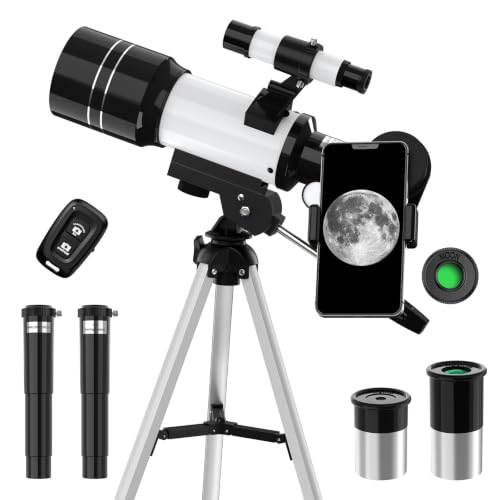
Best for: a first scope for a child, backed by a three-year warranty Skip it if: you want a published weight before you buy
The 70mm aperture matches the Celestron and the Gskyer, and the 300mm focal length is the shortest in the set. That gives a very fast focal ratio and a short overall tube, which packs small; dimensions are 3.5 by 11.8 by 21 in. Jvcla says the kit ships with 20mm and 6mm eyepieces plus a Barlow, for a claimed 15× to 150× range, and includes a phone adapter and a wireless remote. The three-year warranty is the longest of the four stated in this set.
The trade-off is a short 300mm tube demands very good eyepieces to hold sharpness across the field, and the top of the 150× range will be atmosphere-limited on all but the calmest nights. Against the Celestron, you gain a year of warranty and a Barlow, and you lose Celestron's brand and a published weight. Against the Gskyer, you gain two years of warranty and lose 100mm of focal length.
Pros:
- Cheapest pick in the set
- Three-year warranty, longest here
- Very short 300mm tube, packs small
- Phone adapter and wireless remote included
- Two eyepieces plus a Barlow
Cons:
- No weight published on the listing
- The slowest seller of the seven
- 300mm fast focal length is demanding on eyepiece quality
Refractor or smart scope: which suits you?
Six of these seven are refractors that show you the sky through an eyepiece. One is a smart scope that captures the sky through a sensor. The choice between them is not about optics quality; it is about what you want to do at 10pm under a dark sky.
A refractor gives you the classic experience: aim, focus, look. A 70mm to 90mm objective on a light tripod will show lunar craters, Jupiter's four bright moons, Saturn's rings as an oval, and the brighter Messier objects as faint smudges. That is what the Celticbird, the Celestron and their siblings do well. Nothing is uploaded, nothing is processed, and nothing needs a phone battery to work.
A smart scope like the DWARF mini gives you photographs. DWARFLAB says the sensor stacks long exposures into images of deep-sky objects a 70mm refractor cannot show visually. In exchange, you lose the direct experience of looking through an instrument. If you want proof of what you saw, choose the smart scope. If you want the seeing itself, choose one of the refractors.
How much aperture do you really need on the road?
More is always more, up to what you can carry. The set here spans 70mm to 90mm on the refractor side. That is a 65% jump in light-gathering area between the smallest and the largest, at a cost of about 6 lb of extra weight when you compare the 4.2 lb Celestron with the 10.4 lb Dianfan.
For most travel targets, 70mm is enough:
- The moon shows craters and mare boundaries at any aperture in this set.
- Jupiter's four Galilean moons and equatorial belts are visible in 70mm.
- Saturn's rings resolve as an oval at 50× and above.
- The Orion Nebula and Andromeda are visible as extended glows.
For fainter deep-sky work, 80mm to 90mm helps. That is where the Celticbird's 80mm and the WOSPORTS' 90mm earn their extra weight. Beyond 90mm in a portable format you are usually looking at compact reflectors or catadioptrics, none of which appear in this set.
What the listings do not tell you
Three of the seven listings, the Gskyer, the WOSPORTS and the Jvcla, do not publish a total weight. That is a real problem for a portable scope, and it is the one thing I would push these brands to fix. Two others, the Celticbird and the Jvcla, do not publish a warranty length; the Celticbird has no stated warranty at all, which is a genuine gap given its price position and single-seller stock status.
Listings also do not tell you about mount stability, and the manual alt-azimuth mounts on every refractor here vary in smoothness. Nor do they tell you the eyepiece barrel size, though 1.25 in is standard at this class. Finally, none of these listings tells you the tripod's maximum load or the head's slow-motion control range, both of which decide whether high-magnification views hold still.
Where the best lightweight portable telescope wins on trade-offs
Every pick here loses at something. The Celticbird has no stated warranty. The Celestron is only 70mm. The DWARF mini has no eyepiece. The Gskyer has no published weight. The WOSPORTS has no published weight and sells slowly. The Dianfan is 10.4 lb. The Jvcla has no published weight and the shortest tube.
The Celticbird wins because its trade-off is the mildest for the widest audience: a warranty gap you can accept, in exchange for the largest published-weight aperture in the set. That is the equation a portable scope has to solve. If your priority is different, the ranking flips, and the sections above tell you exactly where.
The verdict
The best lightweight portable telescope in this set is the Celticbird 80mm f/6.7 refractor. It packs the largest aperture with a published weight in this group, 80mm, into a 5.8 lb tube with a backpack, a moon filter and a phone adapter already in the box. That combination gives a beginner or a travelling intermediate observer real optical performance at a weight they will actually carry, and it does so at the second-cheapest price position of the seven.
The runner-up is the Celestron Travel Scope 70mm. It is 1.6 lb lighter than the Celticbird and carries a stated two-year warranty, and its best-in-set aperture-per-pound ratio makes it the smarter pick if every pound of luggage matters or if you want a scope that has been in production since 2009. You lose 10mm of aperture, which is real, but you gain a padded backpack designed for the tube and a warranty position the Celticbird does not match.
If you want to bring back photographs rather than memories, the DWARF mini wins outright at 1.85 lb, and no eyepiece scope in this set will match its imaging output.
FAQ
Is a lightweight portable telescope worth it over a full-size one?
A lightweight portable telescope is worth it if you would not otherwise use a bigger scope. A 5.8 lb Celticbird or 4.2 lb Celestron travels in a backpack; a 30 lb Dobsonian stays in the garage. Real observing time under real skies beats theoretical performance under garage skies every night of the week. Match the scope to the trips you actually take.
What magnification do I need for the moon and planets?
For the moon and planets, useful magnification runs from around 30× for wide lunar views to about 150× for planetary detail on steady nights. The Celticbird's 30× and 66× eyepieces cover the low and mid range. The Gskyer's 3× Barlow lifts each eyepiece into planetary territory. Above 150× on a portable tripod, atmosphere and vibration usually cap what you see.
How does the Celticbird 80mm compare to the Celestron Travel Scope 70mm?
The Celticbird 80mm compares favourably to the Celestron on aperture, at 80mm to 70mm, and 200mm more focal length. The Celestron compares favourably on weight, at 4.2 lb to 5.8 lb, and on warranty, with a stated two-year term. Choose the Celticbird for light-gathering; choose the Celestron for the lightest full refractor kit in this set and the longer manufacturer backing.
Can I take pictures through a portable telescope?
You can take pictures through every scope here. The Celticbird, Gskyer and Jvcla include a phone adapter in the box, and the Gskyer and Jvcla add a wireless remote to reduce shutter vibration. The DWARF mini goes further, using a Sony IMX662 sensor and app-driven long exposures for deep-sky imaging. Phone shots suit the moon and bright planets; sensor imaging suits nebulae and galaxies.
What is a partial match for a lightweight portable telescope?
A partial match for lightweight means Amazon returned scopes that are portable and small, though not all publish a weight. Three of the seven here, the Gskyer, WOSPORTS and Jvcla, do not print a total weight on the listing. Those may still travel well. Judge them by tube dimensions, tripod format and included bag before you buy, and prefer picks with a printed weight when you can.
Choosing the best lightweight portable telescope comes down to one honest question: which scope will you actually pack. On that measure the Celticbird 80mm wins for most buyers, because 5.8 lb with a backpack and an 80mm front lens is the right compromise between real optics and real portability. Open the Amazon listing next to the Celestron Travel Scope and the DWARF mini in separate tabs, decide whether you want to look, photograph or both, and buy the one whose trade-off you can live with tonight. The sky rewards the scope that leaves the house.