Best Professional USB C Memory Card Reader for Pros

A working photographer's shortlist of USB-C card readers, ranked by slot mix, size and what the listings actually claim. Winner: Acer's dual-slot ODK4E0.

By Sam BaileyUpdated 15 min read
On this page
- How I cut a long list of readers down to six
- Best professional USB C memory card reader at a glance
- The specification that actually decides this
- Does 'professional' mean anything on a card reader?
- 1. Acer SD Card Reader USB C — Best overall
- 2. BnmxTek USB C to SD Card Reader — Runner-up
- 3. Anker SD Card Reader USB C — Best premium
- 4. Acer 3 in 1 Memory Card Reader — Best for beginners
- 5. RRSITIAU 4 in 1 Card Reader — Best budget pick
- 6. BENFEI 4in1 Memory Card Reader — Best for heavy use
- Which cards do you actually shoot?
- What the listings do not tell you
- Acer ODK4E0 vs Anker AK-A83700A2: which wins?
- The verdict
- FAQ
The best professional USB C memory card reader for most working photographers is the Acer ODK4E0, a 15 g dual-slot dongle that reads SD and microSD simultaneously over a USB 3.0 lane. If you still shoot CompactFlash or juggle four card formats in one edit session, the BENFEI 4in1 is the better buy: it adds CF and Memory Stick slots and a USB-A tail on the same body.
How I cut a long list of readers down to six
The picks in this professional USB C memory card reader roundup were chosen on criteria, then weighted. Here are the four that mattered, in order of the weight I gave them.
- Slot coverage first. A reader is only as useful as the cards it accepts. Two of the six here (BENFEI, RRSITIAU) add CF and MS on top of SD and microSD. The other four are SD plus microSD only.
- Interface generation second. USB 3.0 (5 Gbps) is the working minimum. Three listings state it outright (both Acers and BENFEI). The other three say USB-C without naming a generation, which is a red flag on the spec sheet even if the silicon inside is fine.
- Physical footprint third. A reader lives in a camera bag, not a desk. Weight and dimensions decide whether it stays clipped to a laptop sleeve or gets left behind. Anker publishes 9 g and a 1.65 in body; Acer's ODK4E0 lists 15 g; the BENFEI 4in1 comes in at 2.82 oz and RRSITIAU is a 5.91 in slab.
- Warranty last. Three listings publish a one-year manufacturer warranty. Anker states 18 months. BENFEI does not publish a warranty at all.
Anything without USB-C, without at least two card slots, or without published dimensions in the listing was cut before this shortlist was drawn.
Best professional USB C memory card reader at a glance
| Pick | Slots | Weight | Price |
|---|---|---|---|
Best overall Acer SD Card Reader USB C |
SD + microSD | 15 g | Check Price |
Runner-up BnmxTek USB C to SD Card Reader |
SD + microSD + USB-A | not listed | Check Price |
Best premium Anker SD Card Reader USB C |
SD + microSD | 9 g | Check Price |
Best for beginners Acer 3 in 1 Memory Card Reader |
SD + microSD + USB-A | 2.08 oz | Check Price |
Best budget pick RRSITIAU 4 in 1 Card Reader |
SD + microSD + CF + MS | not listed | Check Price |
Best for heavy use BENFEI 4in1 Memory Card Reader |
SD + microSD + CF + MS | 2.82 oz | Check Price |




The specification that actually decides this
Most guides to a professional USB C memory card reader lean on transfer rate. That is not what decides it. The bottleneck on a modern shoot is almost never the reader chip; it is the UHS-I ceiling on the card itself, and every reader here quotes UHS-I. The differences you feel every day are two: which slots the reader has, and whether it can populate more than one slot at once.
Simultaneous dual-card is the phrase to look for. Both Acers and the BnmxTek explicitly state simultaneous reading and writing across both card slots. The BENFEI listing goes further and claims four cards read and write at once. If you ingest an SD from the A1 slot of your camera and a microSD from a gimbal in the same edit, that single capability saves you a plug-swap on every card. Multiply by a wedding weekend and it is real time.
Does 'professional' mean anything on a card reader?
The word "professional" in the search phrase is the reader's own criterion, not a certified standard. None of these listings carries a professional badge, none is validated for cinema workflows, and none states a sustained write rate. Treat "professional" here as shorthand for a durable, dual-slot, USB 3.0 reader with published dimensions and a warranty that names a term in months or years. That's the shape of a working pro's reader, and it's what the shortlist is filtered against. If your workflow demands CFexpress Type B or SD Express, none of these six will cover it, and you should stop reading and shop that specification directly.
1. Acer SD Card Reader USB C — Best overall
The lightest dual-slot SD-plus-microSD reader here that publishes a warranty, a weight, and a USB 3.0 rating in the same listing.
Best for: hybrid shooters juggling SD and microSD on one USB-C laptop. Skip it if: you shoot CF or CFexpress and need those slots too.
Every reader in this set claims fast transfer. What sets the Acer ODK4E0 apart within this shortlist is the combination of numbers on the spec sheet: 15 g, 0.39 x 2.8 x 0.67 in, USB 3.0 at 5 Gbps, one year of manufacturer cover, and an explicit simultaneous dual-card claim in the listing. Nothing else here has all five in one line.
That matters because a reader lives in a bag. The 15 g body clips to a laptop sleeve without adding a noticeable lump, and the 2.8 in length lets it sit next to a mouse dongle without fouling the port. The BENFEI and RRSITIAU units both cover more card formats, but both are three to four times the length. If you shoot SD and microSD, the extra slots on those two units are paying rent on a footprint you carry every day.
The trade-off against the Anker is 6 g of extra mass in exchange for six months less on the stated warranty; the trade-off against the BnmxTek is the missing USB-A passthrough.
Pros:
- Published 15 g weight and full three-axis dimensions
- USB 3.0 at 5 Gbps stated in listing
- Simultaneous SD and microSD claim
- One-year manufacturer warranty on record
- Slim enough to leave clipped to a laptop sleeve
Cons:
- No USB-A passthrough port
- No CF or Memory Stick support
- Only one seller lists it, so no fallback stock
2. BnmxTek USB C to SD Card Reader — Runner-up
A three-port dongle that adds a USB-A OTG socket to the usual SD-plus-microSD pair.

Best for: anyone who wants an extra USB-A port on the reader itself. Skip it if: weight and dimensions matter and you want them on the spec sheet.
The BnmxTek pitches itself as three ports on one USB-C tail: SD, microSD, and a USB-A female socket that the listing calls OTG expansion. In practice that third port is the reason to buy this one over the winning Acer. Plug a thumb drive or a wired card reader into it and you can pull footage from a client's older USB-A stick without a second adapter. BnmxTek says the reader supports simultaneous dual-slot access and is plug-and-play across macOS, Windows, Linux and ChromeOS.
The gap between this pick and the winning Acer is on the spec sheet, not in the ports. BnmxTek's listing skips weight and detailed dimensions, so I cannot tell you how it compares to the 15 g Acer without opening the box. The one-year manufacturer warranty is on record, matching the Acer.
The set-level trade-off: you gain a USB-A port and lose the reassurance of a published weight. If you never work with USB-A sticks in the field, that's a bad trade.
Pros:
- USB-A OTG port for thumb drives and older kit
- Simultaneous dual-slot claim
- One-year manufacturer warranty stated
- Broad OS compatibility named in listing
Cons:
- No weight or full dimensions published
- No stated USB generation (3.0 vs 3.1)
- Only one seller carries it
3. Anker SD Card Reader USB C — Best premium
The smallest and lightest reader in this set at 9 g and 1.65 in long, from the only brand here with real name recognition.
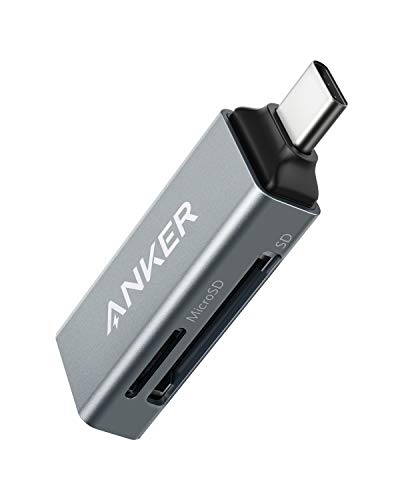
Best for: travellers who value the smallest, lightest body in the set. Skip it if: you want a longer stated warranty than 18 months.
Anker's AK-A83700A2 is the shortest and lightest reader in this shortlist by a clear margin: 9 g against Acer's 15 g, and 1.65 in of length against Acer's 2.8 in. It reads SD and microSD, and Anker says the two slots let you sync, swap and share across both card types. The listing also flags smartphone use as an on-the-go workflow, which fits the ultra-compact housing.
Two things put it in the premium slot rather than the winner's slot. First, the price position: this is the most expensive pick here, and every extra dollar buys size reduction rather than more slots. Second, this design was released in 2019, which means the connector predates USB4 and Thunderbolt 4 laptops. The 18-month stated warranty is the longest of the six, which counts for something.
For a photographer who commutes, flies, and edits on a MacBook lid, the size difference is worth paying for. For a studio where the reader lives on a desk, the extra spend evaporates.
Pros:
- 9 g weight and 1.65 in length, smallest here
- 18-month warranty, longest in this set
- Established brand name in USB accessories
- Two card slots for SD and microSD
Cons:
- The most expensive pick here
- Design dates to 2019, no newer revision listed
- No USB-A passthrough
- No CF or Memory Stick support
4. Acer 3 in 1 Memory Card Reader — Best for beginners
A dual-slot Acer with a USB-A passthrough and an aluminium shell, at 2.08 oz and 2.32 in long.

Best for: first-time buyers who want an aluminium shell and a USB-A passthrough. Skip it if: you already own a hub and only need card slots.
The ODK4H0 is Acer's answer to the BnmxTek: SD, microSD, and a USB-A port on one USB-C tail. Where it earns the beginners' label is the presentation. The listing is explicit about USB 3.0 at 5 Gbps, calls out an aluminium shell for heat dissipation, and states support for SD, microSD, SDHC, SDXC and UHS-I cards. That is the language a new buyer needs to see to feel safe, and it's plainer here than on the BnmxTek page.
The trade-off within this set is size. At 2.08 oz and 2.32 in long, this Acer is heavier than the winning ODK4E0 and the Anker, because it now has to house a USB-A socket. That extra bulk is only worth carrying if you actually use USB-A. A beginner assembling their first travel kit probably does, since older card cases, sticks and mice still ship with USB-A. A pro who already owns a Thunderbolt hub does not.
Pros:
- USB-A passthrough on the reader body
- Aluminium shell for heat dissipation, per listing
- USB 3.0 at 5 Gbps stated
- One-year manufacturer warranty
- Explicit UHS-I support named
Cons:
- Heavier than the winning Acer at 2.08 oz
- No CF or Memory Stick support
- Sits in the premium tier despite dual-slot layout
5. RRSITIAU 4 in 1 Card Reader — Best budget pick
The cheapest of the six and one of only two here that reads CompactFlash and Memory Stick.

Best for: shooters who still have CF or Memory Stick cards in rotation. Skip it if: you only shoot SD and microSD.
RRSITIAU covers four card formats on one reader: SD, microSD, CompactFlash and Memory Stick, plus a detachable USB-C to USB-A adapter that lets you plug the same body into either port style. The listing names support for SD, SDHC, SDXC, microSDHC, microSDXC, CF, Memory Stick Pro Duo, and RS-MMC. That is the widest slot coverage in this shortlist. It is also the cheapest of the six.
The compromises are visible on the spec sheet. The body measures 5.91 in long and 2.62 in wide, which is at least three times the footprint of the winning Acer. Weight is not published. USB generation is not stated. Warranty is one year, on record. If you are still pulling clips off Canon 5D-era CompactFlash cards or transferring family stills off an old Sony camcorder stick, this reader is the whole solution in one purchase. If you have retired those formats, it is a slab of plastic doing nothing that a smaller Acer would not do better.
Pros:
- Reads SD, microSD, CF and MS on one body
- Detachable USB-C to USB-A adapter included
- Cheapest reader in the shortlist
- One-year warranty stated
Cons:
- 5.91 x 2.62 in footprint, the largest here
- No published weight
- No stated USB 3.0 rating
- No simultaneous multi-slot claim
6. BENFEI 4in1 Memory Card Reader — Best for heavy use
Four card slots and both USB-C and USB-A ends, with an explicit four-cards-at-once claim.

Best for: multi-camera workflows that pull SD, microSD, CF and MS at once. Skip it if: you want a small reader that disappears in a pocket.
The BENFEI is the reader I would pick for a busy ingest day. The listing states that the reader accesses four card types (SD, microSD, MS, CF) and reads and writes them simultaneously. It quotes UHS-I mode up to 160 MB/sec and names both USB-C and USB 3.0 ports on the same body, so you can plug it into a MacBook lid today and a Windows desktop tower tomorrow without an adapter. Weight is 2.82 oz, the heaviest in this set.
Against RRSITIAU, which also covers four card formats, BENFEI publishes the throughput figure, publishes the weight, and makes the concurrent-read claim explicitly. Against the Acer ODK4E0, it trades pocket size for slot coverage and the option to run every card in your bag through one dongle. The gap in the listing is warranty, which BENFEI does not name in months or years, and that is worth noting before you buy.
Pros:
- Four card slots on one reader
- Simultaneous read and write claim across all four
- Both USB-C and USB-A ends on one body
- 160 MB/sec UHS-I figure published
- Published 2.82 oz weight
Cons:
- No stated warranty term
- The heaviest and one of the bulkier bodies here
- No dedicated USB-A passthrough for peripherals
Which cards do you actually shoot?
This is the question that resolves five of the six choices above. Answer honestly and the shortlist collapses to two picks.
- SD only, or SD plus microSD. You are the majority. Buy the Acer ODK4E0. If size is worth a premium, buy the Anker.
- SD plus microSD, and you occasionally hand off files on a USB-A stick. The BnmxTek or the Acer ODK4H0. Same slot layout, extra USB-A socket on the body.
- SD plus CompactFlash, because your second body is older or you edit legacy footage. The BENFEI 4in1 if you also want a stated throughput number; the RRSITIAU if the price position matters more than the spec sheet.
- Anything Memory Stick. Only two readers here handle it: BENFEI and RRSITIAU.
- CFexpress Type A or Type B. None of these six covers it. Buy a dedicated CFexpress reader instead.
Notice what this list does not do: it does not rank on transfer rate. Every reader here quotes UHS-I, and UHS-I tops out around 160 MB/sec regardless of the chip inside. Slot coverage is the real fork.
What the listings do not tell you
Card reader listings on Amazon leave three gaps you should assume the worst on.
- Sustained write behaviour under thermal load. Only the Acer ODK4H0 mentions heat dissipation, and even there only by way of the aluminium shell claim. If you're ingesting a full 128 GB card of 4K footage in one pass, expect the reader body to warm up. None of these six is rated for continuous professional ingest across a working day.
- Cable strain on the USB-C tail. All six of these readers are dongles rather than cabled units. That means the reader's own USB-C plug is your strain relief. If you edit with the reader hanging out of a laptop port, treat it as a wear item.
- Backwards compatibility with older SD cards. The listings talk about SDXC and UHS-I, but rarely mention low-capacity SDHC or the very old SD standard. Every reader here should handle them, and none guarantees it in writing.
A professional workflow assumes at least one card reader in the bag has failed, and carries a spare. Two of these at once is not a strange purchase.
Acer ODK4E0 vs Anker AK-A83700A2: which wins?
These are the two dual-slot SD-plus-microSD readers with the tightest spec sheets in the shortlist, and the choice between them is the one most professional buyers will actually make.
Anker wins on size and warranty. 9 g against 15 g. 1.65 in against 2.8 in. 18 months of warranty against 12 months.
Acer wins on the rest. USB 3.0 at 5 Gbps is stated explicitly on the Acer listing and not called out in the same way on the Anker page. Acer sits in the middle price position; Anker is the most expensive in the set. Acer is the newer design; Anker's listing dates from 2019.
If your reader lives clipped to a MacBook lid on planes, buy the Anker. If it lives on a desk or in a side pocket of a camera bag, buy the Acer and put the difference toward a spare SD card.
The verdict
If you shoot SD and microSD and want one reader that disappears into a bag, the Acer ODK4E0 is the pick. It is the only reader here that lists a published weight under 20 g, full three-axis dimensions, a stated USB 3.0 rating and a one-year manufacturer warranty in the same listing. The simultaneous dual-slot claim is what makes it earn its place on a working shoot, not just a hobbyist's desk.
Two conditions flip the recommendation. The first is size: if 6 g and roughly an inch of length are worth paying premium money to shed, the Anker is the smaller, lighter option, and its 18-month warranty is the longest stated here. The second is slot coverage: if your bag still contains a CompactFlash camera or a Sony device that shoots to Memory Stick, neither Acer helps. The BENFEI 4in1 covers four card formats, publishes a 160 MB/sec UHS-I figure, and pairs USB-C with USB-A on one body. It is bulkier and heavier at 2.82 oz, but that is the price of covering every card in the bag with one dongle.
FAQ
Is a professional USB C memory card reader worth it over a cheap dongle?
Is a professional USB C memory card reader worth the premium? Yes, if the qualifiers matter to you: a stated USB 3.0 rating, a published warranty, a simultaneous dual-slot claim, and dimensions you can trust before the box arrives. The Acer ODK4E0 publishes all four. A no-brand dongle at half the size often skips one or more of them, and you pay the difference in guesswork.
What speed can I actually expect from a UHS-I card reader?
What speed does a UHS-I reader deliver in practice? The UHS-I bus itself tops out around 104 MB/sec by spec, and the fastest UHS-I cards claim 160 MB/sec in specific write modes. The BENFEI 4in1 listing quotes exactly that 160 MB/sec figure. In real ingest, expect the card to bottleneck first, not the reader. Buying a faster reader without a faster card changes nothing.
Does the Acer ODK4E0 work with an iPad or an iPhone with USB-C?
Does the Acer ODK4E0 work on a USB-C iPad or iPhone 15 and later? The Acer listing names PCs, laptops, cameras, smartphones and tablets with USB-C or USB-A ports, including MacBook Air and Pro. It does not explicitly name iPhone 15 or 16, though other readers here do. For iPhone use, the BnmxTek and Acer ODK4H0 listings are more explicit.
BENFEI 4in1 vs RRSITIAU 4 in 1: which four-slot reader should I choose?
BENFEI 4in1 vs RRSITIAU comes down to what the listing tells you. BENFEI publishes a 2.82 oz weight, a 160 MB/sec UHS-I figure and a simultaneous four-card claim. RRSITIAU is the cheaper of the two and includes a detachable USB-C to USB-A adapter, but skips the weight and the throughput figure. Buy BENFEI on the spec sheet; buy RRSITIAU on price.
What is the most common mistake when buying a USB-C card reader?
The most common mistake when buying a USB-C card reader is over-buying on slot count. Photographers who only ever shoot SD end up carrying a four-slot slab because the listing looked more "professional." The four-slot bodies here are three to four times the length of the winning Acer. If you do not own CF or Memory Stick cards, the extra slots are dead weight on every trip.
The best reader is the one still in your bag at 6 p.m. on the second day of a shoot, and that usually means the smallest one that fits your card mix. If you shoot SD and microSD, start with the Acer ODK4E0 and add a spare only after you know how you actually use it. If you shoot mixed formats, the BENFEI 4in1 collapses four dongles into one, which is worth the extra grams for anyone running two or three cameras. Either way, buy on slot mix first, size second, and let transfer rate marketing fall down the list where it belongs.