Best Camera Gimbal Stabilizer for Portrait Shooters
Six gimbals, one deciding number: how much camera the arm can hold before it fights you. A payload-first ranking for photographers who shoot people.

By Sam BaileyUpdated 17 min read
On this page
- Best camera gimbal stabilizer for portraits at a glance
- How I screened this field down to six
- Does a gimbal actually help with portraits?
- What payload really decides here
- 1. DJI RS 3 Mini — Best overall
- 2. FeiyuTech SCORP-C2 — Best premium
- 3. FeiyuTech SCORP Mini 2 Kit — Best for heavy use
- 4. DJI Osmo Mobile 7 — Runner-up
- 5. hohem iSteady X3 SE — Best for beginners
- 6. fantaseal 3-Shoe Cage — Best budget pick
- Phone gimbal or camera gimbal for portrait work?
- What the listings don't tell you
- When a different pick wins
- The verdict
- FAQ
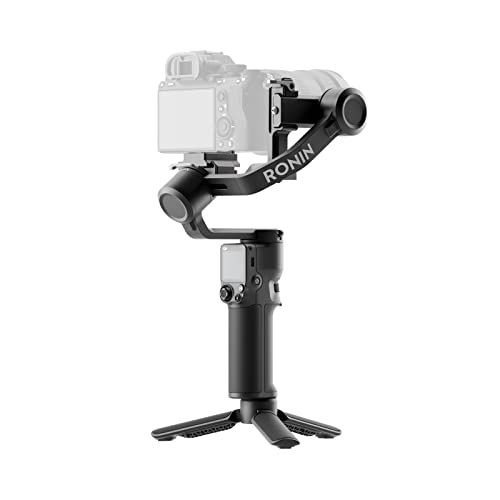
The best camera gimbal stabilizer for portraits is the DJI RS 3 Mini, because it carries a stated 2 kg load on a body that weighs 795 g, which covers most mirrorless-and-prime portrait rigs without wrecking your arm. If your camera runs heavier than that, the FeiyuTech SCORP-C2 is the pick, with a claimed 7.72 lb payload. One number decides this whole field, and it isn't the axis count. All six here are three-axis or non-motorised. Payload is what splits them.
Best camera gimbal stabilizer for portraits at a glance
| Pick | Stated payload | Body weight | Price |
|---|---|---|---|
Best overall DJI RS 3 Mini |
2 kg claim | 795 g claim | Check Price |
Best premium FeiyuTech SCORP-C2 |
7.72 lb claim | 2.91 lb | Check Price |
Best for heavy use FeiyuTech SCORP Mini 2 Kit |
1.2 kg claim | 1.88 lb | Check Price |
Runner-up DJI Osmo Mobile 7 |
Phone only | 0.66 lb | Check Price |
Best for beginners hohem iSteady X3 SE |
Phone only | 0.79 lb | Check Price |
Best budget pick fantaseal 3-Shoe Cage |
Cage, no motors | 0.99 lb | Check Price |


How I screened this field down to six
I started from the published specifications rather than the marketing headers, because every listing in this category leads with the word "smooth" and none of them define it. Weight, dimensions, stated payload, warranty and model number are the fields that can actually be lined up side by side.
Here's what the numbers showed once I sorted them:
- Payload split the field into three groups. Two picks accept a mirrorless body, one accepts a full-frame rig with a zoom, two accept a phone only, and one has no motors at all.
- Body weight ranged from 0.66 lb to 2.91 lb across the six. That's a 4x spread, and it's the difference between a pocketable tool and a two-handed one.
- Only three listings publish a warranty term. The hohem iSteady X3 SE and the fantaseal cage both state 1 year. DJI states its own warranty on both DJI picks. Neither FeiyuTech listing publishes one.
Everything else was noise. Tracking version numbers, mode names and app branding aren't comparable between brands, so I treated them as claims to attribute rather than facts to rank on.
What got cut: anything whose listing gave no weight figure, and anything whose payload claim contradicted its own dimensions. A gimbal you can't verify on paper is a gimbal you're buying on faith.
Does a gimbal actually help with portraits?
Worth saying plainly, because the search term sets an expectation the products don't fully answer. None of these six listings makes any portrait-specific claim. There is no portrait mode, no skin-tone processing, no face-flattering anything in the published data.
What a gimbal does is hold the camera steady while it and you both move. That matters for portrait work in three specific ways:
- Motion portraits. Walking with a subject, orbiting them, or moving from wide to tight in one take.
- Long-lens handheld work. Small hand tremors get magnified by focal length, and a gimbal absorbs them.
- Solo shooting. Face tracking keeps a subject centred when nobody is operating the camera.
For a static, tripod-locked studio portrait, a gimbal contributes nothing. You'd be adding weight and a battery to solve a problem you don't have. Judge the modifier for yourself here: if your portrait work is stills on a stand, skip the whole category and buy a better light. If it's video of people moving, read on.
What payload really decides here
Most gimbal guides compare axis counts and app features. That's not what decides it. Payload does, and it decides it twice.
Payload sets whether the gimbal can hold your rig at all. Load a 3 kg camera onto a 2 kg-rated arm and the motors buzz, the horizon drifts, and battery life collapses. But payload also sets the practical ceiling on your lens, which is the part portrait shooters actually care about. A body plus a 50mm prime is a different weight class from that same body plus a 70-200mm zoom.
Run the arithmetic before you buy. Weigh the body, the heaviest lens you'd mount, and anything bolted on top. Then compare it to these claims:
- DJI RS 3 Mini: up to 2 kg, per DJI's listing.
- FeiyuTech SCORP-C2: 7.72 lb, per FeiyuTech's listing.
- FeiyuTech SCORP Mini 2: 1.2 kg, per FeiyuTech's listing.
The gap between 1.2 kg and 7.72 lb is the entire decision. Leave headroom, too. A gimbal running at its stated maximum is a gimbal working hard, and the arm that's working hard is the arm that drains fastest.
1. DJI RS 3 Mini — Best overall
The best camera gimbal stabilizer for portraits for most mirrorless shooters, because a stated 2 kg capacity on a 795 g body is the right trade in this set.
Best for: mirrorless portrait shooters carrying a body and a fast prime Skip it if: your rig is heavier than 2 kg with the lens on
Within this set, the RS 3 Mini sits in the sweet spot nobody else occupies. It's the only pick that takes a real camera while staying under a kilogram itself. DJI's listing puts the body at 795 g and the load capacity at up to 2 kg, and quotes high-torque motors as the reason. The SCORP Mini 2 Kit carries less. The SCORP-C2 carries far more but weighs 2.91 lb before you mount anything.
The published dimensions are 7.09 x 6.26 x 11.7 in, which is bag-sized rather than case-sized. Model number is P20M, released in 2023, and DJI's own warranty applies. Two sellers list it.
DJI also claims Bluetooth shutter control that reconnects automatically after the first pairing, a third-generation stabilisation algorithm, and native vertical shooting via a quick-release plate on the vertical arm. That last one matters if your portrait work ends up on a phone screen, since it means no bracket hack.
The trade-off against the SCORP-C2 is straightforward. You're giving up headroom. Bolt a long zoom and a cage onto a body and you'll push past 2 kg quickly, at which point this becomes the wrong tool and the FeiyuTech becomes the right one.
Pros:
- Only pick under 800 g that takes a camera
- Stated 2 kg capacity covers body-plus-prime rigs
- DJI warranty stated on the listing
- Native vertical mounting claimed, no bracket needed
- Bluetooth shutter control per DJI
Cons:
- Second-most-expensive pick here
- Stated 2 kg ceiling rules out large zooms
- Beaten on payload by the SCORP-C2 by a wide margin
- No published warranty term in years
2. FeiyuTech SCORP-C2 — Best premium
The only pick in this set that will hold a full-frame body with a 70-200mm and still claim headroom.

Best for: full-frame rigs with a 70-200mm and a cage Skip it if: you shoot handheld all day and hate weight
The payload claim is the whole story: 7.72 lb, per FeiyuTech's listing. That's the largest figure in this group by a distance, and it's the reason this is the answer for anyone shooting portraits on a fast telephoto. Long lenses are heavy, and every other pick here runs out of arm before you finish mounting one.
You pay for that in mass. The published weight is 2.91 lb, roughly four and a half times the DJI Osmo Mobile 7 and nearly twice the SCORP Mini 2 Kit. Dimensions are 13.6 x 6.91 x 9.8 in, the largest in the set. This is a gimbal you plan around, not one you throw in a shoulder bag.
FeiyuTech claims a built-in AI tracking module with face and body following plus gesture control, a modular quick-release plate for native vertical mounting, an integrated underslung handle for low angles, and a 4500mAh battery rated at up to 14 hours with 18W fast charging. If those hold up, the tracking is the useful part for solo portrait sessions, since it means the camera stays on your subject while you direct.
It's the most expensive pick here, and the listing publishes no warranty term at all. That's a real gap when you're buying the heaviest, most mechanically loaded item in the group.
Pros:
- Highest stated payload here at 7.72 lb
- Built-in AI tracking claimed, no app required
- 14-hour runtime claim on a 4500mAh cell
- Underslung handle for low-angle work
- Native vertical mounting per FeiyuTech
Cons:
- Heaviest pick at 2.91 lb
- Largest footprint at 13.6 x 6.91 x 9.8 in
- Most expensive of the six
- No warranty term published on the listing
3. FeiyuTech SCORP Mini 2 Kit — Best for heavy use
A kit-in-a-box pick that trades payload for accessories and a touchscreen.

Best for: long shoot days with mixed cameras and phones Skip it if: you need to balance a large zoom
This is the only pick here that arrives as a bundle. The full listing names a carrying case, an extension rod, an AI tracker fill light and a 1.3-inch touchscreen, and the size field lists it as the Kit with three accessories. If you're switching between a mirrorless body, a phone and an action camera across one shoot, that's less kit-shopping later.
Published weight is 1.88 lb, dimensions 8.43 x 9.21 x 2.32 in, in white. FeiyuTech puts the payload at 1.2 kg and says it accommodates four device types. That 1.2 kg figure is the catch, and it's lower than the DJI RS 3 Mini's stated 2 kg despite this being the heavier body of the two.
FeiyuTech also claims Bluetooth and cable control for focus adjustment via the shutter button, an independent onboard AI tracker that follows faces and objects without an app connection, and a five-way joystick on a redesigned control panel. Onboard tracking is genuinely useful for portraits, because a phone that isn't tethered is a phone that isn't dying mid-session.
Against the RS 3 Mini it loses on both weight and capacity, which is an awkward place to be. What it wins on is the bundle and the screen, and it sits mid-range for price rather than at the top.
Pros:
- Ships with case, extension rod and fill light
- 1.3-inch touchscreen for onboard control
- App-free AI tracking claimed
- Handles four device types per FeiyuTech
- Mid-range price position in this set
Cons:
- Lower stated payload than the lighter RS 3 Mini
- 1.2 kg ceiling rules out telephoto portrait rigs
- No published warranty term
- Only one seller lists it
4. DJI Osmo Mobile 7 — Runner-up
The lightest pick here at 0.66 lb, and the one buyers choose most often in this set.

Best for: phone-first portrait creators who post vertical Skip it if: you shoot on a mirrorless body
If your portrait work lives on a phone, this is the pick. Published weight is 0.66 lb, the lowest of the six, on a folded footprint of 3.66 x 10.9 x 4.21 in. Model DS307, released 2025, colour gray, DJI warranty stated. It sells faster than every other pick here.
DJI claims 300 grams for the gimbal itself, an integrated foldable design with a built-in tripod, an anti-slip ergonomic handle, and ActiveTrack 7.0 subject tracking through the DJI Mimo app. It also claims ShotGuides and One-Tap Edit through the same app. For solo portrait sessions where you're both directing and framing, the tracking plus a built-in tripod is the combination that does the work.
The built-in tripod is the detail worth flagging. It's the only pick in this group whose listing names one, which means you can set the phone down, step into frame, and let tracking hold your subject. That's a genuinely different workflow from every camera gimbal here.
The obvious limit: it holds a phone and nothing else. There's no payload figure because there's no camera mount. Against the RS 3 Mini you're choosing convenience over sensor size, and for portraits that's a real compromise on depth of field and low light.
Pros:
- Lightest pick at 0.66 lb
- Only listing here naming a built-in tripod
- Folds flat for a pocket or small bag
- DJI warranty stated
- The one buyers choose most often in this set
Cons:
- Phone only, no camera mount
- Tracking features depend on the DJI Mimo app
- Only one seller lists it
- No published payload figure to plan around
5. hohem iSteady X3 SE — Best for beginners
The cheapest motorised pick here, with a stated 1-year warranty and a detachable remote.

Best for: first-time gimbal buyers shooting phone portraits Skip it if: you want touchscreen menus and camera control
The entry into this category without a large commitment. It's the second-cheapest of the six and the cheapest with motors in it, and hohem publishes a 1-year warranty, which two of the pricier picks here don't. Weight is 0.79 lb, dimensions 3.86 x 1.73 x 6.32 in folded, model HPG-X3 SE, black.
The feature worth the money on paper is the detachable magnetic remote, which hohem says works from up to 32.81 feet. For portraits that's the shot you can't otherwise get: gimbal on a surface, you next to your subject, framing controlled from your hand. hohem also claims iSteady 8.0 three-axis stabilisation, a foldable pocket-sized body, integration with the Hohem Joy app for AI tracking and gesture modes, and 11 hours of runtime from a 2-hour charge.
That 11-hour claim and the 32.81-foot remote range are the two figures that make this more than a starter toy. Both are hohem's numbers, not measured ones.
The trade-offs are visible. It's phone-only, like the Osmo Mobile 7, and it's the heavier of the two by 0.13 lb. There's no touchscreen, no camera control, and the tracking depends on hohem's own app rather than anything onboard. Buy it to learn on, not to grow into.
Pros:
- Cheapest motorised pick in this set
- Detachable magnetic remote, 32.81 ft claimed range
- 1-year warranty published
- 11-hour runtime claim from a 2-hour charge
- Folds to 3.86 x 1.73 x 6.32 in
Cons:
- Phone only, no camera support
- Heavier than the Osmo Mobile 7 at 0.79 lb
- No touchscreen or onboard menu
- App-dependent tracking, no standalone mode
6. fantaseal 3-Shoe Cage — Best budget pick
The cheapest pick here, and the only one with no motors, no battery and no stabilisation electronics.
Best for: adding grips, mics and lights without motors Skip it if: you need motorised stabilisation
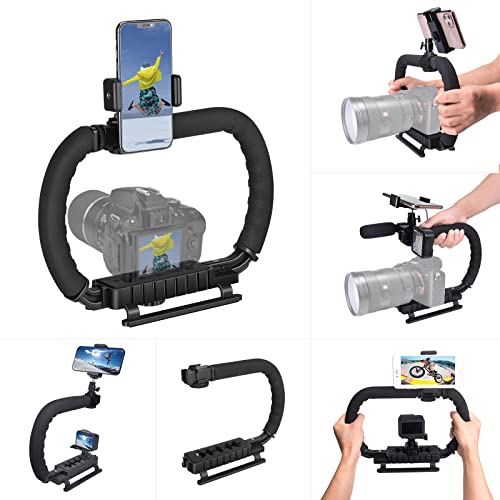
Be clear about what this is. It's a cage and handle rig, not a three-axis gimbal, and it's the cheapest of the six by price position. fantaseal calls it a stabilizer expansion cage mount, and the value is in the mounting points rather than any motion correction.
The listing states high-quality ABS construction, a detachable handle that converts into a C-type low-position grip to reduce lumbar strain, a detachable ball-head phone clip on top for use as a monitor, three cold shoes for microphones and fill lights, and compatibility spanning DSLRs, mirrorless bodies and action cameras including GoPro Hero 11. Published weight is 0.99 lb, dimensions 11 x 9.45 x 3.94 in, warranty 1 year, model M-LPCB.
For portrait work, the honest use case is a two-handed grip that steadies a camera through better ergonomics and a place to hang a light on your subject. Three shoes plus a phone monitor mount is a lot of mounting for very little money, and a fill light on a portrait matters more than most people expect.
What it can't do is fix your walking. There's no motorised correction here at all, so every wobble your hands make lands in the footage. If you came looking for smooth motion, buy one of the five above instead.
Pros:
- Cheapest pick in this set
- Three cold shoes for mics and lights
- Detachable handle converts to a low-angle grip
- Ball-head phone clip for monitoring
- 1-year warranty published
Cons:
- No motors, no axis stabilisation at all
- Heavier than both phone gimbals at 0.99 lb
- Largest length in the set at 11 in
- Wide compatibility means no dedicated fit for anything
Phone gimbal or camera gimbal for portrait work?
Three of these six take a camera. Two take a phone. One takes both and stabilises neither. That split is the second real decision after payload.
Choose a phone gimbal if you shoot portraits for social, you post vertical, and you want a tool that folds into a jacket pocket. The Osmo Mobile 7 at 0.66 lb and the iSteady X3 SE at 0.79 lb both do that, and both add tracking that lets you step into your own frame.
Choose a camera gimbal if depth of field is part of your look. A fast prime on a large sensor separates a subject from a background in a way a phone still approximates in software. That means the RS 3 Mini, the SCORP Mini 2 Kit or the SCORP-C2.
The size penalty is real and worth stating in numbers. Moving from the Osmo Mobile 7 to the SCORP-C2 takes you from 0.66 lb to 2.91 lb of gimbal, before you add a camera or a lens. That's what a bigger sensor costs you on the arm.
What the listings don't tell you
Reading these six side by side, the gaps are as informative as the specifications.
- Two listings publish no warranty term. Both FeiyuTech picks state a model number but no coverage period. The hohem and fantaseal picks both state 1 year, and both DJI picks state DJI's warranty applies.
- Payload is a claim, not a standard. Nobody publishes how they measure it, whether it accounts for off-centre balance, or how runtime changes near the ceiling. Treat every figure as an optimistic maximum.
- Runtime claims come with no test conditions. FeiyuTech quotes up to 14 hours for the SCORP-C2, hohem quotes 11 hours. Neither says at what load.
- Tracking version numbers aren't comparable. ActiveTrack 7.0, AI Tracking 4.0 and iSteady 8.0 are brand-internal names. A higher number means nothing across brands.
- Two picks list only a single seller. The Osmo Mobile 7, the iSteady X3 SE and the SCORP Mini 2 Kit each have one; the RS 3 Mini and SCORP-C2 have two.
The practical takeaway: weigh your own rig, then subtract a comfortable margin from whatever payload figure the listing quotes.
When a different pick wins
Six picks, and the winner changes on a handful of specific thresholds.
- If your camera and lens clear 2 kg, the RS 3 Mini is out and the SCORP-C2 is in. That's the cutoff, and it's not negotiable.
- If you shoot only on a phone, skip all three camera gimbals and take the Osmo Mobile 7 at 0.66 lb.
- If a published warranty term matters more than payload, the hohem iSteady X3 SE and the fantaseal cage both state 1 year and neither FeiyuTech does.
- If you want one box with a case, rod and fill light, the SCORP Mini 2 Kit is the only pick that bundles them.
- If your portraits are static and tripod-mounted, none of the motorised picks earn their keep. The fantaseal cage gives you a grip and three shoes for a light instead.
- If you're testing whether you'll use a gimbal at all, start at the cheapest motorised option and upgrade once you know your habits.
The verdict
Think of the best camera gimbal stabilizer for portraits as three tiers, and pick your tier before you pick your product.
At the entry level, the hohem iSteady X3 SE is the buy. It's the cheapest motorised pick here, it publishes a 1-year warranty that two costlier options don't, and the detachable magnetic remote with a claimed 32.81-foot range gives you a shot you genuinely can't get otherwise. It's phone-only, and at this tier that's the honest trade.
In the middle sit the Osmo Mobile 7 and the SCORP Mini 2 Kit. The DJI is the lightest thing here at 0.66 lb, folds flat, and includes a tripod. The FeiyuTech takes a camera at a claimed 1.2 kg and arrives with a case, an extension rod and a fill light.
At the top, the DJI RS 3 Mini takes the overall win because it does the hard thing: a stated 2 kg payload on a 795 g body, with DJI's warranty behind it. That combination covers the mirrorless-plus-prime rig most portrait shooters actually carry. The FeiyuTech SCORP-C2's exact advantage is headroom, a claimed 7.72 lb against 2 kg, which buys you the telephoto the RS 3 Mini can't hold. Pay the weight penalty only if your lens demands it.
FAQ
Is a camera gimbal stabilizer worth it for portraits?
A camera gimbal stabilizer is worth it for portraits only if your portraits move. Walking shots, orbits and long-lens handheld work all benefit, and tracking lets you direct a subject while the camera holds framing. For static studio stills on a tripod, none of these six adds anything. You'd carry weight and charge a battery to solve a problem you don't have.
How much should you spend on a gimbal for portrait work?
How much you should spend depends entirely on what you're mounting. A phone-only rig sits at the bottom of this set, where the hohem iSteady X3 SE and the Osmo Mobile 7 live. A mirrorless body pushes you to the RS 3 Mini or the SCORP Mini 2 Kit. A full-frame body with a 70-200mm needs the SCORP-C2's claimed 7.72 lb payload, and that's the top of the range here.
What payload do I need for a camera and portrait lens?
The payload you need is the weight of your body, your heaviest lens, and anything mounted on top, plus margin. The RS 3 Mini claims 2 kg, which covers a mirrorless body with a fast prime. The SCORP Mini 2 Kit claims 1.2 kg, which is tighter. The SCORP-C2 claims 7.72 lb, which covers a full-frame telephoto rig.
DJI RS 3 Mini or FeiyuTech SCORP-C2 for portraits?
DJI RS 3 Mini or SCORP-C2 comes down to one number. The RS 3 Mini claims 2 kg of payload at a 795 g body weight, so it's the lighter carry for a body-and-prime setup. The SCORP-C2 claims 7.72 lb but weighs 2.91 lb itself and measures 13.6 x 6.91 x 9.8 in. Take the DJI unless your lens forces the FeiyuTech.
What mistake do first-time gimbal buyers make?
The mistake first-time gimbal buyers make is buying to the stated payload maximum instead of below it. A gimbal running at its ceiling drains faster, buzzes, and drifts off level. The second mistake is assuming a cage counts as a gimbal. The fantaseal pick here has no motors at all, so it improves grip and mounting rather than correcting motion.
Weigh your camera with the lens you actually shoot portraits on, write the number down, and buy the gimbal that clears it with room to spare. That single step eliminates most of this list for you before you compare anything else. For the majority of portrait shooters on a mirrorless body, the DJI RS 3 Mini lands on the right side of the only trade that matters here: it takes a real camera without becoming one more heavy thing to carry, which is the difference between a gimbal you use and a gimbal that stays in the bag.