Best Memory Card Readers for Vloggers: Acer Leads

Five card readers, one clear default. Which slots you need, which connector your laptop actually has, and why the four-slot options are heavier than you expect.

By Sam BaileyUpdated 15 min read
On this page
- Best professional memory card reader for vloggers at a glance
- How I ranked these five readers
- Which card slots does a vlogger actually need?
- Does the connector on the end matter more than the speed claim?
- 1. acer SD Card Reader USB C — Best overall
- 2. RRSITIAU SD Card Reader, 4 in 1 USB C to SD/TF/CF/MS Card — Most versatile
- 3. BENFEI Memory Card Reader — Best for families
- 4. SZHAIYIJIN SD Card Reader for iPhone — Best upgrade
- 5. SmartQ C368 USB 3.0 Card Reader — Best budget pick
- What the listings leave out
- When a different reader wins
- The verdict
- FAQ
The best professional memory card reader for vloggers is the Acer SD Card Reader USB C, a 15 g dual-slot unit that reads SD and microSD at the same time and ships with a 1-year manufacturer warranty. If your footage still lands on CompactFlash or Memory Stick, the RRSITIAU 4-in-1 is the better buy, because it takes four card formats through one USB-C connector.
The deciding specification here is slot count against body size. Two slots fit in 0.39 x 2.8 x 0.67 in. Four slots do not, and every four-format reader in this set pays for the extra card types in bulk, weight, or both.
Best professional memory card reader for vloggers at a glance
| Pick | Card slots | Body | Price |
|---|---|---|---|
Best overall acer SD Card Reader USB C |
SD + microSD | 15 g 0.39 x 2.8 x 0.67 in |
Check Price |
Most versatile RRSITIAU SD Card Reader, 4 in 1 |
SD, microSD, CF, MS | 0.68 x 5.91 x 2.62 in | Check Price |
Best for families BENFEI Memory Card Reader |
SD, microSD, CF, MS | 2.82 oz | Check Price |
Best upgrade SZHAIYIJIN SD Card Reader for iPhone |
SD + microSD | 0.54 x 5.98 x 2.36 in | Check Price |
Best budget pick SmartQ C368 USB 3.0 Card Reader |
SD, microSD, CF, MS | 1.12 oz 0.6 x 2.78 x 1.67 in |
Check Price |


How I ranked these five readers
I set three criteria before looking at a single listing, and weighted them in this order.
- Slot coverage against the cards a video shooter actually fills. Half the weight. A reader that skips your format is worthless regardless of anything else.
- Portability, measured in published weight and dimensions. A third of the weight. Card readers live in a bag pocket, not on a shelf.
- Published warranty and connector flexibility. The remainder. A stated warranty term is one of the few durability signals in this data.
Slot coverage got the heaviest weight because it's the only criterion that can rule a reader out entirely. Portability came second because the best professional memory card reader for vloggers travels, and 2.82 oz behaves differently in a jacket pocket than 15 g does. Warranty came last only because four of the five listings publish one, so it separates less than you'd hope.
What this ranking does not weigh: transfer speed claims. Four of the five make one, in units that don't agree with each other, and none of them is a measured figure. I've reported them where the listing states them and attributed them every time.
Which card slots does a vlogger actually need?
Three of the five readers here handle SD, microSD, CompactFlash and Memory Stick. Two handle SD and microSD only. That split is the whole decision.
Modern mirrorless bodies and action cameras write to SD or microSD. Gimbal-mounted pocket cameras and drones lean microSD. If both of those describe your kit, the two-slot readers cover you and stay smaller doing it.
CompactFlash is the wildcard. It shows up in older professional DSLR bodies and some cinema cameras, and if you've inherited a card library from one, a two-slot reader leaves you stuck. Memory Stick is rarer still, but it's bundled into the same four-format chipset, so you get it whether you need it or not.
- SD plus microSD only: the Acer and the SZHAIYIJIN.
- All four formats: the RRSITIAU, the BENFEI and the SmartQ C368.
- Simultaneous multi-card reads: claimed by the Acer for two cards and by the BENFEI for four.
One format nobody here covers: CFexpress. If your camera writes to a CFexpress Type A or Type B card, none of these five readers accepts it, and no adapter in this set changes that.
Does the connector on the end matter more than the speed claim?
Usually, yes. A reader that can't plug into your machine is a reader that transfers nothing, and the connector story in this set is messier than the slot story.
The Acer terminates in USB-C and the listing says it works with USB-C and USB-A ports across PCs, laptops, cameras, phones and tablets. The RRSITIAU takes a different route: USB-C native, with a detachable USB-C to USB adapter in the box, so it drops into an older laptop without a dongle hunt. The BENFEI is described as a USB-C and USB 3.0 unit covering both. The SmartQ C368 is a USB 3.0 reader, which means USB-A, which means a MacBook owner needs an adapter that isn't included.
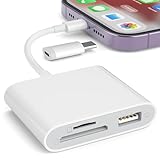
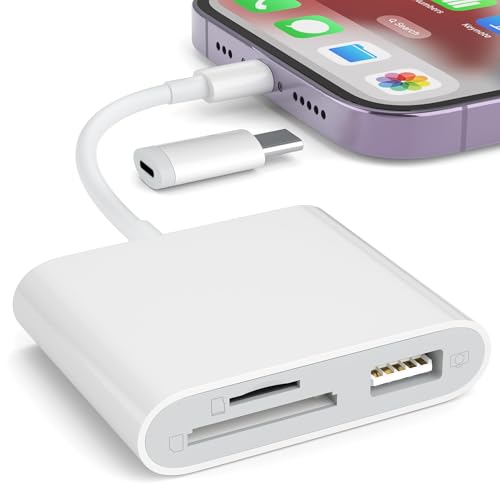
The SZHAIYIJIN is the outlier and the most specific. Its stated size is "(SD+TF+USB) for Lightning", and the listing describes a detachable USB-C to Lightning adapter plus a female USB port for connecting a camera directly. That's a phone-and-tablet accessory that happens to read cards, not a desktop reader.
Speed claims, meanwhile, arrive in three incompatible flavours. Acer says 5Gbps. BENFEI claims UHS-I transfer rates up to 160MB/sec. SmartQ's listing says up to 5GB per second at USB 3.0 speed, a figure that reads like a typo for gigabits. Treat all three as marketing copy and let the connector decide.
1. acer SD Card Reader USB C — Best overall
A 15 g dual-slot reader that covers the two formats most vloggers actually shoot, in the smallest body in this group.
Best for: shooting to SD and microSD on a USB-C laptop Skip it if: you also shoot CFexpress or CompactFlash
Nothing else here is this small. At 0.39 x 2.8 x 0.67 in and 15 g, the Acer is thinner than a USB stick and lighter than a AA battery, which matters when it lives permanently in the same pocket as your spare cards. Compare that to the RRSITIAU at 5.91 in long or the BENFEI at 2.82 oz, and the size gap is obvious rather than marginal.
The functional case is the dual slot. Acer says both card slots read and write simultaneously, so a main-camera SD card and a drone or action-cam microSD card offload in one pass instead of two. For a vlogger cutting a multi-camera edit, that's the difference between one ingest and a queue.
It's also the only pick here with an explicitly stated "1 Year Manufacturer" warranty rather than a bare "1". Acer lists it as plug-and-play with no driver install, and quotes 5Gbps USB 3.0 transfer, which is a claim rather than a measurement.
The trade-off is coverage. Two slots means no CompactFlash and no Memory Stick, and it carries the second-highest price position of the five without adding formats. It's also the slowest seller of this group, so it's a less-travelled choice than the SmartQ.
Pros:
- Lightest body in the set at 15 g
- Smallest footprint, 0.39 x 2.8 x 0.67 in
- Dual simultaneous SD and microSD reads, per Acer
- Explicit 1-year manufacturer warranty
- USB-C connector, no driver install claimed
Cons:
- No CompactFlash or Memory Stick slot
- Premium price position with fewer formats than cheaper picks
- Slowest seller of the five here
- Only one seller lists it
2. RRSITIAU SD Card Reader, 4 in 1 USB C to SD/TF/CF/MS Card — Most versatile
Four card formats, a USB-C connector and a bundled USB adapter, which is the widest compatibility net in this group.

Best for: mixed card libraries including CF and Memory Stick Skip it if: you want something pocket-sized
This is the pick for a shooter whose card drawer has archaeology in it. RRSITIAU lists slots for SD, SDHC, SDXC, Micro SD, Micro SDHC, Micro SDXC, CF, Memory Stick Pro Duo and RS MMC. That's the broadest stated format list of the five, and it sits in the middle price position rather than the top.
The connector arrangement is what pushes it above the other two four-format readers. It's USB-C native, and the listing says a detachable USB-C to USB adapter is included, so it works on a current MacBook and on a five-year-old Windows tower without a separate purchase. The BENFEI covers both port types too, but doesn't describe a detachable adapter you can leave behind.
RRSITIAU also publishes a 1-year warranty and describes it as plug-and-play with no driver, software or network needed, plus support for JPEG, RAW, H.264 and MPEG-4 files. Those format claims are the manufacturer's.
The cost is size. At 0.68 x 5.91 x 2.62 in this is the longest reader here, roughly twice the length of the Acer, and the listing publishes no weight at all. It's a desk unit that travels in a bag compartment, not a pocket. It's also the second-slowest seller of the five.
Pros:
- Four card formats in one body, per the listing
- USB-C native with detachable USB-to-C adapter included
- 1-year warranty published
- Mid-range price position, not the priciest here
Cons:
- Longest body in the set at 5.91 in
- No published weight figure
- Second-slowest seller of these five
- Only one seller lists it
3. BENFEI Memory Card Reader — Best for families
Four slots with a claimed four-cards-at-once read, which suits a shared desk more than a shirt pocket.

Best for: a shared desk with several camera generations Skip it if: you carry your reader in a shirt pocket
The BENFEI's distinguishing claim in this set is volume. Where Acer says two cards at once, BENFEI says four cards read and write simultaneously across SD, microSD, Memory Stick and CompactFlash. If your household or crew hands you three or four cards at the end of a shoot day, that's one ingest window instead of four.
It's listed as a "4-IN-1 USB C/A Card Reader", covering both a USB Type-C port and USB 3.0, with backward compatibility to USB 2.0 and 1.1 stated by BENFEI. The company also quotes UHS-I transfer rates up to 160MB/sec and describes a built-in IC chip handling the signal. Treat both as claims, not test results.
At 2.82 oz it's the heaviest published weight of the five, and roughly five times the Acer's 15 g. That reflects the four-slot chassis. For a fixed desk position it's irrelevant; for a run-and-gun vlogger it's the reason to look elsewhere.
The bigger gap is the paperwork. BENFEI publishes no warranty term and no dimensions in this listing, the only pick here missing both, so you can't check whether it fits a specific bag pocket before buying. It also sits at the top of the price positions in this set.
Pros:
- Four simultaneous card reads claimed
- Covers SD, microSD, Memory Stick and CompactFlash
- Works with both USB-C and USB 3.0 ports
- Backward compatible to USB 2.0 and 1.1, per BENFEI
Cons:
- Heaviest published weight here, 2.82 oz
- No warranty term published
- No dimensions listed, so bag fit is a guess
- Highest price position of the five
- Only one seller lists it
4. SZHAIYIJIN SD Card Reader for iPhone — Best upgrade
The only pick built for offloading straight to a phone or tablet, with a female USB port for plugging a camera in directly.
Best for: offloading footage to an iPhone or iPad in the field Skip it if: your workflow runs through a laptop
This one changes what the reader is for. Every other pick assumes a computer at the other end. SZHAIYIJIN lists this as an SD and TF reader for iPhone and iPad, sized "(SD+TF+USB) for Lightning", with a detachable USB-C to Lightning adapter and a female USB interface for connecting a camera body directly.
For a vlogger who cuts on a phone, that's the upgrade: card out of the camera, footage into the Photos app, rough cut posted before you leave the location. The listing says no app download is required and describes two-way transfer on iOS 13 through 18, so you can push files back to a card as well as pull them off. Both are the manufacturer's claims.
It's the only pick with a published release year, listed as 2026, and it sits in the cheaper half of these five on price position. It's also the fastest seller of the group, which tells you something about how many people want a phone-side reader rather than another desktop one.
The limits are real. Two slots means no CompactFlash. The body is 5.98 in long, the longest here, and no weight is published. The warranty field reads simply "1" with no unit attached, which is thinner documentation than the Acer's.
Pros:
- Reads cards directly to iPhone and iPad, no app claimed
- Female USB port for connecting a camera body
- Two-way transfer on iOS 13 to 18, per the listing
- Sells faster than the rest of this set
- Cheaper price position than the top three
Cons:
- SD and microSD only, no CompactFlash
- Longest body of the five at 5.98 in
- Warranty stated as "1" with no unit
- No published weight
- Only one seller lists it
5. SmartQ C368 USB 3.0 Card Reader — Best budget pick
The cheapest of the five and still four-format, at 1.12 oz with a full set of published specifications.

Best for: a desk-bound backup reader on Windows, Mac or Linux Skip it if: your only ports are USB-C
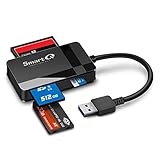
The C368 is the value anomaly. It's the cheapest of the six specifications-complete listings here, yet it still covers Micro SD, SD, Memory Stick and CompactFlash, the same four formats as the two premium-position four-slot readers. SmartQ says each card reads independently.
It's also the best-documented pick in this set: colour, count, 1.12 oz weight, 0.6 x 2.78 x 1.67 in dimensions, a 1-year warranty, model C368, and a stated box contents list of reader, cable organizer and user manual. Nothing else here publishes all of that. At 1.12 oz it's the second-lightest, well under the BENFEI's 2.82 oz despite matching its slot count.
SmartQ lists Windows, macOS and Linux compatibility with no driver needed, and a blue LED that lights when powered so you can see the device is live. The listing also quotes "up to 5GB per second (at USB 3.0 speed)", which is the manufacturer's number and reads inconsistently with USB 3.0's actual ceiling.
The catch is the plug. This is a USB 3.0 reader, meaning USB-A, and no USB-C adapter is described as included. On a current MacBook or a USB-C-only Windows ultrabook, you're supplying your own dongle. That single omission is why it ranks fifth rather than second.
Pros:
- Cheapest of the five
- Four formats including CompactFlash
- 1.12 oz, second-lightest here
- Most complete published specifications in the set
- Windows, macOS and Linux support, no driver needed
Cons:
- USB-A only, no USB-C adapter described
- Sits mid-pack on sales among these five
- Speed claim stated in units that don't match USB 3.0
- Only one seller lists it
What the listings leave out
The single biggest gap across all five: not one publishes a sustained transfer figure you could compare. You get 5Gbps, 160MB/sec, and 5GB per second, in three different units, from three different companies, with no test conditions attached. Card speed and the host port matter more to real-world offload time than any of those numbers, and none of these listings addresses either.
Second gap: heat and continuous duty. Offloading 128GB of 4K footage takes minutes of unbroken work, and nothing here states thermal behaviour, chipset name, or whether performance holds after the first ten minutes. Treat that as unknown.
Third: two listings skip specifications you'd want before ordering. BENFEI publishes neither dimensions nor a warranty term. RRSITIAU and SZHAIYIJIN publish no weight. If bag space or gram counting decides your purchase, the Acer and the SmartQ C368 are the only two picks where you can check both figures in advance.
Every one of these five is stocked by a single seller, so there's no competing offer to compare against.
When a different reader wins
The Acer is my default, but four specific conditions flip it. Each is checkable in under a minute.
- You own a CompactFlash camera. Then the RRSITIAU wins outright. Two slots cannot read a format they don't have, and no adapter fixes it.
- You edit on an iPhone or iPad. Then the SZHAIYIJIN wins. It's the only pick here with a Lightning connector and a female USB port, and the only one that claims two-way transfer with iOS.
- Your laptop has no USB-C port. Then the SmartQ C368 wins, because it's USB-A native and needs nothing extra. The RRSITIAU also works, since its USB adapter is bundled.
- Three or four cards land on your desk at once. Then the BENFEI wins on its claimed four-card simultaneous read, and the extra 2.82 oz stops mattering on a fixed desk.
The threshold I'd use: if every card you own is SD or microSD, buy for size and take the Acer. If even one card is CompactFlash, buy for coverage and take the RRSITIAU. That single question settles it faster than any speed comparison will.
The verdict
Read this set as three tiers, because that's how the choice actually resolves.
At the entry tier, the SmartQ C368 is the surprise. It's the cheapest here, it still reads four formats, it weighs 1.12 oz, and it publishes more specifications than anything else in the group. If your machine has a USB-A port, this is enough reader for a vlogger's whole workflow, and the money you don't spend goes toward another card instead.
In the middle, the RRSITIAU is the coverage pick. Four formats, a USB-C connector, a bundled USB adapter, a 1-year warranty. Its 5.91 in length is the price of that flexibility, and for a mixed card library it's worth paying.
At the premium end, the Acer takes the overall win and the BENFEI takes the shared-desk case. The Acer's argument is 15 g and 0.39 x 2.8 x 0.67 in, the smallest body here, with two slots working at once and an explicit 1-year manufacturer warranty. The BENFEI's exact advantage over it is slot count: four formats and a claimed four-card simultaneous read, which the Acer cannot match at any weight.
Buy the Acer unless CompactFlash, a Lightning workflow, or a USB-A-only laptop pushes you elsewhere.
FAQ
Is the best professional memory card reader for vloggers worth buying over a camera cable?
The best professional memory card reader for vloggers is worth it over a cable for one reason: your camera battery stays out of the transfer. Cable offloads drain the body while you wait, and you can't shoot on a second card meanwhile. A reader also lets you ingest two cards at once, which the Acer's dual slots and the BENFEI's four slots both claim.
Which reader gives the most card formats for the least money?
The most card formats for the least money comes from the SmartQ C368. It's the cheapest pick here and still lists Micro SD, SD, Memory Stick and CompactFlash support, matching the format coverage of the two premium-position four-slot readers. The catch is its USB 3.0 type-A plug, so budget for an adapter if your laptop is USB-C only.
Acer or RRSITIAU: which should a vlogger choose?
Acer or RRSITIAU comes down to one question about your cards. The Acer is 15 g and 0.39 x 2.8 x 0.67 in, reading SD and microSD simultaneously, so it's the pocket choice. The RRSITIAU adds CompactFlash and Memory Stick and includes a USB-C to USB adapter, but stretches to 5.91 in long. Own a CF camera, take the RRSITIAU.
Will any of these readers work with CFexpress cards?
None of these readers work with CFexpress cards. All five list SD, microSD, CompactFlash or Memory Stick support, and CFexpress Type A and Type B appear in no listing here. If your camera writes to CFexpress, you need a dedicated reader outside this set. Check your card's printed label rather than assuming, since CFexpress and CompactFlash share neither shape nor pinout.
What mistake do vloggers make when buying a card reader?
The mistake vloggers make is shopping on the advertised speed figure. Three of these listings quote transfer speeds in three incompatible units, and none is a measured result. Your actual offload time depends on the card's own speed class and your computer's port. Match the connector and the slots to your kit first, then stop reading the megabytes-per-second line.
Pull one card out of your camera bag right now and look at its shape. If it's an SD card or a microSD card, order the Acer and stop thinking about it: 15 g, two slots, a stated 1-year manufacturer warranty, and a body small enough that you'll stop leaving it on the desk. If the card in your hand is a CompactFlash, the RRSITIAU is your reader instead. Either way, the reader is the cheapest link in a video workflow and the one most likely to strand a shoot day's footage on a card, so buy the one that fits your formats and keep a second in the bag.