Best Heavy Duty Sandbag by Denier, Fill and Count

One sandbag guide covers two jobs that never overlap: flood control and strength training. Here's which pick wins for each, split by fill weight, denier and how many bags you actually get.

By Sam BaileyUpdated 14 min read
On this page
- Best heavy duty sandbag at a glance
- Two very different jobs one word hides
- How I screened these five down
- 1. Aimosen 4 Packs Sandbags — Best overall
- 2. DURASACK Heavy Duty Sandbags — Best for beginners
- 3. ASKIZ Heavy Duty Sand Bags — Best for heavy use
- 4. RDX Sandbag for Fitness — Best for small spaces
- 5. Shogun Sports Sandbags — Best premium
- What actually decides a heavy duty sandbag?
- How many bags do you actually need?
- Filled versus unfilled: which should you buy?
- The verdict
- FAQ
The best heavy duty sandbag for most people is the Aimosen 4 Packs, a set of four oxford saddlebags measuring 23.2 x 11.8 x 10.6 in that anchor stands, tents and photo gear without fuss. If you're stocking up before a storm instead, the DURASACK pack of 20 woven polypropylene bags is the better buy, each rated to a 50 lbs fill. Here's the catch this category hides: some of these are training tools you lift, and some are ballast you leave on the ground. The price tiers here don't map to quality so much as to job and quantity.
Best heavy duty sandbag at a glance
| Pick | Fill / Weight | Count | Price |
|---|---|---|---|
Best overall Aimosen 4 Packs Sandbags |
1.5 lb empty each | 4 | Check Price |
Best for beginners DURASACK Heavy Duty Sandbags |
50 lbs capacity (claim) | 20 | Check Price |
Best for heavy use ASKIZ Heavy Duty Sand Bags |
50 lbs capacity (claim) | 100 | Check Price |
Best for small spaces RDX Sandbag for Fitness |
5–200 lb adjustable (claim) | 1 | Check Price |
Best premium Shogun Sports Sandbags |
75 lb size, up to 50 lbs fill (claim) | 1 | Check Price |


Two very different jobs one word hides
The phrase "heavy duty sandbag" covers two products that share almost nothing. One is ballast: empty woven bags you fill with sand and pile against a door, anchor a canopy with, or weigh down a light stand. The other is a training tool: a stitched bag with handles you clean, press and carry.
Buy the wrong type and you feel it fast. A flood bag has no handles, so lifting one for squats shreds your grip. A training bag comes as a single unit, so buying one to hold back water is a waste.
- Ballast bags here: Aimosen, DURASACK, ASKIZ. Bought in multiples, filled on site.
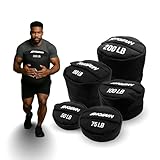
- Training bags here: RDX, Shogun. Single units with handles, meant to be lifted.
Because the search term "heavy duty" doesn't reliably separate these, treat it as a starting label, not a promise. Decide your job first, then read the specs.
How I screened these five down
I compared the published specifications side by side, and the picks split on three cuts before anything else mattered.
- Job first. I sorted each listing into ballast or training by whether the maker mentions handles and lifting. That split alone rules out most mistaken purchases.
- Count next. Ballast bags only make sense in quantity. A single flood bag does nothing, so I weighted the multi-packs on how many you get: 4, 20 and 100.
- Fabric and fill claims last. For training, the denier rating and fill ceiling decide durability and progression. For ballast, UV treatment decides how long a bag survives outdoors.
What got cut in my head, though not from this set, were listings with no stated count and no stated fabric. You can't judge a sandbag you can't measure. Every pick here carries at least enough published detail to compare against the others, even where one or two fields are thin. The best heavy duty sandbag for you falls out of those three cuts almost automatically.
1. Aimosen 4 Packs Sandbags — Best overall
The Aimosen set wins because four separate saddlebags at 23.2 x 11.8 x 10.6 in cover more anchoring jobs than any single bag here.
Best for: anchoring stands, tents and gear indoors or out Skip it if: you need one dense bag for lifting
The Aimosen set is the most flexible pick in this group because you get four bags, not one. That means you can weight four corners of a canopy, or split them between a backdrop stand and a tripod. Each bag weighs 1.5 lb empty and measures 23.2 x 11.8 x 10.6 in, and Aimosen says the oxford fabric is wear-resistant. The design detail I'd flag is the dual zippers: two opposite-direction zips per side, which the brand says lets you keep using a bag if one zip fails.
It arrives empty. Aimosen includes eight PE sealed bags and four aluminium clips, and tells you to fill the PE liners with sand or gravel from around your house, then load them inside. That saddlebag shape drapes over a stand leg, so it holds position better than a bag that just sits flat.
The trade-off against the training picks is real. These have no lifting handles and no dense single-bag format, so they're ballast, not a workout tool. And it's the cheapest option here, which shows in the light empty weight per bag.
Pros:
- Four bags cover multiple anchor points at once
- Saddlebag shape drapes over stand legs
- Dual opposite-direction zippers per side
- Includes 8 PE liners and 4 aluminium clips
- Cheapest of the five picks
Cons:
- No handles, so not suited to lifting
- You supply your own sand
- Light 1.5 lb empty bags, not dense ballast
- Only two sellers list it
2. DURASACK Heavy Duty Sandbags — Best for beginners
DURASACK is the easy first buy because a pack of 20 woven bags at 14 x 26 in gives you enough to build a small wall without overthinking it.

Best for: first-time buyers stocking up before a storm Skip it if: you want a training bag with handles
DURASACK sits in the sweet spot for a first purchase: 20 bags is enough for a doorway barrier or to anchor several structures, without the storage burden of a 100-count case. Each bag measures 14 x 26 in, and the brand states a 50 lbs fill capacity. DURASACK says the woven polypropylene and the tie strings both carry a UV inhibitor, so they hold up to sunlight better than untreated bags.
This is the pick buyers reach for more than any other here, and the format explains why. It's simple. You fill, you tie, you stack. The listing frames them as flood and storm protection, as building blocks for a sandbag wall, and as ballast for signage or trail repair.
Against the ASKIZ 100-pack, DURASACK gives you fewer bags for a job that scales. Against the training picks, it offers nothing to lift with. It's a ballast bag, full stop, and the white colour shows dirt faster than the black options.
Pros:
- 20 bags suit a first flood or anchor job
- UV-inhibitor treatment on bags and ties
- Stated 50 lbs fill capacity
- Tie strings included for closing
- The pick buyers choose most often here
Cons:
- No handles, not a training tool
- Fewer bags than the 100-count pick
- White fabric shows dirt
- Only one seller lists it
3. ASKIZ Heavy Duty Sand Bags — Best for heavy use
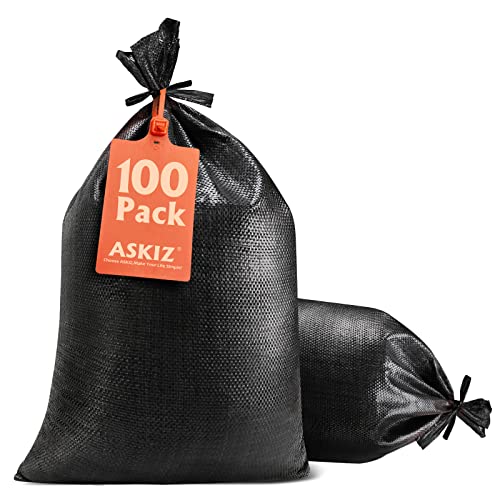
ASKIZ is the pick when the job is big, because 100 UV-protected bags at 25.5 x 16 in cover flood lines and construction sites the smaller packs can't.
Best for: large flood or construction jobs needing many bags Skip it if: you only need a handful of bags
ASKIZ scales further than anything else in this roundup. You get 100 bags, each 25.5 x 16 in, and ASKIZ says the woven polypropylene carries UV protection so the bags last longer in sunlight. That count is the whole point: a serious flood line or a construction ballast job burns through bags fast, and refilling from a 20-pack mid-project is a problem you don't want.
ASKIZ states a 16-inch opening that fills with 50 lbs of sand or gravel, and includes ties to secure each bag. The listing says the pack ships vacuum-packed, which keeps 100 empty bags compact until you need them. The black colour hides dirt better than the white DURASACK, a small edge for bags that live outdoors.
The trade-off is obvious: 100 bags is far too many for a doorway or a couple of light stands. It's a mid-priced pick by position, but the cost is spread across a large count, so the per-bag economics only work if you actually use them. Storage matters too, even vacuum-packed.
Pros:
- 100 bags handle large-scale jobs
- UV protection stated for outdoor life
- 16-inch opening fills to 50 lbs (claim)
- Vacuum-packed to stay compact
- Black fabric hides dirt
Cons:
- Far too many bags for small tasks
- No handles, ballast only
- Requires real storage space
- Only one seller lists it
4. RDX Sandbag for Fitness — Best for small spaces
RDX earns its spot as a home-gym pick because one adjustable bag with eight handles replaces a rack of fixed weights in a tight room.

Best for: home lifters who want an adjustable training bag Skip it if: you need flood or ballast bags in bulk
RDX is a training tool, and that changes everything about how you judge it. RDX says the bag is made of 1200D Cordura fabric with a nylon-coated inner lining, and states an adjustable range you fill from 5 to 200 lb using inner bags. That range is the appeal for a small space: one shell covers light conditioning and heavy carries, so you're not storing five separate weights.
The brand says it has eight strategic handles, which is what separates a lifting bag from a ballast bag. Handles let you clean, press, shoulder and carry the same load, and RDX says the inner bags are leak-proof and water-resistant to stop sand escaping mid-set. It arrives unfilled, so you set your own starting weight.
The empty shell weighs 5 lb. The dimensions on the listing read 0.39 x 0.39 x 0.39 in, which is clearly a placeholder for an empty, folded bag rather than a usable measurement, so I'd treat filled size as unknown. It sits at the top price position here, and that's the trade-off: you pay for the fabric and handles, not for quantity.
Pros:
- 1200D Cordura fabric (claim)
- Eight handles for varied lifts (claim)
- Adjustable 5 to 200 lb range (claim)
- Leak-proof inner bags (claim)
- Ships unfilled to set your own weight
Cons:
- Highest price position in the set
- Filled dimensions not usefully published
- Single bag, no bulk option
- Only one seller lists it
5. Shogun Sports Sandbags — Best premium
Shogun is the premium training pick because a 75 LB size with MIL-Spec fabric claims targets athletes who load heavier than a starter bag allows.

Best for: serious strength athletes wanting a heavier fill ceiling Skip it if: you want published dimensions before buying
Shogun is the other training bag here, pitched squarely at heavier lifters. The listed size is 75 LB, and Shogun says the build uses 1000D MIL-Spec fabric, YKK zippers and triple-stitched seams. Those are the specifics a strength athlete looks for, because a bag that bursts under a clean is worse than no bag at all. The brand also says you can fill or empty it to scale intensity, up to 50 lbs.
There's a mild tension in the listing worth naming: the size reads 75 LB while the fill claim says up to 50 lbs, so read the description carefully before you commit to a target weight. What's clear is that this is a lifting tool, black, built for repeated abuse rather than for holding back water.
Against the RDX, Shogun publishes far less: no stated dimensions, no count, no empty weight. That's the real weakness. It's the second most expensive pick here, and you're buying largely on the fabric and stitching claims rather than on a full spec sheet. For a serious lifter who trusts the build, that's fine. For a cautious buyer, the thin data is a reason to hesitate.
Pros:
- 1000D MIL-Spec fabric (claim)
- YKK zippers and triple-stitched seams (claim)
- 75 LB size for heavier loading
- Leak-proof design (claim)
- Fill or empty to scale sessions
Cons:
- No published dimensions or empty weight
- Size and fill claims don't align cleanly
- Second-highest price position here
- Only one seller lists it
What actually decides a heavy duty sandbag?
Most guides compare fabric denier first. That's the wrong lead. Denier only matters once you've matched the bag to its job, and half these picks aren't lifting bags at all, so their denier is beside the point.
The real deciding criterion is job plus quantity. A ballast buyer needs the right count. A training buyer needs the right fill ceiling and handles. Get those two right and the fabric sorts itself out.
Here's how I'd read the specs by job:
- For ballast: count first (4, 20 or 100), then UV treatment, then bag dimensions for how much sand each holds.
- For training: handles first, then fabric denier (1000D or 1200D here), then the fill range so you can progress.
A 50 lbs capacity claim is meaningful for a flood bag and misleading for a workout bag, where you rarely start near that weight. So don't compare a training bag's fill ceiling against a ballast bag's capacity as if they're the same number. They describe different uses of the same word.
How many bags do you actually need?
Count is the single most common thing buyers get wrong with ballast bags. Too few and you're reordering mid-job; too many and you're storing a case you'll never empty. The three ballast picks span a wide range on purpose.
- A doorway barrier or a few anchors: the DURASACK 20-pack covers it with room to spare.
- A single canopy or several light stands: the Aimosen 4-pack, with saddlebags shaped to drape over legs.
- A flood line, a construction site, a big erosion job: the ASKIZ 100-pack, sold vacuum-packed to save space until you fill.
A rough working rule: a doorway needs a low double-digit count of filled bags stacked in a pyramid, so a 20-pack is a sensible floor for storm prep. Anything approaching a full perimeter or a worksite pushes you toward the 100-count. The training picks sidestep this entirely, since RDX and Shogun each ship as one adjustable bag you refill rather than replace.
Filled versus unfilled: which should you buy?
Every bag in this roundup ships empty, and that's normal for the category. Shipping sand is expensive and pointless when it's cheap or free near you. What varies is how you fill each type.
Ballast bags fill directly: open the mouth, shovel in sand or gravel, tie it off with the included strings. The DURASACK and ASKIZ bags both work this way, with stated 50 lbs capacities and ties in the pack. Simple, but messy, and once filled they're a chore to move.
Training bags use a liner system instead. RDX ships inner bags you fill to your target weight, and Shogun lets you add or remove sand to scale a session. The Aimosen ballast set borrows the same idea, giving you PE sealed liners so the sand doesn't sift out through the zips. That liner approach is worth having whenever the bag will move a lot, whether you're lifting it or hauling it between anchor points. Fill on site, not before, so you never carry the weight further than you must.
The verdict
If you're anchoring gear, the best heavy duty sandbag is the Aimosen 4 Packs. Four saddlebags at 23.2 x 11.8 x 10.6 in, each with dual zippers and a PE liner, cover more jobs than any single bag here, and it's the cheapest pick to boot. That flexibility is why it takes the top spot for general use.
If you're training, the cutoff is fabric and fill ceiling. Below serious loading, the RDX handles it: eight handles, 1200D Cordura by the brand's claim, and an adjustable range from 5 to 200 lb, all in a footprint that suits a small room. Above that, if you load heavy and trust the build, Shogun's 75 LB bag with 1000D MIL-Spec fabric and triple-stitched seams is the heavier-duty choice, though it publishes far less detail.
For pure ballast in bulk, the split is by count: DURASACK's 20-pack for a first storm-prep buy, ASKIZ's 100-pack when the job is big and outdoor. Both state a 50 lbs fill and UV treatment. Match the pick to the job first, and the price tiers stop mattering.
FAQ
Is a heavy duty sandbag worth it over cheap alternatives?
A heavy duty sandbag is worth it when the cheaper option leaks or tears under load. The training picks here cite 1000D and 1200D fabrics with reinforced stitching, and the ballast picks cite UV treatment for outdoor life. If your job is one-time and indoors, a basic bag may do. For repeated use, the tougher build pays off.
What decides the best heavy duty sandbag for flood control?
The best heavy duty sandbag for flood control is decided by count and UV treatment, not fabric weight. DURASACK's 20-pack suits a doorway, while ASKIZ's 100-pack covers a full flood line. Both state a 50 lbs fill capacity and UV inhibitors so the bags survive sun exposure. Buy enough bags for the whole barrier in one order.
How much weight can these sandbags hold?
How much weight these sandbags hold splits by type. The ballast bags, DURASACK and ASKIZ, each state a 50 lbs fill capacity. The training bags claim more range: RDX lists 5 to 200 lb via inner bags, and Shogun cites a 75 LB size with fills up to 50 lbs. Treat all of these as manufacturer claims, not tested figures.
RDX or Shogun for strength training?
For strength training, RDX or Shogun comes down to data versus ceiling. RDX publishes more: 1200D Cordura, eight handles, a 5-to-200 lb range and a 5 lb empty weight. Shogun's 75 LB size and 1000D MIL-Spec fabric suit heavier loading, but it lists no dimensions or empty weight. Choose RDX for the fuller spec sheet, Shogun for the heavier target.
What is the most common heavy duty sandbag mistake?
The most common heavy duty sandbag mistake is buying the wrong type for the job. A flood bag has no handles, so lifting it for workouts wrecks your grip. A training bag ships as one unit, so it's useless for holding back water. Decide ballast or training first, then match count and fabric. The word "heavy duty" alone won't sort them for you.
Start by naming your job out loud: anchoring, flood control, or lifting. That one sentence points you at a pick before you read a single spec. For most people the Aimosen 4-pack is the right default, because four adaptable saddlebags at 23.2 x 11.8 x 10.6 in solve the anchoring problems that actually come up around a home, a shoot or a campsite, and you can spread them wherever weight is needed. Fill them on site from sand you already have, and one order handles jobs a single bag never could.