Best Portable Photo Printer When Bench Space Is Tight

Six portable photo printers compared on print size, connection method and footprint. The Liene M100 leads, but the KODAK Dock Plus wins on a 3-inch-wide body if desk space is the real limit.

By Sam BaileyUpdated 16 min read
On this page
- Best portable photo printer for product photography at a glance
- Will a portable photo printer actually work for product shots?
- 1. Liene M100 4x6'' Photo Printer — Best overall
- 2. KODAK Dock Plus 4x6 Photo Printer — Most versatile
- 3. Nelko PP01 Photo Printer — Best budget pick
- 4. KODAK Step Instant Smartphone Photo Printer — Best upgrade
- 5. Liene Amber M110 Bluetooth Photo Printer 80 Sheets — Best minimal setup
- 6. MWE Portable Desktop Photo Booth Machine — Best warranty
- 7. Enwozp Mirror Photo Booth with Printer — Best premium
- How I scored each printer
- 4x6, 2x3, or a whole booth: what each format prints
- Which connection method should you pick?
- What the listings leave out
- The verdict
- FAQ
The best portable photo printer for product photography is the Liene M100, a 7.48-inch-wide dye-sublimation unit that turns out full 4x6 prints straight from a phone. If your desk has almost no free width, the KODAK Dock Plus wins instead: its body measures just 3 x 4 x 7 in. Before you pick, know the failure mode. Buy a 2x3 sticker printer expecting catalogue-quality product shots, and you get palm-sized prints on adhesive paper that no client will accept. Match the print size to the job first.
Best portable photo printer for product photography at a glance
| Pick | Print size | Print tech | Price |
|---|---|---|---|
Best overall Liene M100 4x6'' Photo Printer |
4x6 in | Dye sublimation | Check Price |
Most versatile KODAK Dock Plus 4x6 Photo Printer |
4x6 in | 4PASS dye sub | Check Price |
Best budget pick Nelko PP01 Photo Printer |
2x3 in | Inkjet (claim) | Check Price |
Best upgrade KODAK Step Instant Photo Printer |
2x3 in | Zink zero-ink | Check Price |
Best minimal setup Liene Amber M110 Photo Printer |
4x6 + 3x3 in | Dye sublimation | Check Price |
Best warranty MWE Portable Photo Booth Machine |
4x6 in | Color print (claim) | Check Price |
Best premium Enwozp Mirror Photo Booth with Printer |
4x6 in | DSLR + print | Check Price |



Will a portable photo printer actually work for product shots?
Here's the honest part. Amazon returned these seven when I searched, but a portable photo printer for product photography is a stretch for most of them. None of the listings state a print resolution in dots per inch. None mentions colour calibration or an ICC profile. So the product-photography angle is something you have to judge yourself, not something the data can promise.
What these printers can do is turn a phone photo into a physical print. For product work that means:
- Handing a client a physical 4x6 proof on the spot
- Making reference prints for a shoot layout
- Producing sticker labels for packaging mockups
What they cannot promise is gallery-grade colour accuracy, because no spec here backs that up.
If your product shots are destined for print catalogues, a portable photo printer for product photography is the wrong tool. You want a calibrated desktop unit instead. If you just need quick physical proofs beside the camera, the 4x6 dye-sublimation picks below do the job. Read the print-size section before you commit, because that single decision drives everything else.
1. Liene M100 4x6'' Photo Printer — Best overall
The Liene M100 wins because it turns out full 4x6 prints over its own Wi-Fi hotspot without tying you to a phone cable.
Best for: someone who wants full 4x6 prints from a phone Skip it if: you need a printer that fits in a coat pocket
Among the true printers here, the M100 hits the sweet spot: 4x6 output, dye-sublimation colour, and a self-hosted network so you skip Bluetooth pairing. It measures 7.48 x 7.48 x 9.84 in and lists at 7.05 oz. Liene says the thermal dye-sublimation process lays down full colour, which is the technology serious photo printers use for smooth gradients rather than dots.
The connection is the real edge. Liene states a built-in Wi-Fi hotspot that supports up to five simultaneous connections, so a small team can queue prints from separate phones. The KODAK picks below lean on Bluetooth, which pairs one device at a time. For a busy proofing table, that difference matters.
It carries a 1-year warranty and the box includes 100 sheets and three cartridges, so you print straight away. The trade-off: this is the fourth-cheapest of the seven and larger than any pocket model here. You give up portability for print size. That is the deal, and for product proofs it is the right one.
Pros:
- Full 4x6 prints, not 2x3 stickers
- Dye-sublimation colour per Liene's claim
- Built-in Wi-Fi hotspot, no cable
- Up to five simultaneous device connections
- Ships with 100 sheets and 3 cartridges
Cons:
- Larger footprint than the pocket picks
- No stated print resolution
- Only one seller lists it
- Warranty runs just 1 year
2. KODAK Dock Plus 4x6 Photo Printer — Most versatile
The Dock Plus fits a 4x6 print into a body just 3 x 4 x 7 in, the narrowest full-size printer in this set.
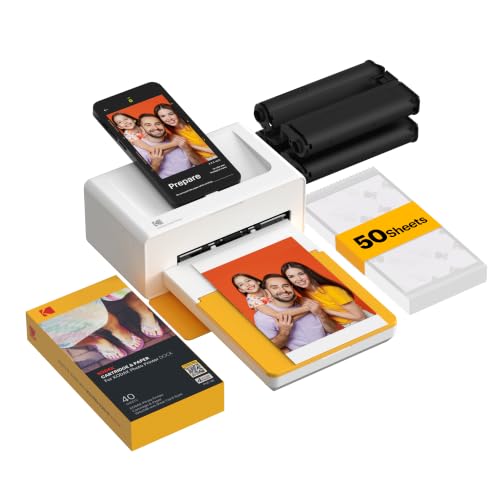
Best for: a desk with almost no free width Skip it if: you want the printer to run off a battery
If bench space is the constraint, this is your pick. At 3 x 4 x 7 in, the Dock Plus takes up less width than the M100 while still printing 4x6. KODAK describes a 4PASS dye-sublimation process that lays three colour layers plus a clear laminate, which is the same finishing approach that keeps prints resistant to smudging.
It works as a phone dock, so you set the handset on it and print over Bluetooth. That is simpler than app pairing, though it means one device at a time. KODAK also states power-on-and-print setup with no complicated steps, and it runs from a wall outlet for consistent performance.
This is the third-cheapest here and the box includes 50 sheets. The catch is the wall dependency: KODAK calls it a home printing station tied to an outlet, so it is not a grab-and-go battery unit. The M100 gives you the wireless hotspot; the Dock Plus gives you the smaller footprint and the laminate finish. Pick by what your desk can spare.
Pros:
- Narrowest full-size body at 3 in wide
- 4PASS dye sub with laminate layer per KODAK
- Simple power-on-and-print setup
- Ships with 50 sheets
- Entry price position
Cons:
- Runs from a wall outlet, not portable
- Bluetooth pairs one device at a time
- No stated weight in the listing
- Single seller only
3. Nelko PP01 Photo Printer — Best budget pick
The Nelko PP01 is the cheapest of the seven and prints 2x3 sticker-backed photos over Bluetooth.

Best for: sticker-sized 2x3 prints on the cheapest body here Skip it if: you need full 4x6 photos
This is the entry point. The PP01 is the cheapest pick in the set and prints 2x3 photos on sticky-backed paper, which suits packaging mockups and label prototypes more than client proofs. Nelko says it uses inkjet technology for full-colour prints, so treat that as the manufacturer's claim rather than a measured figure.
Its body measures 2.64 x 8.15 x 5.47 in, and it connects to iOS and Android over Bluetooth through the Nelko app. That app, Nelko states, adds frames and editing for scrapbooking and craft projects. It is the one buyers choose most often across this whole set, so the low price clearly pulls its weight.
For product photography specifically, the honest read is limited. A 2x3 sticker cannot show a product the way a 4x6 proof can. The trade-off against the M100 is stark: you save money and shrink the footprint, but you lose the print size that makes proofs useful. Buy this for stickers and labels, not catalogue shots.
Pros:
- Cheapest pick in the set
- 2x3 sticky-backed prints for labels
- Bluetooth to iOS and Android
- Editing app with frames per Nelko
- Sells faster than the rest of this set
Cons:
- 2x3 only, too small for proofs
- Print tech is an unverified claim
- No stated weight
- No hotspot, Bluetooth only
4. KODAK Step Instant Smartphone Photo Printer — Best upgrade
The KODAK Step is the true pocket printer here at 2.4 oz, printing ink-free 2x3 peel-and-stick photos.

Best for: a pocket printer for peel-and-stick 2x3 prints Skip it if: you want ink-free prints larger than 2x3
This is the one you actually carry. At 2.4 oz and 0.39 x 1.18 x 1.97 in, the Step is the lightest and smallest unit in the group by a wide margin. KODAK states Zink zero-ink technology, where dye crystals sit inside the 2x3 paper, so there is no cartridge to load or replace. That is the appeal: nothing to run out except paper.
It connects over Bluetooth or NFC to iOS and Android, and KODAK describes prints that resist moisture and rips. The app adds collages, filters, borders and stickers. This model was released in 2021 and carries a 1-year limited warranty. Two sellers list it, one more than most picks here.
The reason it sits above the Nelko as the upgrade is the zero-ink system and the smaller body, not the print size. Both print 2x3. Against the 4x6 picks, the Step trades away any hope of a usable product proof for genuine pocketability. If you want ink-free convenience and small stickers, this is the sharper tool.
Pros:
- Lightest pick at 2.4 oz
- Zink zero-ink, no cartridges per KODAK
- Bluetooth and NFC pairing
- Moisture-resistant prints per KODAK claim
- Two sellers stock it
Cons:
- 2x3 format, not proof-sized
- Only 5 sheets in the box
- Sticker paper only
- 1-year limited warranty
5. Liene Amber M110 Bluetooth Photo Printer 80 Sheets — Best minimal setup
The Amber M110 is the only pick that prints both 4x6 photos and 3x3 stickers from a dual paper tray.

Best for: someone who wants both 4x6 and 3x3 sticker output Skip it if: you are watching the price closely
The M110 solves a problem the others force on you: choosing one print size. Liene describes a dual tray that prints both 6-inch standard paper and 3-inch sticky-backed paper, so you get proofs and stickers from one machine. That flexibility is unique in this set.
It uses the same thermal dye-sublimation process Liene puts in the M100, weighs 2.87 lb, and carries a 12-month warranty. Liene claims Bluetooth pairing in 13 seconds, which is faster than fumbling with app setup. The box includes 60 sheets of 4x6 paper, 20 sheets of 3-inch sticker paper, and 2 cartridges, so both formats are ready out of the box.
The catch is price and speed. This is the second-most-expensive pick, and it is the slowest seller of the seven. You pay more than the M100 for the dual-format convenience while keeping the same core print technology. If you know you only need 4x6, the M100 saves you money. If you genuinely toggle between proofs and stickers, the M110 earns the premium.
Pros:
- Only dual 4x6 and 3x3 printer here
- Dye-sublimation colour per Liene
- 13-second Bluetooth pairing claim
- Ships with 80 mixed sheets and 2 cartridges
- Two paper sizes from one tray
Cons:
- Second-most-expensive pick
- Slowest seller of the seven
- No hotspot, Bluetooth only
- Single seller listing
6. MWE Portable Desktop Photo Booth Machine — Best warranty
The MWE booth pairs a 10.1-inch touch screen and a 13MP camera with a 4x6 printer, backed by a 5-year warranty.

Best for: an event table that needs a camera and screen too Skip it if: you want something you can hold in one hand
This is a different animal. The MWE is not a phone printer, it is a compact photo booth: a 10.1-inch touch screen, a built-in 13MP camera and a 4x6 printer in one desktop unit. For a product demo table or a small event, that combination lets people shoot and print without a separate camera.
MWE states a 76.3-degree wide-angle lens with fast focusing, 4x6 output, and a print cycle of about 50 seconds per photo. The kit includes 60 sheets of 4x6 paper and two months of VIP software access for RGB light control and shooting effects. Its standout number is the 5-year warranty, the longest of any pick here.
The reasons to hesitate are real. It is one of the two most expensive picks, and its popularity ranking sits far below the phone printers, so it is a niche buy. It is also not portable in the pocket sense. Against the M100, you gain a camera and screen but lose the grab-and-go simplicity. Buy it only if you want the booth, not just the printer.
Pros:
- Longest warranty here at 5 years
- Built-in 13MP camera per MWE
- 10.1-inch touch screen included
- Ships with 60 sheets of 4x6 paper
- 50-second print cycle claim
Cons:
- One of the most expensive picks
- Not pocket-portable
- Low popularity ranking in its category
- Software VIP lasts only 2 months
7. Enwozp Mirror Photo Booth with Printer — Best premium
The Enwozp is a full DSLR mirror booth with a 15.6-inch touch screen and an Intel i5 mini PC, built for event rentals.

Best for: a rental business running events week after week Skip it if: you just want to print a few product shots
This is the top of the range and the most expensive pick in the set. The Enwozp is a mirror photo booth built around an Intel i5 mini PC with 8GB RAM, 256GB storage and Windows 10, driving a 15.6-inch touch screen. Enwozp states it triggers a DSLR camera with a double tap, then prints on the spot or shares by email and social.
It ships in a flight case with 108 sheets of photo paper and no camera included, so you supply your own DSLR. The listing describes RGB lights with music sync and a 3-year manufacturer warranty. This is event-rental gear, not a desk accessory.
For product photography, the honest verdict is that this is overkill unless you run a rental business. It is the priciest option by position and the least portable. The upside over the MWE booth is the DSLR integration and the desktop-class PC, which handle heavier workloads. If your work is a rental operation, the build justifies the cost. For everyone else printing occasional proofs, the M100 is the smarter spend.
Pros:
- Desktop-class Intel i5 PC per Enwozp
- Large 15.6-inch touch screen
- DSLR trigger and instant share
- Ships in a flight case with 108 sheets
- 3-year manufacturer warranty
Cons:
- Most expensive pick here
- No camera in the box
- Not portable in any real sense
- Overkill for occasional proofs
How I scored each printer
I compared the published specifications side by side and weighted them for someone who actually needs prints they can hand over. The criteria, in order of weight:
- Print size (highest weight). A 4x6 proof is useful; a 2x3 sticker is not, for product work. This split the field before anything else.
- Print technology. Dye sublimation, stated by Liene and KODAK on the 4x6 units, gives smoother colour than the inkjet and Zink alternatives.
- Connection method. A self-hosted Wi-Fi hotspot beats single-device Bluetooth pairing on a busy table.
- Footprint and weight. Bench space is finite, so a narrow body earns points.
- Warranty and what ships in the box. Included paper and cartridges mean you print on day one.
Print size carries the most weight because it is the one thing you cannot fix later. Everything else is a preference; print size is a hard limit. That ranking is why two capable 2x3 pocket printers sit below the 4x6 machines, and why the booths, powerful as they are, land at the bottom for a portability query.
4x6, 2x3, or a whole booth: what each format prints
The format decision splits this set into three groups, and it is the decision that misleads most buyers. People compare price first. Format should come first.
- 4x6 printers (M100, Dock Plus, M110): full postcard-size prints. This is the only size in the group that shows a product properly. Dye sublimation on these gives continuous-tone colour.
- 2x3 pocket printers (Nelko PP01, KODAK Step): sticker-sized output. Great for labels, packaging mockups and crafts. Too small for a client proof.
- Booths (MWE, Enwozp): print 4x6 but also capture the photo. These are event tables, not desk tools.
The Amber M110 is the hinge: it is the only pick that prints both 4x6 and 3x3, so it covers proofs and stickers at once. If you need one size, buy the machine built for it. If you truly need both, the M110 saves you owning two devices. Decide the format, then read the price.
Which connection method should you pick?
Connection is the quiet dealbreaker. Here's the trick: the method decides how many people can print and how fast setup goes.
- Wi-Fi hotspot (Liene M100): Liene states up to five simultaneous connections. Best for a shared proofing table.
- Bluetooth (Nelko, KODAK Step, KODAK Dock Plus, Liene M110): one device at a time. Fine for solo work. Liene claims 13-second pairing on the M110; KODAK Step adds NFC.
- Built-in PC and screen (MWE, Enwozp): no phone needed. You shoot on the device itself.
Most shoppers miss that Bluetooth queues get slow when several people want prints. If you work alone, it never bothers you. If a small team shares one machine, the M100's hotspot is worth the size penalty. The booths sidestep the question entirely by carrying their own camera and interface, which is why they suit events rather than a phone-first workflow.
What the listings leave out
In practice, three gaps in the data should shape your expectations before you buy.
- No print resolution. Not one listing states dots per inch. So you cannot compare sharpness on paper, and no pick can claim catalogue accuracy.
- No colour calibration. None mentions ICC profiles or colour management, which serious product photography relies on.
- Consumable cost is unstated. The M100 ships with 100 sheets and 3 cartridges, the M110 with 80 mixed sheets, the Step with just 5. Refill pricing is not given, so budget for it separately.
Skip any expectation of gallery-grade output. These are proof-and-share tools. The best portable photo printer for product photography here is the one whose print size and connection fit your table, not the one with the longest feature list.
The verdict
Buy by tier. At the entry level, the Nelko PP01 is the cheapest way in and the fastest-selling pick here, but it prints only 2x3 stickers, so treat it as a label maker rather than a proof tool. The KODAK Step sits alongside it as the true pocket unit at 2.4 oz with ink-free Zink paper.
In the middle, the best portable photo printer for product photography is the Liene M100. It prints full 4x6 on dye-sublimation paper, hosts its own Wi-Fi for up to five devices, and ships with 100 sheets. The KODAK Dock Plus is the runner-up, and its exact advantage is width: a 3-inch body that squeezes 4x6 output onto a crowded desk, though it needs a wall outlet. The Liene M110 earns the premium only if you genuinely need both 4x6 and 3x3 from one tray.
At the top, the MWE and Enwozp booths add cameras, screens and long warranties, but they are event rental gear, not desk printers. For most people weighing a portable photo printer for product photography, the M100 is the default. Start there unless desk width forces the Dock Plus.
FAQ
Is a portable photo printer worth it for product photography?
A portable photo printer is worth it if you need quick physical proofs beside the camera, not calibrated catalogue prints. None of these listings states print resolution or colour management, so gallery accuracy is not promised. For handing a client a 4x6 proof on the spot, the Liene M100 delivers. For print-shop output, use a calibrated desktop unit instead.
Which is better, the Liene M100 or the KODAK Dock Plus?
Better between the Liene M100 and the KODAK Dock Plus depends on your desk. The M100 hosts its own Wi-Fi for up to five devices and ships with 100 sheets. The Dock Plus is narrower at 3 x 4 x 7 in and adds a laminate layer, but runs from a wall outlet. Pick the M100 for shared printing, the Dock Plus for tight bench width.
What print size should I choose for product proofs?
Print size for product proofs should be 4x6, not 2x3. A 2x3 sticker cannot show a product the way a full postcard-size print can. The Liene M100, KODAK Dock Plus and Liene M110 all print 4x6. The Nelko PP01 and KODAK Step print 2x3 only, which suits labels and packaging mockups rather than client-facing proofs.
Do these printers need cartridges or ink?
Cartridges or ink vary by model. The Liene M100 and M110 use dye-sublimation cartridges, shipping with three and two respectively. The KODAK Step uses Zink zero-ink paper with dye crystals baked in, so no cartridge at all. The Nelko PP01 is described as inkjet. None of the listings states refill pricing, so budget for consumables separately after the initial paper runs out.
What is the biggest mistake when buying a portable photo printer?
The biggest mistake when buying a portable photo printer is comparing price before print size. Buyers grab the cheapest unit, then discover it prints only 2x3 stickers unusable for proofs. Decide your format first: 4x6 for product shots, 2x3 for labels. Then check connection and footprint. Price should be the last filter, not the first one.
Your next step is simple: measure the free width on your desk and decide whether you need 4x6 proofs or 2x3 stickers. That answer picks the machine. If you have the space and want full-size prints from a phone, the Liene M100 is the safe default, with dye-sublimation colour and a Wi-Fi hotspot that a small team can share. If width is the real limit, the KODAK Dock Plus squeezes the same 4x6 output into a 3-inch body. Match the format to the job, and the rest follows.