Best APS-C Mirrorless Camera for the Daily Carry

A camera-and-lens shortlist for shooting in public, ranked from a 2 lb Canon kit to a 5.12 oz manual prime. Includes what the listings leave out and which picks are lenses, not bodies.

By Sam BaileyUpdated 16 min read
On this page
- Best APS-C mirrorless camera for street photography at a glance
- Three picks got cut, and why
- Why is half this list lenses and not cameras?
- 1. Canon EOS R50 Mirrorless Camera with 18-45mm Lens — Best overall
- 2. FUJIFILM X100VI Digital Camera with 40MP APS-C Sensor — Best premium
- 3. Sony Alpha a6400 Mirrorless Camera: Compact APS-C — Best upgrade
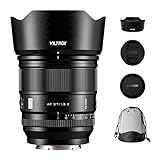
- 4. VILTROX AF 27mm F1.2 Pro APS-C Lens for Sony E-Mount — Best minimal setup
- 5. VILTROX 25mm f1.7 Z for Nikon Z Mount — Best for pros
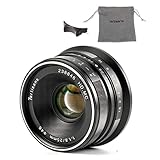
- 6. 7artisans 25mm F1.8 APS-C Portrait Lens for Fujifilm — Best budget pick
- Which mount are you already locked into?
- How small does a camera have to be to disappear?
- What the listings do not tell you
- The verdict
- FAQ
The best APS-C mirrorless camera for street photography here is the Canon EOS R50 kit, because it arrives with an 18-45mm lens, a 64GB card and a bag, so nothing else stands between you and the pavement. If you want one fixed focal length and never a lens change, the Fujifilm X100VI with its 23mm f/2 is the pick instead. Worth knowing up front: this is not the guide for everyone. Two of these six picks are cameras. Three are lenses. One is a fixed-lens compact.
Best APS-C mirrorless camera for street photography at a glance
| Pick | What it is | Key figure | Price |
|---|---|---|---|
Best overall Canon EOS R50 with 18-45mm Lens |
Body + zoom kit | 2 lb kit weight | Check Price |
Best premium Fujifilm X100VI |
Fixed-lens compact | 23mm f/2, 40.2MP claim | Check Price |
Best upgrade Sony Alpha a6400 with 16-50mm |
Body + zoom kit | 0.64 lb body | Check Price |
Best minimal setup VILTROX AF 27mm F1.2 Pro |
Sony E autofocus prime | 40mm equivalent, f/1.2 | Check Price |
Best for pros VILTROX AF 25mm F1.7 Z |
Nikon Z autofocus prime | 6.35 oz, 38mm equivalent | Check Price |
Best budget pick 7artisans 25mm F1.8 |
Fujifilm X manual prime | 5.12 oz, 37.5mm equivalent | Check Price |




Three picks got cut, and why
I screened this set by reading published specifications side by side rather than trusting the sales copy, and three candidates dropped out before ranking.
- No published weight. Two listings gave dimensions but no mass. For a camera you carry for six hours, weight is the single figure that predicts whether it stays on your shoulder or in a drawer. A listing that hides it gets cut.
- Mount ambiguity. One lens listing named so many bodies across so many systems that the actual mount was guesswork. A lens that might not attach to your camera is not a recommendation.
- Bundle padding with no optical content. Kits stuffed with straps and cleaning cloths but no faster glass than the box zoom add bulk, not capability.
What survived splits cleanly. The three complete cameras are the Canon EOS R50, the Sony a6400 and the Fujifilm X100VI. The three lenses are prime, fast and small, and each one fits exactly one system. That division shapes every recommendation below, and it is the reason the ranking is not a straight line from cheapest to most expensive.
Why is half this list lenses and not cameras?
Because the search that produced this set did not filter for a shooting style. It filtered for APS-C, mirrorless and a price range, and the lens listings came along for the ride.
That is worth saying plainly. No product here is certified for shooting in public. There is no specification for discretion, no measured shutter volume, no rating for how fast you can raise a camera to your eye. Anyone claiming a listing proves a camera is built for candid work is reading marketing, not data. Fujifilm's copy does describe the X100VI as a street photography and everyday carry camera, and Canon's copy calls the 18-45mm lens good for street shooting. Both are the manufacturer's words.
So judge it yourself, on three things you can actually check:
- Total carried weight, body plus lens, from the published figures.
- Focal length equivalence, because a 35mm to 40mm equivalent is the classic working range and three picks here land inside it.
- Maximum aperture, because f/1.2 and f/1.7 buy you shutter speed after sunset that an f/3.5 kit zoom cannot.
Everything else in the listings is a claim. Treat it as one.
1. Canon EOS R50 Mirrorless Camera with 18-45mm Lens — Best overall
A complete, ready-to-shoot APS-C kit is the fastest route onto the street, and this is the only pick in the set that includes a lens, a card and a bag together.
Best for: a first serious camera with a lens already attached Skip it if: you need a discreet body that fits a jacket pocket
What sets the R50 apart in this group is completeness. Canon lists the bundle as the body, an 18-45mm RF lens, a shoulder bag and a 64GB UHS-I card, which means the shipping weight of 2 lb covers everything you need. Compare that to the three lens picks, which are useless on their own, and the arithmetic favours Canon for anyone starting from nothing.
The 18-45mm range covers wide through standard, so you can frame a whole shopfront and then tighten to a single face without moving your feet. Canon describes the sensor as APS-C with Dual Pixel AF II, face and eye detection, and oversampled 4K, and calls the camera lightweight and easy to use for new creators. Those are the manufacturer's claims, not measured results.
It sells faster than anything else in this set, which tells you the kit format lands with buyers. The compromise is bulk and speed: the shipped package measures 6 x 8 x 7 in, the zoom is not a fast prime, and the listing publishes no warranty term or maximum aperture. You trade the low-light headroom of an f/1.2 prime for the convenience of never thinking about mounts.
Pros:
- Only pick that ships with body, lens, card and bag
- 18-45mm covers wide to standard without swapping glass
- Sells faster than any other pick here
- 2 lb covers the entire kit, not just a body
- Canon-authorised bundle with 4K and Dual Pixel AF II claims
Cons:
- Kit zoom aperture is not published, so low-light headroom is unknown
- No warranty term stated in the listing
- 6 x 8 x 7 in packed size is the bulkiest here
- Only one seller lists it
- Premium price position without a fast prime included
2. FUJIFILM X100VI Digital Camera with 40MP APS-C Sensor — Best premium
The one camera here built around a single fixed focal length, which is either exactly what you want or exactly what you cannot live with.

Best for: one fixed 35mm-equivalent camera you carry every day Skip it if: you ever want to change the lens
The X100VI is the only pick with a permanently attached lens, and Fujifilm lists it as a 23mm f/2 Fujinon giving a 35mm-equivalent field of view. That equivalence matters. It is the focal length that has framed candid photography for a century, wide enough for context and tight enough to isolate a subject at conversational distance.
Fujifilm claims a 40.2MP X-Trans CMOS 5 HR sensor with X-Processor 5, five-axis in-body stabilisation rated at up to six stops of shake reduction, a hybrid viewfinder, and colour profiles modelled on film stocks. It is also the only pick in this set claiming in-body stabilisation at all, and the bundle adds a soft case and a 32GB card. Those figures come from the listing rather than from any measurement.
Two hard facts sit against it. The listing's stated weight of 3.53 lb is the heaviest here by a wide margin, and it is the slowest seller of the six. The fixed lens is a philosophy, not a feature: no 85mm portrait option, no wide-angle, ever.
Pros:
- Fixed 23mm f/2 gives a 35mm-equivalent field of view
- Only pick claiming five-axis in-body stabilisation
- Body measures just 5 x 2.9 x 2.2 in
- Film-simulation colour profiles per Fujifilm's listing
- Bundle adds soft case and 32GB card
Cons:
- Lens cannot be changed, at any focal length, ever
- 3.53 lb listed weight is the heaviest here
- The slowest seller of the six
- The most expensive pick in this set
- No warranty term published
3. Sony Alpha a6400 Mirrorless Camera: Compact APS-C — Best upgrade
At 0.64 lb, this is the lightest complete camera here, and it opens the door to the largest lens ecosystem in the set.
Best for: a light E-mount body you can grow a lens kit around Skip it if: you want in-body stabilisation
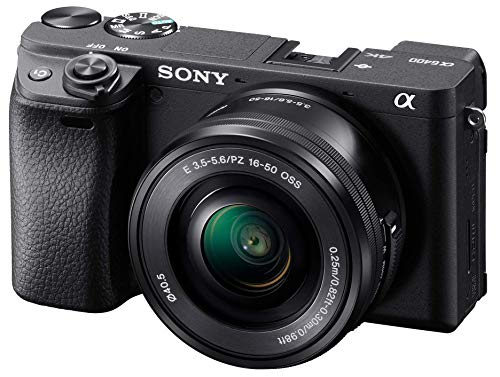
The number that decides this pick is 0.64 lb. That is the published weight, and it is a fifth of what the X100VI lists. Hang it from your neck for an afternoon and the difference is not subtle. Body dimensions run 4.55 x 6.2 x 9.2 in as shipped, and Sony includes a 16-50mm E-mount lens.
Sony's listing claims 425 phase-detection and 425 contrast-detection points across 84 percent of the sensor, up to 11fps continuous shooting at 24.2MP raw, real-time eye autofocus and a tiltable LCD. Note that the same listing also references a 20.1MP 1-inch stacked sensor with a 24-70mm f/1.8-2.8 lens, which does not match the rest of the copy. When a listing contradicts itself, believe none of it and buy on the specifications that are consistent.
Two solid advantages: it carries a 1 year manufacturer warranty, one of only two picks here to publish a term, and it was released in 2019, so E-mount glass for it is everywhere. The VILTROX 27mm f/1.2 below fits it directly.
Pros:
- 0.64 lb is the lightest published body weight here
- 1 year manufacturer warranty stated
- E-mount opens the widest third-party lens choice in this set
- Tilting LCD and eye autofocus per Sony's listing
- Roughly mid-range price position for a complete kit
Cons:
- Listing copy contradicts itself on sensor size and lens
- No in-body stabilisation claimed
- 2019 release makes it the oldest design here
- 16-50mm kit lens aperture is not published
4. VILTROX AF 27mm F1.2 Pro APS-C Lens for Sony E-Mount — Best minimal setup
The fastest aperture in this set by a clear margin, which is what you want when the light goes and you still refuse to raise the ISO.
Best for: Sony E-mount owners who shoot after dark Skip it if: you want the smallest possible lens on the front
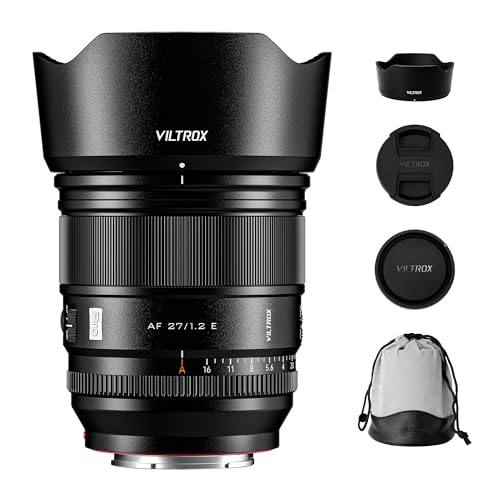
Pair this with the a6400 above and you have a two-piece kit that handles dusk. VILTROX lists a maximum aperture of f/1.2, which is the widest here, ahead of the f/1.7 Nikon Z pick and the f/1.8 Fujifilm one. Wider aperture means a faster shutter at the same light level, and a faster shutter is what freezes a walking stranger mid-stride.
The listing gives a 27mm focal length yielding a 40mm equivalent, an 11-group, 15-element optical design with HOYA aspherical elements, a 0.28 m minimum focus distance and an STM stepper motor with an on-body MF/AF switch. That close-focus figure is genuinely useful for details: hands, signage, a cup on a table.
Physical size is the cost. Dimensions run 2.91 x 3.54 x 2.91 in, which makes it the largest of the three lenses, and the listing publishes no weight at all. An f/1.2 optic is heavy glass by nature. Only one seller lists it, and there is no stated warranty. It also mounts to Sony E only, so Canon, Nikon and Fujifilm owners can stop reading here.
Pros:
- f/1.2 is the widest maximum aperture in this set
- 40mm equivalent sits in the classic walkaround range
- 0.28 m close focus for detail shots
- 15 elements with HOYA aspherical glass per VILTROX
- Autofocus with an on-body MF/AF switch
Cons:
- No published weight, and f/1.2 glass is rarely light
- Largest of the three lenses at 2.91 x 3.54 x 2.91 in
- Sony E-mount only
- No warranty term listed
- Only one seller stocks it
5. VILTROX 25mm f1.7 Z for Nikon Z Mount — Best for pros
A 6.35 oz autofocus prime with a three-year warranty, and the only pick in the whole set that publishes a term that long.

Best for: Nikon Z owners who want a tiny 38mm-equivalent prime Skip it if: you shoot Canon, Sony or Fujifilm
Two figures make the case. First, 6.35 oz, which VILTROX also states as 180g. Second, a 3 Year Manufacturer warranty, triple the a6400's stated term and the longest published cover in this group. A lens that light barely changes the balance of a small Nikon Z body, and a three-year term suggests the maker expects it to survive being carried.
The listing describes a 25mm focal length for a 38mm equivalent, a 12-element, 10-group design with two high-refractive elements, one extra-low dispersion element and two aspherical elements, plus an STM motor with low focus breathing. At 2.52 x 2.22 x 2.52 in it is the second-smallest item here.
The f/1.7 aperture is a stop and a bit slower than the VILTROX f/1.2, so in the same dim street you will either raise ISO or drop shutter speed. And the mount is the hard limit. Nikon Z bodies only, and none of the three cameras in this roundup is a Nikon. This pick assumes you already own the camera, which is exactly why it earns a place: it is the upgrade an existing Z-mount shooter makes.
Pros:
- 3 Year Manufacturer warranty, the longest stated here
- 6.35 oz keeps a small Z body balanced
- 38mm equivalent for general walkaround framing
- 12 elements including ED and aspherical glass per VILTROX
- Entry price position with autofocus included
Cons:
- f/1.7 is over a stop slower than the f/1.2 pick
- Nikon Z mount only, and no Nikon body appears here
- Requires a camera you already own
- Only one seller lists it
6. 7artisans 25mm F1.8 APS-C Portrait Lens for Fujifilm — Best budget pick
The lightest and cheapest item in the set at 5.12 oz, and the only one that asks you to focus by hand.

Best for: Fujifilm X-mount owners learning manual focus Skip it if: you need autofocus
Nothing else here is this small. Dimensions of 2 x 1.26 x 2 in and a weight of 5.12 oz, which 7artisans also gives as 135g with a 32mm height and 51mm diameter, put it a full 1.23 oz below the Nikon Z prime. On an X-mount body it is close to a lens cap with glass in it.
The listing describes an all-metal barrel, 7 elements in 5 groups, 12 diaphragm blades, an f/1.8 to f/16 aperture range and a 37.5mm equivalent with a 68-degree angle of view. Compatibility is listed across a long run of Fujifilm X bodies including X-T30, X-Pro2, X-E2, X-H2 and X-T200. Note that the X100VI in this roundup has a fixed lens, so this will not attach to it.
The trade-off is stated nowhere in the copy but obvious from what is absent: no autofocus motor is mentioned, so treat this as a manual-focus lens. On a moving subject that means pre-focusing at a set distance and stepping into the zone, a technique that takes practice. No warranty is published either.
Pros:
- 5.12 oz, the lightest pick in the set
- 2 x 1.26 x 2 in barely adds depth to a body
- All-metal construction with 12 diaphragm blades
- 37.5mm equivalent, 68-degree angle of view
- The cheapest of the six
Cons:
- No autofocus mentioned in the listing
- No published warranty term
- Fujifilm X-mount only, and will not fit the fixed-lens X100VI
- f/1.8 is the slowest of the three primes
- Only one seller lists it
Which mount are you already locked into?
This is the question that decides your purchase, and most guides bury it under sensor talk. Three of these six picks fit exactly one system and nothing else.
- You own nothing yet. Buy a complete camera: the Canon EOS R50 kit, the Sony a6400 kit or the Fujifilm X100VI. Ignore the lenses entirely.
- You shoot Sony E. The VILTROX 27mm f/1.2 is your pick, and it also fits the a6400 in this roundup.
- You shoot Nikon Z. The VILTROX 25mm f/1.7 at 6.35 oz, with a 3 Year Manufacturer warranty.
- You shoot Fujifilm X. The 7artisans 25mm f/1.8, so long as your body is one of the listed models and not the fixed-lens X100VI.
- You shoot Canon RF. Only the R50 kit applies. No lens here fits an RF mount.
Mount compatibility is binary. A lens either attaches or it does not, and no amount of specification quality fixes the wrong flange. Check your body's mount name before you click anything, because this is the most common and most expensive mistake in the category.
How small does a camera have to be to disappear?
Small enough that raising it does not announce you. Published weight is the only proxy you have, and the spread across this set is enormous.
Lightest to heaviest, from the listings:
- 7artisans 25mm f/1.8, 5.12 oz
- VILTROX 25mm f/1.7 Z, 6.35 oz
- Sony a6400 body, 0.64 lb
- Canon EOS R50 kit, 2 lb
- Fujifilm X100VI, 3.53 lb
Read that carefully, because the figures are not measuring the same thing. The a6400's 0.64 lb is a body. The R50's 2 lb is a body plus lens plus bag plus card. The X100VI's 3.53 lb almost certainly reflects a packed bundle with case and card. Comparing one against another without noting what is on the scale is how buyers convince themselves a camera is four times heavier than it is.
The practical guidance: a body plus one small prime is the lightest genuinely usable combination, which is why pairing the a6400 with either VILTROX prime beats carrying a zoom for casual work. Physical dimensions matter more than mass for discretion anyway. The X100VI's 5 x 2.9 x 2.2 in body is the flattest camera profile listed here.
What the listings do not tell you
Plenty, and knowing the gaps protects you.
No shutter volume. No listing here states how loud the shutter is or whether a silent electronic mode exists. For quiet work that is the specification you most want and the one nobody publishes.
Warranty is mostly missing. Only two of six picks state a term: the a6400 at 1 year manufacturer, the VILTROX Z lens at 3 Year Manufacturer. The other four say nothing, so budget accordingly.
Battery life is absent everywhere. Not one listing gives a shot count. A day of shooting on one battery is a hope, not a plan. Buy a spare.
Bundle contents drift. Bundles are assembled by sellers and the exact contents can change. Read the current listing before you buy, not this article.
Every pick has a single seller except one. Five of six show one seller; the a6400 shows two. Narrow sourcing is worth knowing.
Sensor claims are the manufacturer's. Fujifilm's 40.2MP figure and Sony's 425-point autofocus figure are both listing copy. Neither has been independently confirmed anywhere in this data.
The verdict
If you own no camera, buy the Canon EOS R50 kit. It is the best APS-C mirrorless camera for street photography in this set for the simple reason that it arrives complete: an 18-45mm lens, a 64GB card and a shoulder bag inside a 2 lb package, with Canon's own claims of Dual Pixel AF II and 4K on top. It also sells faster than anything else here, which suggests the format works for the people buying it.
If you already own a camera, buy glass instead. The cutoff is your mount name. Sony E takes the VILTROX 27mm f/1.2, the widest aperture in the set and the only one that gets you a full stop past f/1.7 after dark. Nikon Z takes the VILTROX 25mm f/1.7 at 6.35 oz with a three-year stated warranty. Fujifilm X takes the 7artisans 25mm f/1.8 at 5.12 oz, provided you accept manual focus.
The X100VI is the runner-up overall, and its exact advantage is singular: a fixed 23mm f/2 giving a 35mm-equivalent view with claimed five-axis stabilisation, so there is no lens decision left to make. It is also the heaviest listed pick and the most expensive. That is the price of never choosing again.
FAQ
Is a lens or a body the better first purchase?
A lens or a body depends entirely on what you already own. With no camera, a body kit is the only functional choice, because three of these six picks are lenses that do nothing alone. With a body already in hand, a fast prime like the f/1.2 or f/1.7 VILTROX transforms low-light capability far more than a second camera would.
Is the Fujifilm X100VI worth it over the Canon kit?
Whether the X100VI is worth it comes down to whether you want a fixed lens. It costs more than the Canon EOS R50 kit and lists a heavier 3.53 lb, but it offers a 23mm f/2 at 35mm equivalent, claimed 40.2MP capture and five-axis stabilisation in a 5 x 2.9 x 2.2 in body. The Canon gives you a zoom and interchangeable RF glass.
What focal length works for the best APS-C mirrorless camera for street photography?
The focal length that works for most candid shooting is a 35mm to 40mm equivalent. Four picks land there: the X100VI at 35mm equivalent, the VILTROX 27mm at 40mm equivalent, the VILTROX 25mm Z at 38mm equivalent and the 7artisans at 37.5mm equivalent. Wide enough for context, tight enough to isolate one person.
Sony a6400 or Canon EOS R50: which should I pick?
Between the a6400 and the R50, weight and ecosystem decide it. The Sony publishes 0.64 lb for the body and a 1 year manufacturer warranty, and E-mount gives you the largest third-party lens choice in this set, including the VILTROX f/1.2. The Canon kit is heavier at 2 lb but ships with a bag and a 64GB card included.
What mistake do buyers make most in this category?
The mistake buyers make most is ordering a lens for the wrong mount. Sony E, Nikon Z, Fujifilm X and Canon RF are physically incompatible, and no specification overcomes that. The 7artisans lens will not fit the X100VI at all, because that camera's lens is permanently attached. Read your body's mount name first, every time.
Start with your mount. If the answer is "I do not have one", the Canon EOS R50 kit removes every remaining decision for a while, and shooting badly with a complete camera teaches you more than researching a perfect one. If you already own a Sony, a Nikon or a Fujifilm body, a fast prime is the cheaper and more transformative purchase, because the thing that limits candid photography at dusk is aperture, not resolution. Check the mount, check the published weight, then buy once.