Best Waterproof Action Camera for Field Wildlife Work

A waterproof action camera and a motion-triggered trail camera solve two different wildlife problems. Here's which of six picks fits which job, ranked by what the listings actually publish.

By Sam BaileyUpdated 17 min read
On this page
- Best waterproof action camera for wildlife photography at a glance
- How I screened these six listings
- Action camera or trail camera for wildlife photography?
- 1. AKASO Brave 4 Action Camera 4K30 Ultra Hd Waterproof — Best overall
- 2. CEYOMUR Trail Camera — Best budget pick
- 3. DEATTI 4K 48MP Trail Camera WiFi Bluetooth Connection — Best upgrade
- 4. AKASO EK7000 4K30FPS 20MP WiFi Action Camera with EIS — Best lightweight
- 5. Hiicam Action Camera 4K 30FPS — Most versatile
- 6. Hiicam 4K Action Camera 20MP Touch Screen WiFi EIS 131FT — Best premium
- What the specs actually tell you about reach
- What the listings do not tell you
- When a different pick wins
- The verdict
- FAQ
The best waterproof action camera for wildlife photography is the AKASO Brave 4, which pairs a 131ft waterproof case with 20MP stills, four selectable view angles and two 1050mAh batteries at 5.61 oz. If your subject only shows up when nobody's watching, the CEYOMUR CY50 trail camera is the better buy at 0.63 lb with 850nm night vision. Sensor size is what actually splits this field, and none of these six publish one. So the deciding specification becomes trigger behaviour: whether the camera waits for the animal, or you do.
Best waterproof action camera for wildlife photography at a glance
| Pick | Waterproofing | Trigger type | Price |
|---|---|---|---|
Best overall AKASO Brave 4 |
131ft housing claim | Manual | Check Price |
Best budget pick CEYOMUR Trail Camera |
IP66 claim | Motion activated | Check Price |
Best upgrade DEATTI 4K 48MP Trail Camera |
IP66 claim | Motion, 0.1s claim | Check Price |
Best lightweight AKASO EK7000 |
131ft housing claim | Manual plus remote | Check Price |
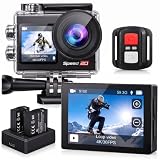
Most versatile Hiicam Speed 10 |
131ft housing claim | Manual plus remote | Check Price |
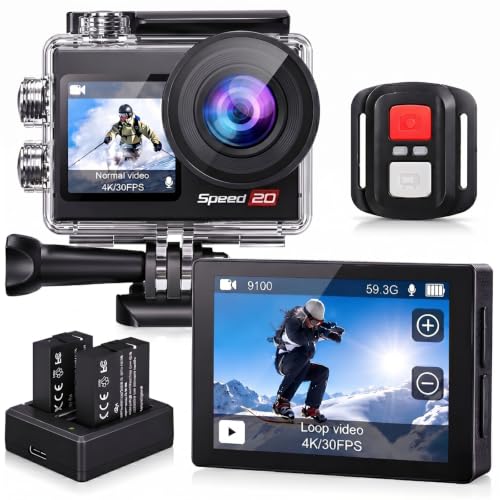
Best premium Hiicam Speed 20 |
131ft housing claim | Manual, touchscreen | Check Price |


How I screened these six listings
I started from what a wildlife shooter can actually verify before buying: published waterproof depth or IP rating, weight, dimensions, warranty length, and whether the camera fires on its own. Everything else in these listings is manufacturer copy.
Four of the six are action cameras rated by their makers to 131ft inside a housing. Two are trail cameras with an IP66 claim on the body itself, no housing needed. That split is the whole article, and it's the split most guides to the best waterproof action camera for wildlife photography gloss over.
What got cut in the screening:
- Anything with no published waterproof figure at all.
- Anything where I could not identify a model number.
- Duplicate housing kits that were accessories, not cameras.
Four of the six publish a warranty. Two AKASO models list 1 Year Manufacturer, the CEYOMUR lists a 1-year warranty, both Hiicam units list 6 Months Warranty, and the DEATTI listing publishes no warranty term I can quote. That's a real difference. It's also the only durability signal any of these listings give you, which tells you something about how thin the published data is in this category.
Five of the six are listed by a single seller. Only the Hiicam Speed 10 shows more than one. That matters less for the camera and more for what happens if the housing gasket fails.
Action camera or trail camera for wildlife photography?
Here's the trick with the best waterproof action camera for wildlife photography: the phrase describes two completely different tools, and Amazon's search returns both.
An action camera is a camera you point. It records when you press record. Wildlife rewards patience and distance, and an action camera gives you neither: a 170° wide angle puts a deer at forty yards in about six pixels. Where these cameras genuinely earn their place is close, wet work. Tide pools. A snorkel over a reef. A hide on a riverbank at three feet. Rock pools, amphibians, fish, crabs.
A trail camera is a camera that waits. It bolts to a tree, watches a 120° arc, and fires on heat and movement while you're asleep. The DEATTI T4 claims a 0.1s trigger time and 36 infrared LEDs at 940nm. The CEYOMUR CY50 claims 24 LEDs at 850nm. Neither is waterproof to a depth: both are sealed to IP66, which is a rain-and-dust rating, not a diving one.
So the honest answer runs like this:
- Subject is underwater or you're holding the camera? Action camera.
- Subject is a mammal on a trail at night? Trail camera.
- Both? Buy one of each. The Brave 4 and the CY50 cover the pair.
Amazon's results for this search do not filter for wildlife suitability, so treat "for wildlife" as a judgement you make about the shooting scenario, not a feature any of these six can promise you.
1. AKASO Brave 4 Action Camera 4K30 Ultra Hd Waterproof — Best overall
The Brave 4 is the most completely specified waterproof action camera here, and the four selectable view angles are the reason it works for wildlife at all.
Best for: handheld and mounted work near water, where you can get within a few feet of the subject Skip it if: you need unattended motion-triggered shots
Every other action camera in this set ships with one wide angle and a promise. AKASO publishes four for the Brave 4: 170°, 140°, 110° and 70°. That 70° setting is the one that matters. Wide angles push subjects away and stretch anything near the frame edge, which is exactly wrong for a bird or a fish. Dropping to 70° tightens the frame considerably.
The body measures 1.57 x 0.91 x 2.32 in and weighs 5.61 oz. AKASO says the housing is rated to 131ft, or 40 metres, with the case fastened. The listing claims 4K at 30fps, 1080p at 60fps and 20MP photos, plus Wi-Fi and HDMI output.
The bundle is the quiet win. Two 1050mAh batteries and a dual charger come in the box, with AKASO claiming up to 90 minutes per battery. Three hours of recording across two cells is the difference between one session and two on a cold morning.
Its trade-off against the trail cameras is absolute: it cannot fire on its own. And at 5.61 oz it's the heaviest action camera here, nearly three times the EK7000.
Pros:
- Four view angles including a tighter 70° option
- Two 1050mAh batteries plus dual charger included
- 131ft housing depth claim, matching the best here
- 1 Year Manufacturer warranty
- Full dimensions and weight published
Cons:
- Heaviest action camera in this set at 5.61 oz
- No motion trigger, so no unattended shooting
- Only one seller lists it
- Image stabilization is a listing claim, not a measured figure
2. CEYOMUR Trail Camera — Best budget pick
The cheapest of the six is also the only one that gives you a published weight, dimensions, colour and a full year of warranty on a motion-triggered body.

Best for: a first unattended camera on a game trail or garden fence line Skip it if: you want 4K video
At 0.63 lb and 7.1 x 5.71 x 4.02 in, the CY50 is small enough to strap high on a trunk without a ladder. The army green finish is not styling: a camera you can't see is a camera that doesn't get stolen or investigated by a curious badger.
CEYOMUR claims 36MP photos and 2K video, plus 24 infrared LEDs at 850nm. That 850nm figure deserves a note. It sits lower on the spectrum than 940nm, which means the LEDs produce a faint visible red glow when they fire. Some animals notice. The upside is that lower-wavelength LEDs typically throw more usable light for the same power draw, so night images tend to be brighter.
The listing also describes a redesigned layout with lens, screen and controls all on one side, instead of the flip-open clamshell most trail cameras use. If you've ever fumbled a clamshell shut in the rain with cold hands, you know why that's on the box. Sealing is claimed at IP66.
Against the DEATTI, it gives up video resolution and it's the slower of the two on published trigger data, since CEYOMUR publishes no trigger time at all.
Pros:
- Cheapest of the six
- 0.63 lb body with full dimensions published
- 1-year warranty, matching the longest here
- Army green camouflage finish
- 24 IR LEDs at 850nm for brighter night frames
Cons:
- 2K video, not 4K, unlike the DEATTI
- 850nm LEDs emit a faint visible glow at night
- No published trigger time
- IP66 is a rain rating, not a submersion depth
3. DEATTI 4K 48MP Trail Camera WiFi Bluetooth Connection — Best upgrade
DEATTI publishes the highest photo resolution claim and the fastest trigger claim in the set, and pairs it with 940nm LEDs that fire without a visible glow.

Best for: night activity at a fixed spot where an animal spooked by red glow is the risk Skip it if: you expect remote phone viewing from home
The two headline claims: 48MP stills with 4K video, and a 0.1s trigger time across a 120° detection arc. Trigger speed is what decides whether you photograph a fox or the space a fox occupied a moment ago, so it's the most useful number on this listing.
The night vision setup is 36 infrared LEDs at 940nm. That's the higher wavelength, which sits far enough into the infrared that the array is effectively invisible when it fires. Compare the CEYOMUR's 850nm and you have a genuine choice: invisible illumination here, brighter illumination there.
The body is the largest in this set at 8 x 4.6 x 3.9 in. It ships with 8 batteries and a 32 GB SD card, so it's ready to hang out of the box. IP66 sealing covers rain and dust.
Read the first bullet on the listing carefully, because DEATTI leads with a warning rather than a feature. The T4 cannot join your home Wi-Fi and does not support remote viewing. The built-in hotspot works with the TrialCam Go app at the camera, which means you still walk to the tree.
Its trade-off is the thinnest published spec sheet of the six: no weight, no colour, no warranty term.
Pros:
- 48MP photo and 4K video claim, highest here
- 0.1s trigger time claim across 120° detection
- 36 LEDs at 940nm, no visible glow
- 8 batteries and 32 GB card included
Cons:
- No remote viewing and cannot join home Wi-Fi
- No published warranty term
- Largest body in the set at 8 x 4.6 x 3.9 in
- No published weight or colour
4. AKASO EK7000 4K30FPS 20MP WiFi Action Camera with EIS — Best lightweight
At 2 oz the EK7000 is by a wide margin the lightest camera here, and the wrist remote solves the problem of reaching a mounted camera without moving.

Best for: helmet, chest, kayak and boat mounts where every ounce shifts the balance Skip it if: you want the cheapest way into this category
Weight is not a vanity spec on a mounted camera. At 2 oz and 1.5 x 0.9 x 2 in, the EK7000 is roughly a third the mass of the Brave 4 and it barely registers on a chest harness or a paddle mount. On a long stalk, that's the camera you forget you're carrying.
The 2.4GHz wrist remote is the feature that makes it a wildlife tool rather than a sports one. You start recording from your wrist without touching the camera, which means a mount you've spent ten minutes aligning stays aligned. AKASO puts the Wi-Fi range at up to 10 metres for the AKASO GO app.
Claimed capability covers 4K at 30fps, 2.7K at 30fps and 20MP stills, with built-in electronic image stabilization and 4x zoom. The housing carries the same 131ft claim as the Brave 4. Warranty is 1 Year Manufacturer, and the listing dates the model to 2018.
Two honest marks against it. It sells faster than anything else in this set, yet it carries the second-highest price position, and the Brave 4 gives you more for less: four view angles instead of one, and two batteries instead of the unstated count here. Its zoom is digital, which crops rather than reaching.
Pros:
- 2 oz, the lightest camera in this set
- 2.4GHz wrist remote leaves the mount undisturbed
- 131ft housing depth claim
- 1 Year Manufacturer warranty
- Full weight, dimensions and release year published
Cons:
- Second-highest price position for fewer view angles than the Brave 4
- 4x zoom is digital, so it crops the frame
- Battery count not published
- No motion trigger for unattended use
5. Hiicam Action Camera 4K 30FPS — Most versatile
The second-cheapest pick here, and the only one in the set that more than one seller stocks.

Best for: snorkelling, bike and helmet mounts on a tight budget Skip it if: you want a warranty longer than six months
Hiicam's listing spreads this camera across three uses in its own title: helmet, bike and snorkelling. For a wildlife shooter that translates to one thing, which is that you can take it into shallow water and onto a bike frame without buying a second body. The claimed housing depth is 131FT, matching both AKASO models.
Published figures: 1.61 x 2.2 x 0.95 in, Pure Black, model Speed 10, size marked Speed-V5. The listing claims 4K at 30fps, 30MP photos, electronic image stabilization, a 170° wide angle, app control over Wi-Fi and a remote.
That 30MP photo claim is the highest of the four action cameras here, ahead of the 20MP on both AKASOs and the Speed 20. Treat it as the manufacturer's number rather than a measured one, because megapixel counts on cameras in this class often come from upscaling rather than sensor resolution.
Two things pull it down. The warranty is 6 Months Warranty, the shortest here alongside its Hiicam sibling, and the listing publishes no weight, which for a camera you mount is a genuine gap. It's also the slowest seller of the six, and it gives you only a 170° angle where the Brave 4 gives four.
Pros:
- Second-cheapest of the six
- Several sellers stock it, unlike the other five
- 30MP photo claim, highest of the action cameras
- 131FT housing depth claim
- Compact at 1.61 x 2.2 x 0.95 in
Cons:
- 6 Months Warranty, shortest in the set
- No published weight
- Single 170° angle with no tighter option
- Slowest seller of the six
6. Hiicam 4K Action Camera 20MP Touch Screen WiFi EIS 131FT — Best premium
A touchscreen makes framing quicker with wet hands, but this is the most expensive pick here on the thinnest published spec sheet.
Best for: touchscreen framing in the field, if buttons frustrate you Skip it if: you compare published specifications closely before buying
The Speed 20 is the sibling of the Speed 10, one model up. The single feature Hiicam publishes covers 4K at 30fps video and 20MP photos. Beyond that, the title carries the touchscreen, electronic image stabilization, Wi-Fi and the 131FT waterproof claim.
Touch control is worth something specific in this category. Changing resolution or angle through a button menu takes several presses you have to look at; a touchscreen puts it one tap away, which matters when a heron lands and you have three seconds. Hiicam publishes Black as the colour, a count of 1, model Speed 20 and 6 Months Warranty.
And that's the whole spec sheet. No weight. No dimensions. No battery count. For the most expensive camera in this set, that is a lot of blanks, and it's why this pick sits last despite the touchscreen. The Brave 4 sits at a lower price position and publishes weight, dimensions, four view angles, two 1050mAh batteries and twice the warranty term.
The trade-off is stark when you line the two Hiicams up. The Speed 10 costs less, publishes more dimensions, claims a higher photo resolution and has more sellers stocking it. You are paying here for the screen and little else you can verify.
Pros:
- Touchscreen for faster setting changes in the field
- 4K30FPS and 20MP claim
- 131FT waterproof claim in the listing
- Electronic image stabilization listed
Cons:
- Highest price position in the set with the fewest published specifications
- No published weight or dimensions
- 6 Months Warranty, shortest here
- Claims a lower photo resolution than the cheaper Speed 10
What the specs actually tell you about reach
Most guides to the best waterproof action camera for wildlife photography compare resolution. Resolution is the wrong number, and here's why.
A 48MP claim, a 36MP claim and a 20MP claim all describe how many pixels land on the file. None of them describe how much of the frame your subject fills. A wide-angle lens at 170° spreads a distant animal across a handful of those pixels regardless of how many there are in total. Cropping in afterwards just enlarges them.
The figures that genuinely predict a usable wildlife frame:
- View angle. A tighter angle fills more of the frame with the subject. Only the Brave 4 publishes a range, from 170° down to 70°.
- Trigger time. On the trail cameras, DEATTI's 0.1s claim is the only published figure. Slow triggers photograph empty trails.
- Detection arc. DEATTI publishes 120°, which sets how wide a path the camera watches.
- IR wavelength. 850nm on the CEYOMUR is brighter and faintly visible; 940nm on the DEATTI is invisible and dimmer.
- Battery capacity. Two 1050mAh cells on the Brave 4 outlast a single unstated cell.
None of these six publish a sensor size or a focal length. That absence is the single biggest limit on what any of them can do at distance, and no listing here fills it in.
What the listings do not tell you
Four things you'd want before buying a waterproof action camera for wildlife photography, and which none of these listings answer.
How the housing behaves after a season. Every 131ft claim assumes an intact gasket. Gaskets dry, crack and pick up grit. No listing here states whether replacement seals are available, and only the Hiicam Speed 10 has more than one seller if you need parts.
Whether the audio survives submersion. A sealed housing muffles sound. The EK7000 lists external microphone support, which is the only audio path any of these publish, and it works on land only.
Battery life in cold. AKASO puts the Brave 4 at up to 90 minutes per 1050mAh cell. That's a room-temperature number. Cold cuts lithium output, and nobody publishes a temperature range.
Storage capacity limits. Only the DEATTI ships with a card, at 32 GB. The other five publish no maximum supported card size, which for 4K recording is the figure that decides how long you can leave a camera running.
When a different pick wins
Three conditions flip the recommendation away from the Brave 4:
- Your subject appears when you're not there. Buy the CEYOMUR CY50 or the DEATTI T4. No action camera in this set has a motion trigger, so the Brave 4 simply cannot do this job at any price.
- You're mounting to a helmet or chest harness for hours. Buy the EK7000. At 2 oz against 5.61 oz, the weight difference is felt on every mount, and the wrist remote means you never reach up to a camera you've carefully aimed.
- A visible red glow would spook your subject. Buy the DEATTI T4. Its 940nm LEDs fire without visible light where the CEYOMUR's 850nm array glows faintly. If you're photographing deer or fox at a bait site, that's decisive.
One more threshold worth naming. If you need the camera to survive genuine submersion rather than rain, the cutoff is between a housing and an IP rating. The four action cameras claim 131ft inside a case. The two trail cameras claim IP66, which covers heavy rain and dust and nothing deeper. Do not take an IP66 trail camera into a stream.
The verdict
The AKASO Brave 4 is the best waterproof action camera for wildlife photography in this set, and the four selectable view angles are why. Everything else here gives you one wide angle and hopes distance won't matter; the Brave 4's 70° setting is the only published option that tightens the frame around a subject. Add 131ft of claimed housing depth, 5.61 oz with full dimensions listed, two 1050mAh batteries with a dual charger, and 1 Year Manufacturer warranty, and it's the most completely specified camera you can hold in this group.
Two conditions flip it. If your subject only shows up unattended, no action camera works, and the CEYOMUR CY50 is the cheapest sound entry at 0.63 lb with a 1-year warranty and 24 LEDs at 850nm. If you're mounting the camera for hours rather than carrying it, the AKASO EK7000 wins on the numbers that matter there: 2 oz against 5.61 oz, plus a 2.4GHz wrist remote that lets you record without touching the mount.
The EK7000's exact advantage over the Brave 4 is that weight and that remote, and nothing else. It costs more and gives you one view angle. Buy it only if the mount is the point.
FAQ
Is a waterproof action camera for wildlife photography worth it?
A waterproof action camera for wildlife photography is worth it when your subject is close and wet: tide pools, streams, reef snorkelling, amphibians at the water's edge. The 131ft housing claim on the Brave 4 opens water no trail camera can enter. For distant mammals or birds, a wide 170° lens works against you, and a motion-triggered trail camera does that job far better.
Which offers better value, the AKASO Brave 4 or the EK7000?
Better value goes to the AKASO Brave 4. It sits at a lower price position than the EK7000 and publishes more: four view angles from 170° to 70° instead of one, two 1050mAh batteries with a dual charger, and full weight and dimensions. Both claim 131ft housing depth and both carry 1 Year Manufacturer warranty. Choose the EK7000 only if 2 oz over 5.61 oz decides it.
What does IP66 mean on a trail camera?
IP66 on a trail camera means the body is sealed against dust and heavy water jets, which covers rain, spray and snow. It does not mean submersion. The CEYOMUR CY50 and DEATTI T4 both carry the IP66 claim and both are strictly land cameras. The four action cameras here claim 131ft depth, but only with the waterproof housing fastened.
Do these cameras work at night for wildlife photography?
Night wildlife photography works only on the two trail cameras. The DEATTI T4 lists 36 infrared LEDs at 940nm, invisible when they fire. The CEYOMUR CY50 lists 24 LEDs at 850nm, brighter but with a faint red glow some animals notice. The four action cameras publish no infrared illumination at all, so they need daylight or an external light source.
What mistake do first-time buyers make in this category?
The most common mistake is buying on megapixel count. A 48MP claim tells you nothing about how much of the frame an animal fills, because a 170° lens spreads a distant subject across very few pixels no matter the file size. View angle, trigger time and detection arc predict a usable wildlife frame. Resolution only decides how large you can print the one you get.
Start by answering one question: will you be holding the camera or leaving it? Holding it near water points you at the AKASO Brave 4, where the 70° angle and the second 1050mAh battery both earn their place on a long morning. Leaving it on a tree points you at the CEYOMUR CY50 or the DEATTI T4. The Brave 4 is the sensible default because it does the one thing a trail camera never will, which is go underwater with you, and it publishes more of its own numbers than anything else in this group.