Best Softbox Lighting Kit: Torjim 27-Inch Leads
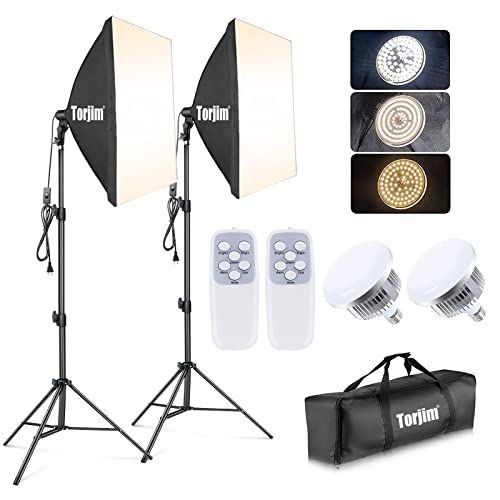
Five softbox kits compared on published specs alone: panel size, bulb wattage, colour temperature range and stand height. The Torjim 27-inch pair wins, but three named conditions flip that.

By Sam BaileyUpdated 14 min read
On this page
- Best softbox lighting kit for low light at a glance
- Why three kits were cut before the list existed
- What actually decides a softbox lighting kit for low light?
- Does a bigger panel beat a brighter bulb?
- How much room does each kit need?
- 1. Torjim Softbox Photography Lighting Kit — Best overall
- 2. EMART Softbox Photography Lighting Kit 2Pack 50W LED — Most versatile
- 3. Thoslatay Softbox Lighting Kit 2pack — Best warranty
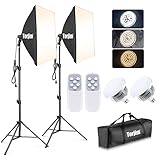
- 4. Torjim Softbox Photography Lighting Kit — Best budget pick
- 5. MOUNTDOG Softbox Lighting Kit — Best premium
- What the listings do not tell you
- The verdict
- FAQ
The best softbox lighting kit for low light is the Torjim Softbox Photography Lighting Kit, because it pairs two 27" x 27" panels with 85W bulbs and a 3000K-7500K range. If your room is narrow, the EMART 50W kit folds to a 16" x 16" panel and still gives you two heads. Get this wrong and you don't get a dark photo. You get a grainy one, because your camera pushes ISO to compensate for a panel that's too small and too far away, and noise shows up in skin tones first. Cheap kits fail at exactly that point.
Best softbox lighting kit for low light at a glance
| Pick | Panel size | Bulb output | Price |
|---|---|---|---|
Best overall Torjim Softbox Photography Lighting Kit |
27" x 27", 2 panels | 85W x 2 3000K-7500K |
Check Price |
Most versatile EMART Softbox Photography Lighting Kit 2Pack 50W LED |
16" x 16", 2 panels | 50W x 2 3000K-6000K |
Check Price |
Best warranty Thoslatay Softbox Lighting Kit 2pack |
16" x 16" | 85W 2700K-6400K |
Check Price |
Best budget pick Torjim Softbox Photography Lighting Kit |
16" x 16" | 85W 3000K-7500K |
Check Price |
Best premium MOUNTDOG Softbox Lighting Kit |
19.7" x 27.5", 2 panels | 85W x 2 5700K fixed |
Check Price |


Why three kits were cut before the list existed
Three disqualifications did most of the work here.
- No published panel dimensions. A softbox is a light modifier first. If the listing won't say how big the diffusion surface is, there's nothing to compare and no way to predict how the light falls.
- No stated colour temperature. Mixing a fixed 5700K head with a warm room bulb creates a colour cast you fix in post or not at all. Four of these five publish a Kelvin range.
- No warranty statement. Stands and sockets are the parts that fail. All five survivors here publish a one-year term, which is why the warranty award below rests on other evidence too.
What survived is a set of five kits from four brands, all in the soft boxes category, all sold with stands and bulbs included rather than as bare modifiers. That last point matters more than it sounds. A softbox alone is useless in a dim room; you need the head, the socket and something to hold it at face height.
I then lined up panel area, wattage, Kelvin range and maximum stand height across all five. Those four figures are the only ones every listing states in comparable terms, so those four figures decided the ranking.
What actually decides a softbox lighting kit for low light?
Most guides for a softbox lighting kit for low light compare wattage. That's the wrong headline number.
Wattage tells you what the bulb draws, not what reaches your subject. The panel size decides how soft the light looks and how much of it you can place close without hot spots. A 27" x 27" panel wrapping light around a face at three feet does something a 16" square physically cannot, no matter what bulb is inside it.
Here's the trick with dim rooms: you're not fighting darkness, you're fighting distance. Light falls off fast. Move a panel from two feet to four feet and you lose a large fraction of what hits the subject. So the kit that wins in a low-light room is the one with the biggest panel you can park closest.
The second deciding figure is colour temperature range. Three of these five span 3000K or lower up to 6000K or higher:
- Torjim 27": 3000K-7500K
- Torjim 16": 3000K-7500K
- EMART: 3000-6000K
- Thoslatay: 2700K-6400K
- MOUNTDOG: 5700K, single value
That range is what lets you match a warm living-room lamp instead of clashing with it. A fixed 5700K head forces you to kill every other light in the room.
Does a bigger panel beat a brighter bulb?
Run the two extremes in this set against each other. The Torjim 27" pair gives you 729 square inches of diffusion per panel at 85W. The EMART gives you 256 square inches at 50W. That's a real gap in both directions, and it stacks.
Bigger panel plus brighter bulb wins on paper. But the EMART wins on placement, and placement is half the fight in a small room. Its 16" x 16" box collapses with a push of a rod, and the stand runs from 17" to 63". You can set it on a desk, tilt it 120° and shoot straight away.
So the honest answer: a bigger panel beats a brighter bulb when you have the floor space to use it. Under about six feet of clear width, the smaller kit you can actually position beats the larger one you keep bumping into.
How much room does each kit need?
Published dimensions and stand heights tell you more about fit than any marketing line.
- Torjim 27" x 27": packed dimensions 6.69 x 27.6 x 7.09 in, stands adjustable from 27" upward, two panels. Needs the most floor.
- MOUNTDOG 19.7" x 27.5": 27.5 x 2 x 19.7 in, two panels. Tall and narrow, so it fits a corner better than a square of similar area.
- EMART 16" x 16": 63 x 16 x 16 in packed, stands 17" to 63", two panels. The most placement options here.
- Thoslatay 16" x 16": 16 x 16 x 16 in, stand 18" to 60".
- Torjim 16" x 16": single softbox, 60" stand.
Two of the five reach 63" or above. If you shoot standing subjects, that ceiling matters, because a key light below eye level gives you the horror-movie look. Sit your subject down and a 60" stand is plenty.
1. Torjim Softbox Photography Lighting Kit — Best overall
Two 27" x 27" panels and 85W bulbs give this kit the most usable light of the five, provided you have the floor space.
Best for: shooting seated portraits or talking-head video in a dim room Skip it if: your shooting space is under about six feet wide
Panel area is what separates this from everything below it. At 27" x 27" per side, each box covers roughly 2.8 times the diffusion surface of the 16" squares here, and there are two of them. In a room with no useful window light, that's the difference between a clean exposure and pushing ISO into visible grain.
The 3000K-7500K range is the widest in this set, matching the smaller Torjim. That upper end is useful if you're mixing with daylight through a curtain; the lower end lets you sit alongside tungsten room lamps without a colour clash. A remote is included, which matters once a light is at head height behind a diffuser.
Torjim says the inner nylon reflector brightens output while the removable PET diffuser softens it, and rates the bulbs at about 6000 hours. The head rotates 210°, stands are aluminium alloy, and a carry bag is included. Warranty is one year, model ST-10877, released 2022.
The trade-off is bulk. Packed at 6.69 x 27.6 x 7.09 in and priced above three of the four alternates, this is the kit you commit space to rather than the one you tuck behind a sofa.
Pros:
- Largest panels here at 27" x 27", two of them
- 85W bulbs, tied for highest wattage in this set
- Widest colour range at 3000K-7500K
- 210° rotatable head and included remote
- Carry bag and aluminium stands included
Cons:
- Bulkiest packed size of the five
- Second-priciest pick here
- Only two sellers list it
- Panel size is impractical in a narrow room
2. EMART Softbox Photography Lighting Kit 2Pack 50W LED — Most versatile
A pull-rod 16" x 16" box on a 17"-to-63" stand, with app control on both heads, makes this the easiest kit to reposition.

Best for: creators who reposition lights constantly and want app control Skip it if: you need maximum output per head
The mechanism is the story. EMART describes a press-and-pull rod that opens or closes the 16" x 16" box in one motion, which is a different experience from threading rods into a fabric socket every time. If you shoot in a room you also live in, that decides whether the lights come out at all.
Control is the second differentiator. EMART says each 50W head adjusts colour temperature and brightness individually by app or remote, across 3000-6000K. No other pick here claims phone control. Two heads with independent settings lets you run a warmer key and a cooler rim without swapping bulbs.
Stand range is 17" to 63", the widest span in this set, and the head adjusts 120°. Two boxes, two bulbs, two stands and a carry bag are included, with a one-year manufacturer warranty on model EM-SBK1616P-2WJ. Second-cheapest of the five.
Where it loses: 50W per head is the lowest wattage here, and the 16" panel is among the smallest. In a genuinely dark room you'll be placing these close, which limits how wide a scene you can cover.
Pros:
- One-motion pull-rod assembly, unique in this set
- App and remote control on each head
- Widest stand range at 17" to 63"
- Two complete lights, second-cheapest here
- 120° adjustable heads and carry bag included
Cons:
- Lowest bulb wattage of the five at 50W
- Narrowest colour range among the adjustable kits
- Small 16" panel limits coverage distance
- Only two sellers list it
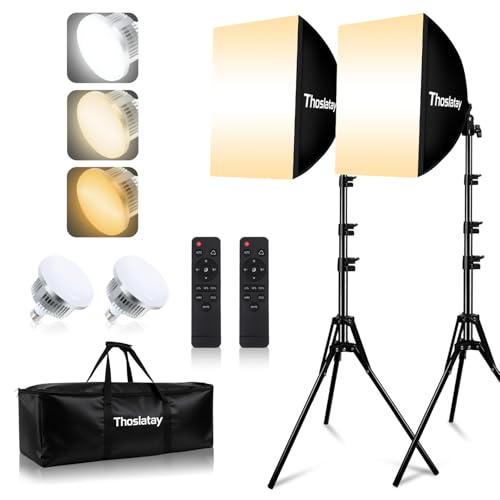
3. Thoslatay Softbox Lighting Kit 2pack — Best warranty
The only pick here with a published CRI claim, backed by a one-year term and the widest warm-end colour reach at 2700K.
Best for: product shooters who care about colour accuracy claims Skip it if: you want two full lights in one box
Colour rendering is the differentiator. Thoslatay claims 95+ CRI on its 85W bi-colour bulbs, and no other listing in this set publishes a CRI figure at all. For product work where a fabric swatch or a paint colour has to read true, that claim is worth more than an extra 35W.
The Kelvin span runs 2700K to 6400K, reaching further into warm territory than any other pick. That's useful when you're matching a room lit by older incandescent bulbs rather than fighting it. Thoslatay says brightness and colour temperature both adjust by a 30ft wireless remote, though the listing notes the remote itself is not powered by an included battery.
The stand adjusts between 18" and 60", the box is 16" x 16", and the head rotates 210°. Warranty is one year. Priced mid-range for this set, third of five.
The published detail is thin compared with the Torjim and EMART entries. Wattage, Kelvin range and stand height are stated, but the packed dimensions read as a 16 x 16 x 16 in cube and there's no stated bulb life or bag. Against the two-panel kits above, you're getting less light for a similar outlay.
Pros:
- Only pick publishing a CRI figure, claimed 95+
- Widest warm reach at 2700K
- 85W bulb matches the top wattage here
- 30ft remote adjusts brightness and colour
- 210° rotatable head, 18"-60" stand
Cons:
- Remote battery not included per the listing
- Less published spec detail than the Torjim kits
- No carry bag stated
- Only one seller lists it
4. Torjim Softbox Photography Lighting Kit — Best budget pick
The cheapest way into 85W and a 3000K-7500K range, as long as one light is enough.

Best for: a single-light setup for streaming or a first key light Skip it if: you need a second light for background separation
This is the cheapest pick in the set and it doesn't cut the two specs that matter most for a dim room. You still get an 85W bulb, tied with the Thoslatay and the two-panel Torjim for the highest wattage here, and you still get the full 3000K-7500K range that the 27" kit offers.
What you give up is the second head. The package is one softbox, one remote, one LED bulb, one 60in tripod stand and one soft diffuser. For a streamer sitting at a desk, one key light placed slightly off-axis does most of the job, and you can add a second later. For anyone shooting products, one light means one shadow you have to live with.
Torjim describes PET fabric with a foldable nylon cover for reflectivity, independent locking knobs on the aluminium stand and a 210° rotatable head. Model TJ, released 2023, one-year warranty.
The 16" panel is the real limit. At that size you're placing it close, which crops how much of a scene it covers. Against the EMART at a similar entry position, you're trading a second light for higher wattage on one.
Pros:
- Cheapest of the five picks
- 85W bulb, tied for highest wattage
- Full 3000K-7500K colour range
- 60" stand with independent locking knobs
- Remote and soft diffuser included
Cons:
- One light only, no fill or rim option
- Smallest panel area in this set at 16" x 16"
- Stand tops out at 60", lower than two rivals
- Only two sellers list it
5. MOUNTDOG Softbox Lighting Kit — Best premium
Two 19.7" x 27.5" rectangular panels and 85W bulbs, at the highest price position here and with the thinnest published spec sheet.

Best for: portrait work that suits a tall, narrow rectangular panel Skip it if: you want published detail on the bulbs and stands
Panel shape is what this kit brings that nothing else here does. At 19.7" x 27.5", the boxes are rectangular rather than square, and a tall panel in the vertical orientation mimics a standing window better than a square of similar area. For head-and-shoulders portraits, that shape puts a longer catchlight in the eye and falls off more naturally down the body.
Area sits between the two groups: larger than the three 16" squares, smaller than the Torjim 27" pair. Both bulbs are 85W at 5700K on E27 sockets, with a remote included, and MOUNTDOG says the two boxes work together to soften light and reduce shadows. Packed dimensions are 27.5 x 2 x 19.7 in, warranty one year, model A-0027.
The 5700K figure is fixed, not a range, and that's the biggest practical cost. Every other adjustable pick here lets you dial warmer to match room lighting. With this one you either match 5700K everywhere or accept mixed colour.
It's also the most expensive pick in this set, with only one listing detail published about the boxes and nothing stated about stand height, bag or bulb life. Paying the most for the least documented kit is a hard case to make.
Pros:
- Rectangular 19.7" x 27.5" panels suit vertical portraits
- Two 85W bulbs, tied for highest wattage
- Second-largest panel area in this set
- E27 sockets accept standard replacement bulbs
- Remote included
Cons:
- Fixed 5700K with no colour adjustment
- Most expensive pick here for no extra published capability
- Thinnest spec sheet of the five, no stated stand height
- Only one seller lists it
What the listings do not tell you
None of these five publishes a lumen or lux figure. Wattage is a proxy for output, not a measurement of it, and an 85W LED from one brand may not match an 85W LED from another. Treat the wattage column as a rough sort, not a guarantee.
Bulb life appears once, in the Torjim 27" listing, at about 6000 hours. The other four say nothing about it. E27 is the socket named on the MOUNTDOG, which means standard replacement bulbs fit; assume nothing about the others until you check the listing.
Flicker is the other silence. Cheap LED drivers can pulse in a way you don't see but a camera does, showing up as banding at higher shutter speeds. No listing here addresses it, so if you shoot video above 1/125 sec, test before you commit to a shoot.
Two of the five are stocked by a single seller. That's worth knowing before you plan on buying a matching second kit later.
The verdict
The Torjim 27" kit is the best softbox lighting kit for low light in this set, and the reason is geometry rather than power. Two 27" x 27" panels give you roughly 2.8 times the diffusion surface of the 16" squares here, at 85W each, over a 3000K-7500K range. In a dim room that means you can place a soft, wide light close to your subject and keep ISO down, which is the whole game.
Two conditions flip it. First, floor space: under about six feet of clear width, the Torjim panels become obstacles, and the EMART 50W pair with its 17"-to-63" stands and one-motion pull rods is the kit you'll actually set up. Second, colour accuracy: if you're shooting products where a swatch has to read true, the Thoslatay is the only pick publishing a CRI claim, at 95+.
A third flip if you only need one light. The 16" Torjim is the cheapest pick here and keeps both the 85W bulb and the 3000K-7500K range, so a desk-based streamer loses very little.
The EMART's exact advantage over the winner is control and speed: individual app adjustment on each head, and a box that opens with one push.
FAQ
Is a softbox lighting kit for low light worth it over a ring light?
A softbox lighting kit for low light is worth it when you're lighting more than a face. The panels here run from 16" x 16" up to 27" x 27", so the diffusion surface is far larger than a typical ring light, and larger surfaces wrap light more gently around a subject. A ring light still wins on desk footprint and simplicity for close-up talking heads.
How much light do I need in a dark room?
How much light you need depends on distance more than wattage. Four of these five kits use 85W bulbs, and the fifth uses 50W per head, but output halves fast as you move a panel away. Place a panel within three or four feet of your subject and even the 50W EMART heads give you a workable exposure without pushing ISO into visible noise.
Torjim 27-inch or EMART 50W: which should I buy?
Between the Torjim 27-inch and the EMART 50W, floor space decides it. The Torjim gives you 27" x 27" panels and 85W bulbs, better in any room you can spread out in. The EMART gives you 16" x 16" pull-rod boxes, 17"-to-63" stands and app control on each head, which is the better buy in a tight room you also live in.
Does colour temperature range matter for a softbox lighting kit?
Colour temperature range matters most when other lights are on. Four picks here adjust: 3000K-7500K on both Torjim kits, 3000-6000K on the EMART, 2700K-6400K on the Thoslatay. That lets you match warm room lamps instead of clashing with them. The MOUNTDOG is fixed at 5700K, so you'd need to switch off every competing light source.
What mistake do first-time buyers make with softbox kits?
The mistake first-time buyers make is placing the light too far away. A softbox gets softer as it gets closer, and light falls off sharply with distance, so a panel pushed to the back of the room delivers hard, dim light. Start at arm's length from your subject, slightly above eye level and off to one side, then adjust.
Pick the panel size your room can hold, then work down the spec list from there. If you have six feet of clear floor and shoot people, order the Torjim 27" pair and place one panel close at 45 degrees, the second further back as fill. If your room is tighter, the EMART pull-rod kit gets set up more often, and a light you use beats a light you leave folded. Either way, the fastest quality gain isn't more wattage. It's moving the panel two feet closer.