Best Silent USB Microphone: Blue Yeti Leads

Six USB mics compared on their published specs and noise-handling claims, with a clear winner, a budget alternative, and the truth about what 'silent' really means when you buy a microphone.

By Sam BaileyUpdated 14 min read
On this page
- Best silent usb microphone at a glance
- How I screened these six mics
- What does silent actually mean for a USB mic?
- 1. Logitech Creators Blue Yeti — Best overall
- 2. FIFINE AmpliGame AM8 — Most versatile
- 3. TONOR Conference G11 — Best upgrade
- 4. ZealSound K66 — Best for families
- 5. CMTECK G009 — Best warranty
- 6. JOUNIVO JV-601 — Best budget pick
- Which pickup pattern keeps a room quietest?
- What more money buys across these six
- When a cheaper pick wins
- The verdict
- FAQ
The best silent USB microphone here is the Logitech Creators Blue Yeti, because its four switchable pickup patterns let you narrow the pattern to reject room noise, and its 3.51 lb body sits still without shifting on the desk. If you want a start-now, upgrade-later path, the FIFINE AmpliGame AM8 is the pick, since it runs over USB today and swaps to XLR later. One warning up front: no listing here reports a measured noise floor, so "silent" is a shortlist goal, not a promised number. That is the deciding factor. Read on for what to check yourself.
Best silent usb microphone at a glance
| Pick | Type / Pattern | Weight | Price |
|---|---|---|---|
Best overall Logitech Creators Blue Yeti |
Condenser, 4 patterns | 3.51 lb | Check Price |
Most versatile FIFINE AmpliGame AM8 |
Dynamic, USB/XLR | 1.32 lb | Check Price |
Best upgrade TONOR Conference G11 |
Condenser, omni | 4.76 oz | Check Price |
Best for families ZealSound K66 |
Condenser, cardioid | 1.09 lb | Check Price |
Best warranty CMTECK G009 |
Condenser, cardioid | Not listed by weight | Check Price |
Best budget pick JOUNIVO JV-601 |
Condenser, omni | 7.05 oz | Check Price |


How I screened these six mics
I compared the published specifications side by side, then sorted the six by what a quiet-setup buyer actually controls. Every one plugs in over USB, so connection type did not separate them. What did separate them was pattern, mass, and stated noise handling.
Here is what I looked at, in order:
- Pickup pattern. A tight cardioid or a switchable pattern rejects more room noise than a fixed omnidirectional. Two picks are omnidirectional, which is the wrong shape for a quiet desk.
- Weight and footprint. A heavier body resists desk knocks and vibration. The Blue Yeti is 3.51 lb; the TONOR G11 is 4.76 oz.
- Onboard controls. A hardware mute and gain knob let you cut noise without touching software.
- Stated warranty. Only three of six publish a cover length.
Nothing here ships a lab-measured self-noise figure. So I treated each maker's "noise cancellation" or "noise reduction" wording as a claim to attribute, not a number to trust. That single gap is why the winner earns its place on pattern flexibility rather than a spec sheet promise.
What does silent actually mean for a USB mic?
A silent USB microphone, in listing terms, is a mic that captures your voice while rejecting the sounds around it. None of these six reports a measured self-noise level in decibels. So "silent" is not a number you can compare here.
What you can compare:
- Pattern shape. Cardioid and switchable patterns reject off-axis room noise. Omnidirectional patterns pick up the whole room, which is louder.
- Noise-reduction claims. ZealSound describes an "Intelligent Noise Reduction Mode." CMTECK cites a "CCS2.0 SMART CHIP." JOUNIVO cites "noise-canceling technology." These are the makers' words, not verified figures.
- Physical stability. A heavier mic transmits fewer desk bumps into the recording.
The primary keyword misleads slightly on Amazon: the search ignores the "silent" qualifier and returns general USB mics. So judge quietness yourself, using pattern and controls. Do not expect a mic here to be silent out of the box; expect one to help you get there.
1. Logitech Creators Blue Yeti — Best overall
The Blue Yeti wins because four switchable patterns and a heavy, stable body give you the most control over what the mic hears.
Best for: creators who want four pickup patterns and onboard controls Skip it if: you have a small desk or want a light mic
Within this set, the Yeti is the only mic offering four pickup patterns. Logitech lists cardioid, omni, bidirectional, and stereo. That matters for a quiet setup, because you can switch to cardioid and reject most of the room, then change later without buying a second mic. No other pick here gives you that choice.
At 3.51 lb, it is the heaviest of the six by a wide margin. The next heaviest, the AM8, is 1.32 lb. That mass keeps the mic planted and shrugs off desk knocks that a light mic turns into thumps. It measures 11.6 x 4.92 x 4.72 in, so it needs real desk space.
Logitech says its Blue VO!CE software adds vocal effects and modulation, and the mic carries onboard gain, mute, and headphone controls. The trade-off is size and price: it is the most expensive pick here and the largest body, so a cramped desk or a tight budget points you elsewhere.
Pros:
- Only pick here with four pickup patterns
- Heaviest body at 3.51 lb resists desk vibration
- Onboard gain, mute, and headphone controls
- 2-year manufacturer warranty
- Blue VO!CE software claimed for vocal shaping
Cons:
- The most expensive pick in this set
- Largest footprint at 11.6 x 4.92 x 4.72 in
- Heaviest to mount on a boom arm
- Only two sellers list it
2. FIFINE AmpliGame AM8 — Most versatile
The AM8 is the most versatile because it runs over USB now and swaps to XLR later, so it grows with you.

Best for: streamers who want a USB start and an XLR upgrade path Skip it if: you never plan to add an audio interface
The AM8 is the only dynamic microphone here. Dynamic mics are naturally less sensitive to distant room noise than condensers, which helps in a busy or untreated space. That makes it a smart quiet-setup choice even without a stated noise figure.
FIFINE lists a frequency response of 50Hz to 16KHz and a dual connection: plug it into USB today, then connect the same mic to an audio interface over XLR when you upgrade. No other pick offers that path. It weighs 1.32 lb and measures 9.65 x 3.35 x 4.96 in, and the listing describes a controllable RGB ring plus a headphone jack for monitoring.
It sells faster than the rest of this set, which tells you it is the one buyers reach for most here. The trade-off is that the XLR side needs an interface and an XLR cable that FIFINE says is not included, so the upgrade path costs extra later.
Pros:
- Only dynamic mic in this set
- USB now, XLR upgrade path later
- Frequency response of 50Hz to 16KHz claimed
- Headphone jack for real-time monitoring
- Sells faster than the rest of this set
Cons:
- XLR cable not included per the listing
- XLR mode needs a separate interface
- Sits in the premium price position here
- 1-year warranty is shorter than the Yeti's
3. TONOR Conference G11 — Best upgrade
The G11 is the best upgrade for group audio, because its omnidirectional pattern is built to capture a whole table at once.

Best for: small meetings needing wide room pickup Skip it if: you sit alone at a desk and want a tight vocal focus
The G11 is a specialist. TONOR describes it as an omnidirectional condenser made for small to medium meetings over Zoom, Skype, and similar software. That wide pattern is the opposite of quiet-focused: it hears the room on purpose, so several people can share one mic.
It is the lightest full-size mic here at 4.76 oz, with a low 1.97 x 7.87 x 11.8 in footprint and an anti-slip base TONOR says keeps it stable. There is a mute button with an indicator light. Two sellers list it, giving you a second buying source.
Understand the swap you are making. For a single voice in a quiet room, an omnidirectional pattern picks up more background than a cardioid, so this is the best upgrade for meetings, not for a solo recording booth. The trade-off against the Yeti and the AM8 is focus: you gain table coverage and lose room rejection.
Pros:
- Built for small and medium meetings
- Lightest at 4.76 oz
- Low, wide desktop footprint
- Anti-slip base claimed for stability
- Two sellers stock it
Cons:
- Omni pattern picks up more room noise
- Wrong shape for a solo quiet setup
- No published warranty length
- No onboard gain control
4. ZealSound K66 — Best for families
The K66 is best for families because it works across phones and computers and puts noise reduction and echo control on physical knobs.

Best for: households sharing one mic across phones and computers Skip it if: you need a documented long warranty
The K66 earns the family pick on flexibility. ZealSound lists compatibility with iPhone, iPad, Android, Mac, and PC, so one mic covers a household with mixed devices. It uses a cardioid condenser capsule, which is the right pattern for cutting room noise when one person speaks at a time.
It weighs 1.09 lb and measures 6.1 x 1.58 x 1.58 in, a slim upright that fits a shared desk. ZealSound describes dedicated knobs for microphone volume, monitoring volume, and echo, plus an "Intelligent Noise Reduction Mode" for cleaner voice. Treat that mode as the maker's claim, not a tested result.
The warranty runs 365 days from purchase, shorter than the two-year cover on the Yeti and the CMTECK G009. It sits roughly mid-range for this set. The trade-off is that you pay more than the two entry picks without gaining a switchable pattern, so the value is in the wide device support, not the feature count.
Pros:
- Works with phones, tablets, Mac, and PC
- Cardioid pattern for single-voice focus
- Physical knobs for volume, monitoring, and echo
- Slim 6.1 x 1.58 x 1.58 in body
- Noise Reduction Mode claimed
Cons:
- 365-day warranty is shorter than rivals
- Only one seller lists it
- No switchable pickup pattern
- Priced above the two entry picks
5. CMTECK G009 — Best warranty
The G009 pairs the longest stated cover in the entry tier with a cardioid pattern that suits a quiet desk.

Best for: buyers who want the longest stated cover on a small mic Skip it if: you want a heavy, stable desktop stand
The G009 stands out on protection. It carries a 2-year limited warranty, matching the Yeti and beating the ZealSound K66's 365 days, while sitting in the entry price tier. That is a rare combination in this set: long cover at a low price position.
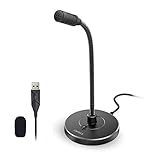
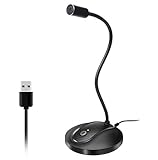
It uses a cardioid condenser capsule, the tight pattern that helps reject room noise for a single speaker. CMTECK cites a "CCS2.0 SMART CHIP" for active noise cancelling and adds a flexible gooseneck that adjusts 360 degrees, plus a mute button with an LED indicator. The body measures 4.41 x 2.68 x 4.21 in, a small desktop unit.
The listing does not publish a weight, so I cannot compare its mass against the Yeti or the AM8. That matters, because a light gooseneck mic transmits more desk vibration than a heavy body. The trade-off is stability: you get the best warranty here, but not the planted feel of the winner.
Pros:
- 2-year limited warranty at an entry price
- Cardioid pattern for single-voice focus
- 360-degree adjustable gooseneck
- Mute button with LED indicator
- Compact 4.41 x 2.68 x 4.21 in base
Cons:
- No published weight to judge stability
- Only one seller lists it
- No switchable pickup pattern
- Noise cancelling is a maker claim, not a figure
6. JOUNIVO JV-601 — Best budget pick
The JV-601 is the budget pick because it is the cheapest of the six and still gives you a mute button and a gooseneck.
Best for: first-time buyers on the tightest budget Skip it if: you want a published warranty
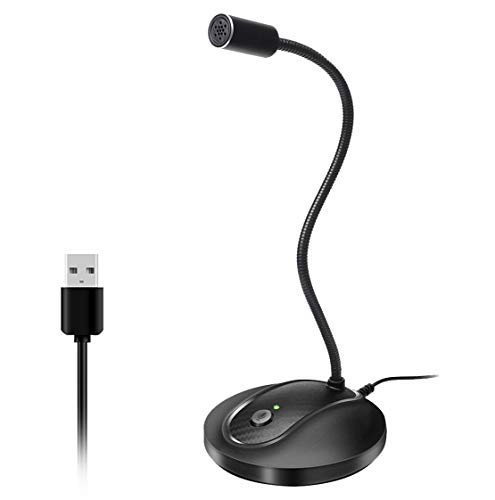
The JV-601 is the cheapest of the six, which is its whole case. For a first mic that beats a laptop's built-in, it covers the basics: a 360-degree gooseneck, a one-click mute button with an LED indicator, and plug-and-play use on Windows 7 through 11 and macOS with no driver.
It weighs 7.05 oz and measures 9 x 3 x 3 in, and JOUNIVO includes a 1.8m USB cable. Here is the catch for a quiet setup: it is an omnidirectional condenser, so it hears the whole room. JOUNIVO cites "noise-canceling technology," which is the maker's claim, but an omni pattern works against room rejection by design.
There is no published warranty, the only pick here without a stated cover. Against the CMTECK G009, which is also entry-priced but carries 2 years and a cardioid pattern, the JV-601 trades protection and focus for the lowest price. Buy it only if that price is the deciding factor.
Pros:
- The cheapest of the six
- 360-degree adjustable gooseneck
- Mute button with LED indicator
- Plug-and-play on Windows and macOS
- Includes a 1.8m USB cable
Cons:
- Omni pattern picks up more room noise
- No published warranty at all
- Only one seller lists it
- Noise cancelling is a maker claim only
Which pickup pattern keeps a room quietest?
Pattern is the single spec that decides how much room a mic hears. If quiet recordings are your goal, this is where you focus first.
- Cardioid captures sound from the front and rejects the back and sides. The ZealSound K66 and CMTECK G009 use this. It is the quiet-setup default.
- Switchable lets you pick cardioid when you want focus. The Blue Yeti is the only pick here that offers it.
- Omnidirectional captures the whole room evenly. The TONOR G11 and JOUNIVO JV-601 use this. It is best for a group, worst for a single quiet voice.
- Dynamic is a capsule type, not a pattern, but the FIFINE AM8's dynamic design is naturally less sensitive to distant noise.
So the ranking for room rejection runs: switchable and cardioid first, dynamic close behind, omnidirectional last. Match the pattern to your room, not the marketing.
What more money buys across these six
Spending more in this set does not simply buy a quieter mic. It buys flexibility and mass. Here is the map, without figures.
The two entry picks, the JOUNIVO JV-601 and the CMTECK G009, cover the basics: a gooseneck, a mute button, and plug-and-play use. The G009 adds a 2-year warranty, which the JV-601 lacks entirely.
The mid picks, the ZealSound K66 and TONOR G11, add either wide device support or a conference-ready omni pattern. Neither adds a switchable pattern.
The premium picks, the FIFINE AM8 and the Blue Yeti, are where control appears. The AM8 buys a dynamic capsule and an XLR upgrade path. The Yeti, the most expensive here, buys four pickup patterns, a 3.51 lb stable body, and onboard gain and mute. That flexibility is what your extra spend actually delivers.
When a cheaper pick wins
A cheaper pick can be the smarter buy. Use these if/then flips:
- If your desk is small and crowded, then skip the 3.51 lb Blue Yeti and take the slim ZealSound K66 at 6.1 x 1.58 x 1.58 in.
- If you record only one voice and want long protection cheaply, then the CMTECK G009 with its cardioid pattern and 2-year warranty beats the pricier mid picks.
- If several people share the mic for calls, then the omnidirectional TONOR G11 does the job the Yeti's tighter patterns fight against.
- If price is the hard limit, then the JOUNIVO JV-601, the cheapest of the six, gets you recording today.
The Yeti wins on control and stability. But control you do not need is money you did not have to spend.
The verdict
The best silent USB microphone here is the Logitech Creators Blue Yeti. Its four switchable pickup patterns are unique in this set, so you can dial in cardioid to reject the room and change later without a second mic. Its 3.51 lb body is the heaviest here, and that mass keeps desk vibration out of your recordings. The onboard gain, mute, and headphone controls, plus a 2-year warranty, complete the case.
Two conditions flip that choice. First, if you plan to grow into an audio interface, the FIFINE AM8 is the better buy, because it starts on USB and swaps to XLR with a cable FIFINE says you supply. Its dynamic capsule also rejects distant noise well. Second, if your desk cannot hold a mic 11.6 x 4.92 x 4.72 in, step down to the slim ZealSound K66 or the compact CMTECK G009.
The AM8's exact advantage over the Yeti is the upgrade path: one mic that follows you from a USB starter setup into an interface-based rig. The Yeti cannot do that. But for control today, on a desk with room, the Yeti is the pick.
FAQ
Is a silent USB microphone worth it over a headset mic?
A silent USB microphone is worth it if voice quality matters, because a dedicated capsule with a cardioid or switchable pattern rejects far more room noise than a headset boom. The Blue Yeti offers four patterns; a headset offers none. For calls only, a headset is fine. For streaming or recording, the standalone mic wins clearly.
What does silent actually mean when buying one of these?
What silent actually means here is a mic that helps you reject room noise, not one with a proven noise floor. None of these six publishes a measured self-noise figure. Judge quietness by pattern instead: cardioid and switchable patterns reject the room, while omnidirectional patterns capture it. Maker "noise reduction" claims are marketing, not verified numbers.
Does the Blue Yeti need extra software to run?
The Blue Yeti does not need extra software to run; it is plug-and-play with onboard gain, mute, and headphone controls. Logitech offers Blue VO!CE software as an optional layer for vocal effects and modulation, but the mic records without it. That optional software is a claim from the listing, useful for shaping voice but not required to capture audio.
Blue Yeti or FIFINE AM8 for a quiet setup?
Blue Yeti or FIFINE AM8 comes down to your future plans. The Yeti gives four patterns and a 3.51 lb stable body for control now. The AM8 is a dynamic mic, naturally less sensitive to distant noise, and it upgrades from USB to XLR later. Choose the Yeti for patterns today, the AM8 for a growth path.
What mistake do first-time buyers make with these mics?
The mistake first-time buyers make is choosing an omnidirectional mic for a solo quiet setup. The TONOR G11 and JOUNIVO JV-601 use omni patterns that capture the whole room, which is louder, not quieter. For one voice in a room, pick a cardioid mic like the CMTECK G009 or the Blue Yeti's cardioid mode instead.
Start by measuring your desk and deciding whether you want an upgrade path. If space allows and you want the most control over what the mic hears, the best silent USB microphone for most people is the Blue Yeti, thanks to those four switchable patterns and its planted 3.51 lb body. Match the pattern to your room, treat every "noise reduction" claim as the maker's word, and check the current price through the link before you commit. The right pattern does more for a quiet recording than any marketing badge.