Best Professional Overhead Camera Tripod for Top-Down Work

A K&F Concept 76 in rig with a removable boom arm leads this set of six overhead camera stands, judged on published height, load figures, weight and how the horizontal arm actually attaches.

By Sam BaileyUpdated 19 min read
On this page
- Best professional overhead camera tripod at a glance
- Who should skip a best professional overhead camera tripod entirely
- How I cut the field down to six
- What actually decides a top-down rig: boom design, not height
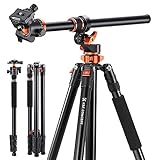
- 1. K&F Concept 76 in Overhead Camera Tripod — Best overall
- 2. K&F CONCEPT 90''/230cm Ultra High Horizontal Overhead — Best premium
- 3. NEEWER 90 Inch Tall Overhead Horizontal Camera Tripod — Most versatile
- 4. NEEWER Basics 64.5" Horizontal Overhead Tripod — Best upgrade
- 5. Nineigh 75" Phone Tripod Stand — Best warranty
- 6. Pozliv Overhead Camera Mount with Ring Light — Best budget pick
- How much height do you really need above a table?
- What the listings do not tell you
- When a different pick wins
- The verdict
- FAQ
The best professional overhead camera tripod in this group is the K&F Concept 76 in Overhead Camera Tripod, because its boom arm detaches and swings the full 0 to 180 degrees while the whole rig still weighs 3.64 lb. If you need to get a camera 90 in up, the K&F CONCEPT 90''/230cm model is the better buy, at 4.45 lb. Neither is a studio-grade cine stand, and that distinction matters more than the height numbers. This set is aluminium travel gear pressed into overhead duty.
Best professional overhead camera tripod at a glance
| Pick | Max height | Boom / overhead method | Price |
|---|---|---|---|
Best overall K&F Concept 76 in Overhead Camera Tripod |
76.7 in | Removable extension arm 0-180°, 360° pan |
Check Price |
| 90 in | Tilting 28mm centre column 0-180°, 360° |
Check Price | |
Most versatile NEEWER 90 Inch Tall Overhead Horizontal Camera Tripod |
90 in | Flexible centre column horizontal, 360° |
Check Price |
Best upgrade NEEWER Basics 64.5" Horizontal Overhead Tripod |
64.5 in | 18.8 in column 180° tilt, 360° rotate |
Check Price |
Best warranty Nineigh 75" Phone Tripod Stand |
75 in | 3-step overhead conversion 3-way pan head |
Check Price |
Best budget pick Pozliv Overhead Camera Mount with Ring Light |
Desk clamp | Scissor boom arm C clamp mount |
Check Price |



Who should skip a best professional overhead camera tripod entirely
Start here, because this is the cheapest decision in the whole process. Plenty of people searching for an overhead rig do not need one.
If every shot you take is on a fixed desk, a clamp beats a tripod. A clamp puts zero legs in your floor space, and floor space is what you run out of first in a small room. The Pozliv mount in this set uses a C clamp and a scissor arm, which is a different product category from the five stands around it.
If you shoot flat-lay stills rather than video, and you can move the subject, a copy stand or a plain tripod with a reversible column often does the job. None of these six is a copy stand.
And if your camera plus lens is heavy glass, look hard at the numbers below. The two 90 in picks quote 22 lb / 10 kg, the K&F 76 in quotes 8 kg. Those are the manufacturers' figures for the head, not measurements of the rig with an arm fully extended sideways. Extend a boom and the effective safe load drops, every time.
Who should buy one:
- Food, craft and product shooters who need the camera directly above a table
- Creators who film the same scene from overhead and from the front
- Anyone shooting in a room where the subject cannot be moved to a desk edge
How I cut the field down to six
Three disqualifications did most of the work.
- No horizontal capability, no entry. Any stand that only goes up and down was cut, however good the leg locks looked. Overhead means the camera has to sit out over the subject, so either a boom arm or a tilting centre column is mandatory.
- No published load figure or no published height, cut. Marketing copy that says "heavy duty" without a number tells you nothing. Four of these six state a maximum height in inches. Three state a load in kilograms.
- Single-purpose phone cradles, cut. A holder that takes nothing but a phone is a phone accessory. I kept the Nineigh 75" only because its listing states two quick-release plates, one for a camera and one for a phone.
What survived is a set of six with a clear internal split: four aluminium column-tilt or boom stands, one phone-first tall stand, one desk clamp arm. Every one of the five stands publishes a one-year manufacturer warranty, which is worth noting mainly because it is the one spec where the whole field ties.
I then ranked on how the overhead position is achieved, how much the rig weighs, and how much the listing actually discloses. Sparse listings got marked down. That is why the NEEWER Basics 64.5" sits fourth despite a sensible design, and why the Pozliv sits last despite being the cheapest of the six.
What actually decides a top-down rig: boom design, not height
Most guides to a professional overhead camera tripod rank by maximum height. Height is the wrong hero. Once a stand clears about 60 in, you have enough reach for a standing-height table, and extra inches only matter for shooting down onto a floor.
What decides it is how the camera gets out over the subject, and there are two answers in this set.
A removable boom arm bolts on and off. The K&F Concept 76 in ships one, and the listing says it swings 0 to 180 degrees, rotates 360 degrees horizontally, and fits any 3/8" tripod interface. That last detail is the quiet advantage. A separate arm can live on a different stand, come off for normal shooting, and be counterweighted at the far end.
A tilting centre column flips the whole column sideways instead. Both 90 in picks and the NEEWER Basics work this way. The column becomes the arm. It is quicker and there is no extra part to lose, but you cannot remove it, and the leg spread has to counterbalance everything hanging off one side.
The practical difference is where the weight sits. A column-tilt rig loads its mass over one leg pair. A boom arm lets you swing the arm between two legs and keep the load closer to centre. K&F says the 90 in model uses an enlarged 28mm centre column specifically to cut shake in the horizontal position, which tells you the brand knows this is where these designs strain.
Judge a best professional overhead camera tripod on the arm, then on the legs, then on the height figure. In that order.
1. K&F Concept 76 in Overhead Camera Tripod — Best overall
A 3.64 lb aluminium stand with a genuinely removable 0-180° boom arm, which is the most useful overhead mechanism in this set.
Best for: table-top and food shooters who want a removable boom arm Skip it if: you need more than 76 in of vertical reach
The specification that matters here is the arm. K&F says it moves from 0 to 180 degrees, rotates 360 degrees horizontally for panoramas, and mounts on any 3/8" tripod interface. Nothing else in this group offers a boom you can unbolt and reuse. That single design choice turns one purchase into a stand plus an accessory.
The rest reads well against the field. Height range is 17.3 in to 76.7 in across four leg sections, folding down to 15 in by the listing's own account. Load is quoted at 8 kg, and the whole thing weighs 3.64 lb, which is the second-lightest of the five full stands. The head is a 28mm metal ball head with a 1/4" screw, and K&F says it works with most Arca-Swiss quick release plates.
Leg locks are flip levers rather than twist collars, one-handed by design. That suits overhead work, where you are usually adjusting height with a camera already mounted.
The trade-off against the two 90 in picks is plain: 14 in less reach and a lower quoted load. Against the entry picks, it costs more. It sits mid-range for this set and asks you to pay for the arm.
Pros:
- Removable boom arm, 0-180° and 360° pan
- Arm fits any 3/8" tripod interface
- 3.64 lb, second-lightest full stand here
- Folds to 15 in for travel
- One-handed flip leg locks
Cons:
- 76.7 in maximum, 14 in shorter than both 90 in picks
- 8 kg quoted load is the lowest of the three stands that state one
- Only one seller lists it
- Boom arm adds a part you can misplace
2. K&F CONCEPT 90''/230cm Ultra High Horizontal Overhead — Best premium
The tallest and most heavily specified pick here, with a 28mm centre column built to resist sag in the horizontal position.

Best for: shooters who need 90 in of height plus a detachable monopod Skip it if: you carry your kit on foot all day
At 90 in / 2.3 m maximum height, this reaches higher than four of the five other picks and ties the NEEWER 90 in. Height that far up matters for one specific job: shooting straight down onto the floor, or over a large set from above. Below that, it is headroom you rarely use.
The interesting figure is not the height. K&F states an enlarged 28mm diameter centre column, chosen to cut camera shake specifically when the column is positioned horizontally. That is the failure mode of every column-tilt overhead rig, and it is the only listing in this set that names it as a design target. The 28mm ball head is rated at 22 lb / 10 kg, tied for the highest quoted load here, and the legs adjust across 0-180° tilt with full 360° panoramic rotation.
One leg detaches as a monopod, which helps in tight interiors. Model is KF09.119, and the warranty is one year.
It is the most expensive pick here and the heaviest at 4.45 lb. That is the honest cost of 90 in and a fat column. The extra weight is also stability, so treat it as a studio-leaning choice rather than a hiking one.
Pros:
- 90 in / 2.3 m maximum height, joint tallest here
- 22 lb / 10 kg quoted load, joint highest
- 28mm column specified to reduce horizontal shake
- Detachable monopod leg for tight spaces
- Full 360° panoramic rotation, 0-180° tilt
Cons:
- 4.45 lb, the heaviest pick in this set
- Most expensive pick here
- Centre column tilts but cannot be removed as an arm
- Only one seller lists it
- No release year published
3. NEEWER 90 Inch Tall Overhead Horizontal Camera Tripod — Most versatile
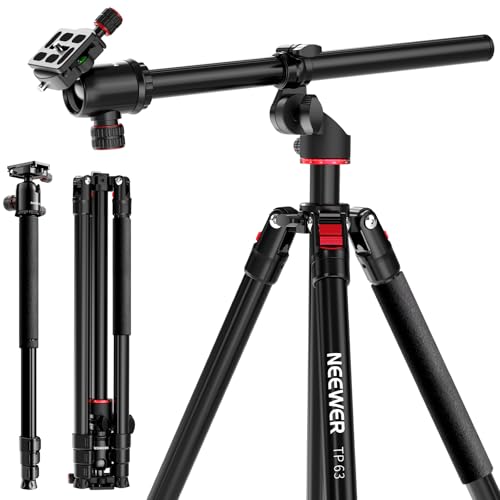
Three tools in one body: a 90 in tripod, a horizontal overhead rig and a monopod built from one of its own legs.
Best for: one-bag creators switching between tripod, monopod and overhead Skip it if: you want the widest quoted load figure for the least money
This is the 2025 TP63, and it packs the most modes of any pick here. NEEWER says the centre column raises for high angles and swings to horizontal for 360° overhead work, that three leg angles are available, and that one leg tube unscrews and joins the head to become a monopod. Legs invert for low shots.
The numbers: 90 in maximum height, 4.1 lb, folded dimensions of 7.48 x 29.1 x 7.48 in, and a stated 10 kg / 22 lb load. The head is a 360° ball with an Arca-type quick release plate, tilting from +90° to -90° on locking knobs, with a scaled pan base for repeatable framing. Body is heavy-duty metal alloy by NEEWER's description, and the listing names camcorders, telescopes and sliders alongside DSLRs.
That folded length of 29.1 in is the figure to watch. It is longer than the K&F 76 in packs down to, so this rides on the outside of a bag rather than inside it.
Against the K&F 90 in it matches height and load while weighing 0.35 lb less, but its column is described as flexible rather than dimensioned, so you get no anti-sag figure to compare. It also sits in the top price bracket here.
Pros:
- 90 in height with 10 kg / 22 lb quoted load
- One leg converts to a monopod
- Arca-type QR plate, +90° to -90° tilt
- Inverted legs and three leg angles
- 4.1 lb, lighter than the other 90 in pick
Cons:
- 29.1 in folded, the longest packed size here
- No published column diameter to judge horizontal rigidity
- Premium price position for a metal-alloy travel stand
- Only one seller lists it
4. NEEWER Basics 64.5" Horizontal Overhead Tripod — Best upgrade
A stripped-back 2025 stand with a 18.8 in horizontal column and five leg sections, at 3.45 lb the lightest pick in the set.

Best for: phone-and-DSLR hybrid shooters on a mid budget Skip it if: you need published height and dimension figures before buying
NEEWER is explicit that BASICS is its economy line, focused on essential functions with no extras. That framing is useful, because it tells you what you are trading away.
What you get: a 18.8 in / 47.5 cm centre column that mounts horizontally on a 1/4" ball head, five foldable leg sections extending to 64.5 in, 180° column tilt, 360° rotation on locking knobs, and a quoted 22 lb / 10 kg load. A phone holder attachment is included, so the same rig covers a Canon or Sony body and a handset. Weight is 3.45 lb, the lowest of the five full stands. Aluminium alloy with an anti-rust finish, one-year warranty, model TP66.
That 18.8 in column length is the number to think about. It is a known reach, which is more than the two 90 in picks tell you about their horizontal extension. Short arms sag less.
The catch is disclosure. There is no published maximum height spec beyond the title, no folded dimensions and no colour listed. Five leg sections also mean more joints, and joints are where flex lives. Two sellers stock it, which is one more than most here.
Pros:
- 3.45 lb, lightest full stand in this set
- Stated 18.8 in horizontal column reach
- 22 lb / 10 kg quoted load
- Phone holder plus 1/4" ball head included
- Anti-rust aluminium finish
Cons:
- 64.5 in is the shortest reach of the five stands
- No folded dimensions or size spec published
- Five leg sections add flex points
- Economy line by the maker's own description
5. Nineigh 75" Phone Tripod Stand — Best warranty
A 75 in phone-first stand that converts to overhead in three steps and ships two quick-release plates, one for a phone and one for a camera.
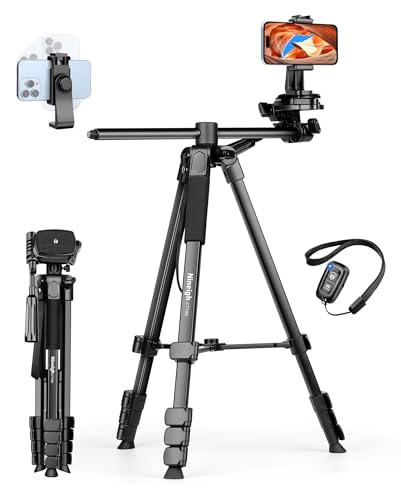
Best for: kitchen and desktop creators shooting mostly on a phone Skip it if: you mount a heavy mirrorless body with a fast zoom
This one earns its place on breadth of coverage rather than rigidity. Nineigh says the overhead conversion takes three steps, and names kitchen shots and desktop recording as the target jobs. Height runs from 18.5 in to 75 in, so it stretches taller than the NEEWER Basics and only 1.7 in short of the K&F 76 in.
The head is a 3-way pan design rather than a ball, which suits video: vertical, panoramic and up-down moves each get their own axis, so you can pan without the frame rolling. Two quick-release plates come in the box for switching between phone and camera, and a remote is included with the phone holder. Construction is aluminium alloy and plastic, with non-slip rubber feet. Model CT190, one-year warranty.
It is the second-cheapest pick here, which explains what is missing. No load capacity is published anywhere in the listing, and no weight either. For a stand that will hold something out over your countertop, an unstated load figure is the single biggest gap in this whole set. Plastic in the build is named by the maker, not inferred.
Treat it as a phone rig that tolerates a light camera, not the reverse.
Pros:
- 75 in maximum, 18.5 in minimum height
- Two quick-release plates for phone and camera
- 3-way pan head for controlled video moves
- Remote included with the phone holder
- Second-cheapest pick in this set
Cons:
- No published load capacity at all
- No published weight or folded size
- Aluminium and plastic build by the maker's description
- Only one seller lists it
6. Pozliv Overhead Camera Mount with Ring Light — Best budget pick
A desk clamp with a scissor boom arm and a 6 in ring light, and the one pick here that uses no floor space at all.
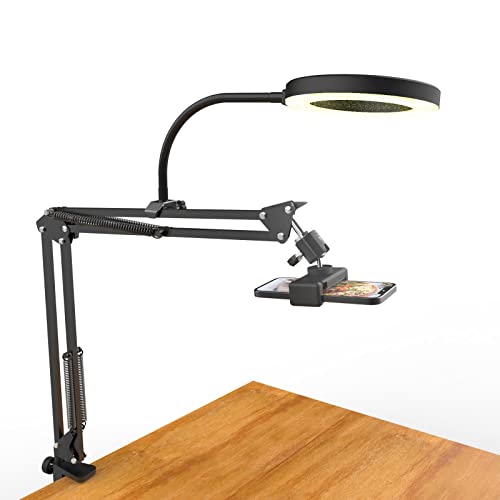
Best for: desk-bound nail, craft and webcam recording Skip it if: you ever need to shoot standing, or away from a desk edge
This is not a tripod and I am not going to pretend it is. It is the cheapest pick here, it is the one buyers choose most often across this set, and two sellers list it. It belongs in the roundup because for a fixed desk it solves the overhead problem more directly than any stand.
The kit, per Pozliv, is a scissor boom arm, a ball head, a C clamp, a phone clip holder and an extra flexible clamp arm. The 6 in ring light has three lighting modes with ten brightness levels each, and a 360° swivel ball head. Both the tripod head and the clip arm head use universal 1/4" threads, and the listing names iPhone plus Logitech Brio 4K, C930e, C920, C920s, C922, C922x and C615 webcams.
Light plus mount in one purchase is the real argument. Overhead work is nearly always underlit, because your own head blocks the room light, and none of the five stands includes any lighting.
The limits are hard ones. Pozliv describes support for phones, the ring light, compact cameras and action cameras, so a full DSLR is outside its brief. No load figure, no weight, no warranty and no dimensions are published, and it is filed under selfie lights rather than tripods for a reason.
Pros:
- Cheapest pick in this set
- Includes a 6 in ring light, 3 modes, 10 levels
- C clamp uses zero floor space
- Universal 1/4" threads on both heads
- Named webcam compatibility list
Cons:
- Not a stand, needs a desk edge to clamp to
- No published load, weight or warranty
- Rated for phones and compact cameras only
- Cannot reach standing height or floor-level shots
How much height do you really need above a table?
Work backwards from the surface, not from the spec sheet.
A standard kitchen counter sits around 36 in. A dining table sits lower, near 30 in. Add the distance you need between lens and subject to frame a plate or a work area, and most food and craft setups land somewhere in the 55 in to 70 in range for the camera.
That is why 64.5 in on the NEEWER Basics is not the handicap it looks like on paper, and why 90 in is only decisive for two jobs: shooting down onto the floor, and shooting over a tall set or a group.
Then subtract for the arm. On a column-tilt design, swinging the column horizontal costs you the column's own length in height. The NEEWER Basics publishes that as 18.8 in, so the effective overhead height is meaningfully below the 64.5 in headline. On the K&F 76 in the boom arm mounts separately, so the geometry is different again.
Rough guide:
- Desk or countertop, seated work: a clamp arm is enough
- Standing counter, phone or compact camera: 64 in to 76 in
- Standing counter, DSLR plus lens: 76 in and a stated load figure
- Floor-level flat lays, full-set overheads: 90 in
What the listings do not tell you
Read a professional overhead camera tripod listing carefully and you notice what is absent. Four gaps repeat across this set.
Horizontal load is never stated. Every load figure here is a head rating. NEEWER quotes 22 lb / 10 kg, K&F quotes 22 lb on the 90 in and 8 kg on the 76 in. None of them says what the rig safely holds with the arm fully out to one side, which is the only number an overhead shooter actually needs.
Counterweight provision is not mentioned. No listing in this group describes a hook, a weight bag or a ballast point. If you hang a camera off one side, you sort the balance yourself with a sandbag on the opposite legs.
Materials are described loosely. "Heavy duty metal alloy" and "aluminium alloy" appear, and Nineigh names plastic in the build. Tube wall thickness never appears anywhere.
Head type and load are not matched. A 28mm ball head is quoted at 10 kg on the K&F 90 in, which is a genuine number for the head. The legs holding it are a separate question and the legs are never rated.
Two of the six publish no weight at all. That is a real disclosure gap, and it is why the Nineigh and the Pozliv sit at the bottom of this ranking rather than at the top of the value end.
When a different pick wins
The winner is not the winner for everybody. These are the flips, with thresholds you can check before you buy.
- Your subject is on the floor, or the set is large. Go to the K&F CONCEPT 90''/230cm. The threshold is 76 in: past that, the two 90 in picks are your only options, and the K&F's 28mm column is the one specified for horizontal rigidity.
- You need one stand for three jobs and you travel. Go to the NEEWER 90 Inch. Tripod, monopod and overhead in 4.1 lb, provided you can live with 29.1 in folded.
- Weight on your back is the binding constraint. Go to the NEEWER Basics 64.5". At 3.45 lb it is the lightest full stand here, and its 18.8 in column is the only horizontal reach that is actually published.
- You shoot phone video 90% of the time. Go to the Nineigh 75". A 3-way pan head and two quick-release plates cover phone-first work better than a ball head does.
- The camera never leaves your desk. Go to the Pozliv. A C clamp and a 6 in ring light beat any stand for a fixed workstation, at the lowest price in this set.
One note on the "professional" part of the search. Nothing in this group is a steel cine stand or a rated overhead rigging system, so if your work involves a heavy cinema body suspended above people, this whole set is the wrong shelf. Judge these six as capable aluminium travel stands with genuine horizontal capability, and they hold up well.
The verdict
If you shoot table-top work with a camera under about 8 kg, buy the K&F Concept 76 in Overhead Camera Tripod. The removable extension arm is the reason. It swings 0 to 180 degrees, rotates 360 degrees, fits any 3/8" interface, and comes off entirely when you want a plain 76.7 in stand. That flexibility is worth more day to day than the 14 in of extra height you give up, and 3.64 lb keeps it portable.
If you shoot down onto floors or over large sets, buy the K&F CONCEPT 90''/230cm. Its advantage is precise: 90 in of reach, a 22 lb / 10 kg quoted load, and an enlarged 28mm centre column that K&F states was sized to cut shake when the column sits horizontal. No other listing in this set names horizontal rigidity as a design goal.
The cutoff is 76 in of vertical reach. Below it, the 76 in K&F and its detachable boom win on flexibility and weight. Above it, only the two 90 in picks qualify, and between those the K&F trades 0.35 lb of extra mass for a dimensioned column while the NEEWER TP63 trades that rigidity spec for a monopod leg and a shorter list of compromises on paper.
Everything else here is a specialist. The NEEWER Basics for lightness, the Nineigh for phone-led kitchen video, the Pozliv for a desk that never changes.
FAQ
Is a professional overhead camera tripod worth it over a clamp arm?
A professional overhead camera tripod is worth it the moment your subject stops being a desk. A clamp needs an edge to grip and keeps the camera within about arm's reach of that edge. A stand goes anywhere in the room, reaches 64.5 in to 90 in in this set, and handles a DSLR. If you only ever film one workstation, the clamp is smarter.
What is the real deciding spec for a top-down camera stand?
The real deciding spec is how the camera gets out over the subject. A removable boom arm, like the one on the K&F Concept 76 in, unbolts and works on other stands. A tilting centre column, used by both 90 in picks and the NEEWER Basics, is faster but permanent and loads all the weight over one leg pair. Check the arm before the height.
K&F Concept 76 in or K&F CONCEPT 90''/230cm: which should I pick?
Choose between these two on reach. The 76 in model gives you 76.7 in, an 8 kg quoted load, a detachable 0-180° boom arm, and 3.64 lb of carrying weight. The 90 in model gives you 90 in, a 22 lb / 10 kg load and a 28mm column built for horizontal stability, at 4.45 lb. Table work favours the 76 in.
Will these tripods hold a DSLR with a heavy lens?
Whether these tripods hold a DSLR depends on the published figure. Three state a load: 8 kg for the K&F 76 in, and 22 lb / 10 kg for the K&F 90 in and both NEEWER models. The Nineigh and Pozliv publish none. Remember every figure is a head rating, so extending an arm sideways reduces what the rig safely carries.
What mistake do first-time overhead buyers make most often?
The mistake buyers make most often is ignoring the counterweight. Hang a camera off one side of a tilted column and the whole rig wants to tip that way. None of these six listings mentions a ballast hook or weight bag, so plan on a sandbag across the opposite legs. Second mistake: buying for maximum height instead of arm rigidity.
Start by measuring the surface you shoot on and the frame you want, then pick from the height bands above rather than from the headline inch counts. For most food, craft and product work on a table, the K&F Concept 76 in Overhead Camera Tripod is the sensible default, and the reason is boring in the best way: the arm comes off. That one detail means the stand still earns its space in your bag on days when nothing needs shooting from above, which is more days than you think. Add a sandbag on day one.