Best Professional Budget Action Camera for 4K Work

Seven action cameras compared on published sensor, stabilization and depth figures, with a named winner, three conditions that flip the pick, and an honest look at what 4K on a spec sheet actually buys you.

By Sam BaileyUpdated 19 min read
On this page
- Best professional budget action camera at a glance
- How I cut this field down to seven
- Does 4K on the box mean professional footage?
- 1. AKASO Brave 4 Action Camera 4K30 Ultra Hd Waterproof — Best overall
- 2. AKASO EK7000 4K30FPS 20MP WiFi Action Camera with EIS — Best upgrade
- 3. DJI Osmo Action 4 Essential Combo — Most versatile
- 4. DJI Osmo Action 6 Enhanced Combo — Best premium
- 5. Aidzhi 4K Waterproof Mini Action Camera — Best for pros
- 6. Hiicam 4K Action Camera 20MP Touch Screen WiFi EIS 131FT — Best minimal setup
- 7. Hiicam 4K Action Camera with 64GB Card 30MP EIS WiFi 131FT — Best budget pick
- Sensor size is the line, and 4K is not
- What more money actually buys here
- Which spec should decide your best professional budget action camera?
- What these listings never tell you
- The verdict
- FAQ
The best professional budget action camera in this set is the AKASO Brave 4, a 5.61 oz body rated to 131 ft in its housing with two 1050mAh batteries included and a 1-year manufacturer warranty. If your footage has to survive a color grade, the DJI Osmo Action 4 Essential Combo is the better buy, because its listing claims 10-bit capture and D-Log M. The deciding specification here is sensor size, not resolution. Every camera below records 4K. Only two publish a sensor figure.
Best professional budget action camera at a glance
| Pick | Top video claim | Waterproof depth | Price |
|---|---|---|---|
Best overall AKASO Brave 4 |
4K30, 20MP | 131 ft, with case | Check Price |
Best upgrade AKASO EK7000 |
4K30, 20MP, EIS | 131 ft, with case | Check Price |
Most versatile DJI Osmo Action 4 Essential Combo |
4K120 claim, 10-bit | Not stated in listing | Check Price |
Best premium DJI Osmo Action 6 Enhanced Combo |
8K claim, f/2.0-f/4.0 | Not stated in listing | Check Price |
Best for pros Aidzhi 4K Mini Action Camera |
4K30, EIS 2.0 claim | 33 ft, no case needed | Check Price |
Best minimal setup Hiicam Speed 20 |
4K30, 20MP | 131 ft, with case | Check Price |
Best budget pick Hiicam Speed 10 |
4K60 claim, 20MP | 131 ft, with case | Check Price |





How I cut this field down to seven
Three things got listings cut before I compared anything else.
First, no published waterproof figure and no published sensor figure. A camera that tells you neither has nothing you can check. Second, resolution claims with no stabilization claim attached. 4K from a shaking mount is unusable footage, and the listing that omits stabilization usually omits it for a reason. Third, no warranty statement of any kind.
What survived splits cleanly into three groups.
- Housing-based waterproofing at 131 ft. The Brave 4, the EK7000 and both Hiicam models all reach that depth inside an included case.
- Sensor-first cameras. The two DJI models are the only ones in this set that publish a sensor dimension, 1/1.3-inch and 1/1.1-inch.
- Wearables. The Aidzhi GO9 is the only pick rated IPX8 to 33 ft without an external case.
That grouping matters more than the ranking. If your work is underwater, group one is your whole shortlist. If it's client delivery, group two is. I lined up the published weight, depth and warranty figures side by side, and the pattern held: the cameras that publish the most are the cameras you can plan around.
Does 4K on the box mean professional footage?
Every camera here records 4K on the box. That tells you almost nothing.
4K is a pixel count, not an image quality standard. Resolution describes how many pixels the file contains. It says nothing about how much light each pixel collected, and light is what separates footage a client accepts from footage they send back. Two cameras can both write a 3840-pixel-wide file while one of them produces a clean image at dusk and the other produces mush.
Here's the trick with this category. The number that actually predicts image quality is the sensor. DJI's Osmo Action 4 listing states a 1/1.3-inch sensor with 2.4μm pixels. The Osmo Action 6 listing states a 1/1.1-inch square sensor. No other pick in this set publishes a sensor figure at all.
That's why the word "professional" in this search is only partly answered by what Amazon returned. Sensor size, 10-bit capture and a log profile are the specifications a professional workflow actually needs, and only two of these seven publish any of them. The rest are capable cameras, but claiming they meet a professional standard would mean inventing figures their listings don't carry.
Skip the resolution war. Check what the listing says about the sensor, the bit depth, and the stabilization system by name.
1. AKASO Brave 4 Action Camera 4K30 Ultra Hd Waterproof — Best overall
The Brave 4 is the most complete package in this set, because it publishes weight, dimensions, depth and a real warranty, then adds two batteries.
Best for: someone shooting water and trail footage who wants two batteries in the box Skip it if: you need 10-bit color for a client edit
What separates the Brave 4 from the rest of the housing-based group is disclosure. The listing publishes a 5.61 oz weight, a 1.57 x 0.91 x 2.32 in body, and a 1-year manufacturer warranty. Two of the other four housing cameras publish six months, and one publishes a warranty field that reads as placeholder text. When a camera is going on a chest mount for a season, knowing who stands behind it for twelve months is worth more than a frame rate bump.
AKASO says the camera shoots 4K at 30fps and 20MP stills, with four selectable fields of view at 170°, 140°, 110° and 70°. That last figure is the useful one. A 70° setting is narrow enough to shoot a talking head without the barrel distortion that makes cheap action footage look cheap. The listing also claims 131 ft of depth inside the case and two 1050mAh batteries rated at roughly 90 minutes each, plus a dual charger.
The trade-off is honest. This is the second-cheapest pick here, and it buys you no published sensor figure and no bit-depth claim. Against the DJI pair, it loses on grading headroom.
Pros:
- 1-year manufacturer warranty, longest in the housing group
- Two 1050mAh batteries and dual charger included
- Four selectable angles down to a low-distortion 70°
- 131 ft rated depth with the case fitted
- Second-cheapest pick in this set
Cons:
- No published sensor size or bit depth
- Capped at 30fps in 4K per the listing
- Needs the external case for water, unlike the Aidzhi
- Only one seller lists it
2. AKASO EK7000 4K30FPS 20MP WiFi Action Camera with EIS — Best upgrade
At a published 1.76 oz, the EK7000 is by far the lightest camera here, which changes what you can mount it to.

Best for: helmet and handlebar mounting where every ounce counts Skip it if: you want a clear warranty commitment in writing
The weight figure is the story. The listing publishes 1.76 oz and a 0.95 x 2.3 x 1.6 in body, which makes it lighter on paper than every other pick, including the 5.11 oz Osmo Action 4. On a helmet mount, that difference is the one you feel after two hours. The count field lists 31, which points to a bundle of mounts and straps rather than a single bare camera, and that matters if you're building a rig from scratch.
AKASO claims 4K30 and 2.7K30 video with 20MP stills, built-in electronic image stabilization, 4x zoom, and support for an external microphone. That external mic support is rarer than it sounds in this group. It's also the fastest seller of the seven, so parts and mounts are easy to source. The listing claims a 2.4G wrist remote and Wi-Fi with roughly 10 meters of range.
Two things hold it back. The published warranty field is unusable, reading as placeholder characters rather than a term, so you're buying without a stated period. And the model dates to 2019, the oldest release year given here.
Pros:
- Lightest published weight in this set at 1.76 oz
- External microphone support, uncommon in this group
- Bundle count of 31 suggests a full mount kit
- 131 ft rated depth with the included case
- Sells faster than the rest of this set
Cons:
- Warranty field is unreadable, no stated term
- 2019 release, the oldest here
- No published sensor size
- Blue-only colour in this listing
3. DJI Osmo Action 4 Essential Combo — Most versatile
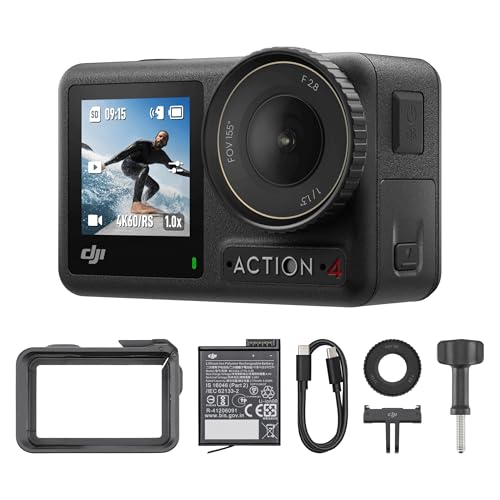
This is the pick to buy if your footage gets graded, because it's one of only two here that publish a sensor figure and a bit depth.
Best for: paid work that has to survive color grading Skip it if: spending the most in this set is off the table
DJI publishes a 1/1.3-inch sensor with a 2.4μm pixel size, and that single figure explains why this camera sits where it does. Larger pixels collect more light, and low-light footage is where budget action cameras fall apart first. The listing also claims 10-bit color depth and a D-Log M profile, which is the specification that separates a file you can push in post from a file that falls apart the moment you touch the curves.
The rest of the published data is unusually complete for this set: 5.11 oz, a 1.3 x 2.8 x 1.73 in body, black, released in 2024, with DJI warranty support named. DJI claims 4K at 120fps with a 155° field of view, a 1770mAh battery rated to 150 minutes, operation down to -20°C, and a magnetic quick-release that swaps to vertical in seconds. For vertical social delivery alongside horizontal client cuts, that mount system is the practical win.
The costs are real. This is the second-most expensive pick here, the listing states no waterproof depth figure, and "Essential Combo" means a lighter accessory bundle than DJI's larger kits.
Pros:
- Publishes a 1/1.3-inch sensor with 2.4μm pixels
- 10-bit and D-Log M claimed for grading headroom
- 1770mAh battery claimed at 150 minutes
- Cold operation claimed to -20°C
- Lightest of the two DJI picks at 5.11 oz
Cons:
- No waterproof depth figure in the listing
- Second-most expensive pick in this set
- Essential Combo carries fewer accessories than larger kits
- Warranty listed only as the brand name, with no term
4. DJI Osmo Action 6 Enhanced Combo — Best premium
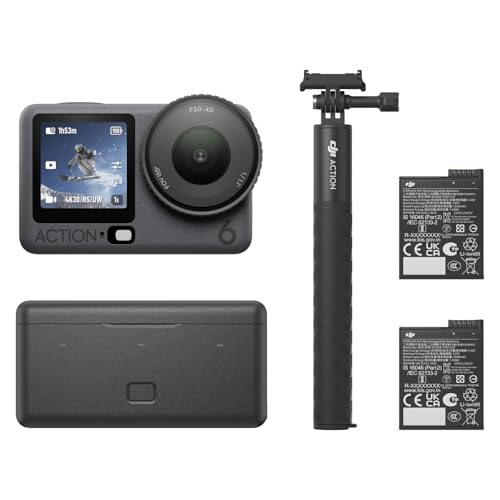
The 1/1.1-inch square sensor and a variable f/2.0 to f/4.0 aperture make this the only pick here with a published aperture range at all.
Best for: shooters who crop and reframe in post Skip it if: your delivery ceiling is 1080p
DJI states a 1/1.1-inch square sensor, the largest published in this comparison, and a variable aperture from f/2.0 to f/4.0. Nobody else here publishes an aperture figure. A variable aperture means the camera can stop down in bright sun instead of relying purely on shutter speed, which is the difference between usable midday footage and a video that looks over-sharpened.
A square sensor is the other thing worth understanding. It captures a taller frame than a standard 16:9 sensor, so a vertical crop pulls from real pixels rather than upscaling. DJI claims 8K video, 360° HorizonSteady stabilization, up to 4 hours of shooting in normal conditions, and gesture plus voice control. The published body is 5.26 oz at 1.3 x 2.87 x 1.86 in, making it the heaviest and the longest of the picks with published dimensions.
This is the most expensive pick here, and the honest question is whether you'll use it. If your final output is 1080p, an 8K claim buys you cropping room and nothing else. The listing also states no waterproof depth, same gap as the Action 4.
Pros:
- Largest published sensor here at 1/1.1 inches
- Only pick publishing an aperture range, f/2.0 to f/4.0
- Up to 4 hours of shooting claimed
- Square sensor supports vertical crops without upscaling
- Gesture and voice control claimed
Cons:
- Most expensive pick in this set
- Heaviest published weight at 5.26 oz
- No waterproof depth figure in the listing
- 8K is wasted output if you deliver 1080p
5. Aidzhi 4K Waterproof Mini Action Camera — Best for pros
The only pick here rated waterproof without a case, at IPX8 to 33 ft, with 64GB of storage built into the body.

Best for: hands-free point-of-view work in tight spaces Skip it if: you dive deeper than 33 ft
Every other waterproof pick in this set needs a plastic case bolted around it. The Aidzhi GO9 doesn't. Its listing claims IPX8 protection to 33 ft with no additional housing, and that changes how you work. No case means no fogging, no muffled audio, and no fiddling with latches in the rain. It also means the camera stays thumb-sized, which is the point of the design.
Aidzhi claims a magnetic wearable body with an included magnetic lanyard, 64GB of built-in storage, up to 350 minutes of battery life, EIS 2.0 stabilization, and 4K30 recording with automatic audio. Built-in storage is worth flagging: no card to buy, no card to lose, no card slot to flood. The published warranty is 1 year manufacturer, matching the Brave 4 and beating both Hiicam models.
The limits are equally clear. 33 ft is well short of the 131 ft the housing cameras reach, so snorkelling is fine and diving is not. This is the third-most expensive pick here, the listing publishes no weight or dimensions, and 64GB of fixed storage means you offload before you fill it rather than swapping in a fresh card.
Pros:
- IPX8 to 33 ft with no external case required
- 64GB built-in storage, no card needed
- Up to 350 minutes of battery life claimed
- Magnetic lanyard mount for hands-free wear
- 1-year manufacturer warranty published
Cons:
- 33 ft depth, a quarter of the housing picks' rating
- No published weight or dimensions
- Fixed storage cannot be swapped mid-shoot
- Third-most expensive pick in this set
6. Hiicam 4K Action Camera 20MP Touch Screen WiFi EIS 131FT — Best minimal setup
A touchscreen 4K camera rated to 131 ft, and the pick with the thinnest published specification sheet of the seven.
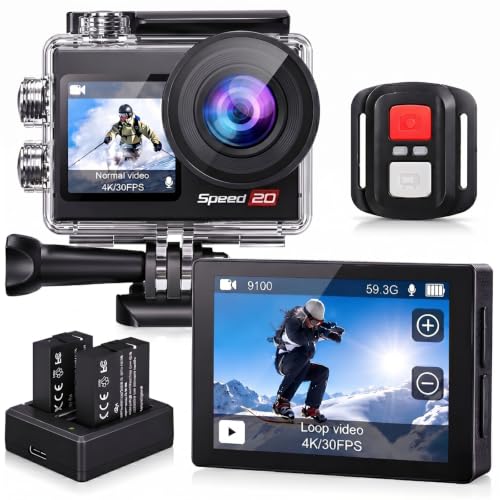
Best for: a simple touchscreen camera for occasional trips Skip it if: you compare published specifications before buying
The case for the Speed 20 is simplicity. Hiicam claims 4K30 video with 20MP stills, EIS, Wi-Fi, and a touch screen, and the title states 131 ft waterproof capability. For a reader who wants to point a camera at a kayak trip twice a summer and not think about it, that combination does the job. Touch operation matters more than people expect, because menu diving on a four-button action camera in cold weather is genuinely unpleasant.
Where it falls short is everything the other listings tell you and this one doesn't. There is no published weight, no dimensions, and one feature bullet in total. Compare that to the Brave 4, which publishes weight, dimensions, warranty and model together. The published warranty here is 6 months, half what the Brave 4 and the Aidzhi state.
It's the fourth-cheapest pick and it sits in the middle of this set on price, which is the problem. It costs more than the Brave 4 while publishing less. Only one seller lists it, and it's the second-slowest seller of the seven, so accessory availability is a fair concern.
Pros:
- Touch screen operation, easier than button menus
- 131 ft waterproof rating stated
- 4K30 and 20MP claimed by Hiicam
- Roughly mid-range for this set on price
Cons:
- Only one feature claim published in the listing
- No published weight or dimensions
- 6-month warranty, shortest here alongside the Speed 10
- Costs more than the Brave 4 with fewer published specs
7. Hiicam 4K Action Camera with 64GB Card 30MP EIS WiFi 131FT — Best budget pick
The cheapest of the seven, and the only entry-priced pick claiming 4K at 60fps with dual screens and a card in the box.

Best for: a first action camera with storage included Skip it if: you need long-term support behind the purchase
This is the cheapest pick here, and the claim sheet is unusually full for that position. Hiicam states 4K at 60fps, 20MP stills, EIS, and a dual-screen layout with a 2-inch rear IPS touch panel and a 1.4-inch front display. Doubling the frame rate over the 4K30 cameras is the headline, because 60fps gives you a clean half-speed slow motion that 30fps simply cannot produce. The front screen is the vlogging feature the Brave 4 and EK7000 lack in the same form.
The published body is 1.61 x 2.2 x 0.95 in in Velocity Black, with 131 ft depth claimed inside the included housing, a 64GB card supplied, and remote plus expandable storage support. For a first camera where you don't yet know whether you'll shoot ten hours or a hundred, having the card in the box removes a decision.
The compromises are structural. The published warranty is 6 months, the shortest term stated in this set, and there's no published weight or sensor figure. It's also the slowest seller of the seven by a wide margin, which usually means thinner third-party mount support.
Pros:
- Cheapest pick in this set
- 4K60 claimed, double the frame rate of most picks here
- Dual screens with a 2-inch touch panel
- 64GB card included, no extra purchase
- 131 ft rated depth with the housing
Cons:
- 6-month warranty, shortest stated here
- Slowest seller of the seven
- No published weight or sensor size
- Only one seller lists it
Sensor size is the line, and 4K is not
Two cameras here publish a sensor dimension. Five don't. That single split is more predictive than any resolution number on any of these boxes.
A sensor is the chip that converts light into an image. Bigger sensor, more light per pixel, cleaner footage when the sun goes behind a cloud. The Osmo Action 4 lists 1/1.3 inches with 2.4μm pixels. The Osmo Action 6 lists 1/1.1 inches. Those are the only hard image-quality figures published across all seven listings.
Bit depth is the second line. 10-bit capture, which only the Osmo Action 4 listing claims, stores far more tonal steps than 8-bit. Push the shadows on 8-bit footage and you get banding in the sky. That's the failure mode that gets footage rejected.
Here's how I'd apply it:
- Delivering to a client who grades: you need the published sensor and bit-depth figures, which means one of the two DJI picks.
- Delivering raw clips with no grade: the sensor gap matters less, and the Brave 4's warranty and dual batteries matter more.
- Shooting underwater below 33 ft: depth beats sensor, and you're in the 131 ft housing group.
The word "professional" is doing a lot of work in this search, and only two of these seven listings publish the specifications that back it up.
What more money actually buys here
Across the seven picks, the price ladder buys three things, in a clear order.
At the bottom, the two cheapest picks buy you inclusion. The Speed 10, the cheapest here, ships with a 64GB card and a housing rated to 131 ft. The Brave 4, second-cheapest, ships with two 1050mAh batteries, a dual charger and a 1-year warranty. Neither publishes a sensor figure. What you're paying for is a working kit, not image quality.
In the middle, you buy convenience. The Speed 20 adds a touch screen. The Aidzhi GO9 adds IPX8 waterproofing without a case and 64GB of internal storage. Notice what's missing at this tier: still no sensor figure, still no bit-depth claim. Spending more here does not improve the image on paper, it improves how the camera handles.
At the top, you finally buy sensor and codec. The Osmo Action 4 adds a 1/1.3-inch sensor and 10-bit D-Log M. The Osmo Action 6 adds a 1/1.1-inch square sensor and a variable f/2.0-f/4.0 aperture. This is the only tier in this set where the published image specifications improve at all.
The uncomfortable part: the jump from the cheapest pick to the mid-priced pick buys you handling, not pictures. If image quality is your reason for upgrading, the middle of this ladder is where money goes quietest.
Which spec should decide your best professional budget action camera?
Pick the one spec your work depends on, then let it choose the camera. Most shoppers do this backwards, choosing a camera and then hoping the specs fit.
- Depth. If you're going below 33 ft, only the four 131 ft housing picks qualify: Brave 4, EK7000, Speed 20, Speed 10.
- Grading headroom. If a colorist touches the file, the Osmo Action 4's 10-bit and D-Log M claim is the only published answer here.
- Weight on a mount. The EK7000's published 1.76 oz is the lightest figure in this set, well under the 5.11 oz Osmo Action 4.
- Warranty length. 1 year on the Brave 4 and the Aidzhi GO9, 6 months on both Hiicam models, unstated on the EK7000 and on both DJI picks beyond the brand name.
- Frame rate for slow motion. The Speed 10 claims 4K60 and the Osmo Action 4 claims 4K120. Everything else here claims 4K30.
- Nothing to fit or fasten. Only the Aidzhi GO9 claims water resistance with no case at all.
Run down that list once and your best professional budget action camera decision usually resolves in under a minute. The list is ordered deliberately: depth and grading are the two constraints that eliminate cameras outright, and the rest are preferences.
What these listings never tell you
Three gaps run through this whole set, and they're worth knowing before you buy.
Sensor silence. Five of seven listings publish no sensor figure. That isn't an oversight. When a manufacturer has a sensor worth naming, they name it in the first bullet, which is exactly what DJI does twice here.
Stabilization by initials. Four listings claim EIS or EIS 2.0. Electronic image stabilization crops into the frame and shifts it digitally to cancel shake, which costs field of view and works less well in low light. It is not the same thing as the 360° HorizonSteady the Osmo Action 6 listing claims by name. "EIS" tells you a system exists, not how much it recovers.
Battery figures without conditions. The Brave 4 lists 90 minutes per battery, the Osmo Action 4 lists 150 minutes, the Osmo Action 6 lists up to 4 hours, and the Aidzhi lists up to 350 minutes. None of those figures carries a stated resolution or frame rate in the listing. Runtime at 1080p30 and runtime at 4K60 are not comparable numbers, so treat all of them as ceilings.
One more: waterproof depth appears in four titles and in neither DJI listing. Both DJI cameras are marketed as waterproof action cameras, but the depth figure isn't in the data supplied, so I'm not going to put a number on it.
The verdict
The AKASO Brave 4 is the pick I'd start with. It publishes more of what you need to plan around than anything else at its price position: 5.61 oz, a 1.57 x 0.91 x 2.32 in body, 131 ft rated depth with the case, a 1-year manufacturer warranty, and two 1050mAh batteries with a dual charger already in the box. Four selectable angles down to 70° give you a usable talking-head framing that most action cameras can't produce without distortion.
Two conditions flip it. First, if your footage gets color graded before delivery, buy the DJI Osmo Action 4 Essential Combo instead. Its exact advantage is published and specific: a 1/1.3-inch sensor with 2.4μm pixels, plus a 10-bit D-Log M claim. Those are the figures a grade depends on, and the Brave 4 publishes neither. Second, if you're shooting hands-free in the rain and never going deeper than snorkelling, the Aidzhi GO9's IPX8 rating to 33 ft with no external case, plus 64GB of internal storage, removes the housing from your workflow entirely.
Everything else is preference. The EK7000 wins on published weight at 1.76 oz. The Speed 10 wins on price and claims 4K60. The Osmo Action 6 publishes the largest sensor here at 1/1.1 inches. But the Brave 4 asks the fewest questions of a buyer who wants to shoot this weekend.
FAQ
Is a professional budget action camera actually worth buying?
A professional budget action camera is worth buying when the specification you need is published. The Brave 4 states 131 ft depth, 5.61 oz and a 1-year warranty. That's checkable. What isn't worth buying is a listing that claims 4K and publishes nothing else, because resolution alone tells you nothing about how the image holds up.
What does more money buy in this best professional budget action camera lineup?
More money buys sensor and codec, and nothing else reliably. At the cheapest positions you get included cards, batteries and housings. In the middle you get touch screens and case-free waterproofing. Only at the top do published image specifications improve, with the Osmo Action 4's 1/1.3-inch sensor and 10-bit claim, and the Osmo Action 6's 1/1.1-inch sensor.
Which waterproof depth do I need for snorkelling versus diving?
Waterproof depth you need depends entirely on whether you descend. Snorkelling stays within a few feet of the surface, so the Aidzhi GO9's IPX8 rating to 33 ft is ample and needs no case. Diving requires the housing group: the Brave 4, EK7000, Hiicam Speed 20 and Speed 10 all state 131 ft with their included cases fitted.
AKASO Brave 4 or DJI Osmo Action 4: which should I buy?
Choose between the Brave 4 and the Osmo Action 4 on what happens after the shoot. The Brave 4 gives you two 1050mAh batteries, a 1-year warranty and 131 ft depth for far less money. The Osmo Action 4 gives you a published 1/1.3-inch sensor and a 10-bit D-Log M claim, which is what a color grade needs.
What mistake do first-time action camera buyers make?
The mistake first-time action camera buyers make is comparing resolution numbers and ignoring everything else. Every pick here records 4K. Only two publish a sensor size, only one publishes a bit depth, and warranty terms range from 6 months to a year. Those three fields separate these cameras far more than pixel counts do.
Start by deciding your depth limit, because that single answer removes most of this list immediately. Below 33 ft, you're choosing among the four housing cameras and the Brave 4 leads them on published warranty, weight and included batteries. Above that, the Aidzhi GO9 or one of the DJI pair. The Brave 4 earns the default slot for a reason that has nothing to do with resolution: it's the pick whose listing answers the most questions before you buy, and in a category built on unverifiable marketing bullets, published figures are the only real currency.