Best NVG Monocular by Sensor, Zoom and Weight
Five digital night vision monoculars compared on published sensor specs, weight, field of view and warranty length, with a named winner and the conditions that flip the pick to something else.

By Sam BaileyUpdated 15 min read
On this page
- Best nvg monocular at a glance
- How I screened the listings down to five
- Why sensor resolution decides a best nvg monocular pick
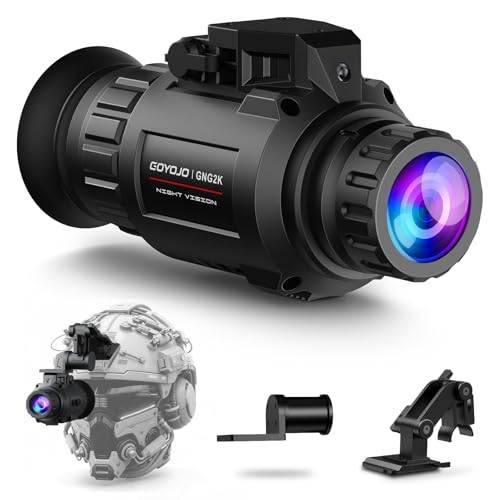
- 1. GOYOJO GNG2K Night Vision Monocular — Best overall
- 2. Nightfox Prowl 2 Night Vision Goggles — Runner-up
- 3. TRV Digital 4X Zoom Night Vision Monocular — Best for heavy use
- 4. GOYOJO Head-Mounted Night Vision Monocular Goggles — Best for beginners
- 5. BIBIRE Night Vision Monocular — Best budget pick
- Does a helmet-mountable NVG monocular actually mount to your helmet?
- What magnification numbers really mean here
- What more money buys in this set
- The verdict
- FAQ
The best nvg monocular here is the GOYOJO GNG2K, because it publishes the sharpest sensor figure in the set at 2688x1520 with a 60Hz refresh and still weighs only 0.85 lb on a helmet. If you care more about peripheral awareness than pixel count, the Nightfox Prowl 2 swaps between 55° and 105° lenses and drops to 0.68 lb. Sensor resolution is what splits this field. Everything below the top two publishes a magnification number instead, and that number is doing different work than buyers assume.
Best nvg monocular at a glance
| Pick | Sensor / optics claim | Weight | Price |
|---|---|---|---|
Best overall GOYOJO GNG2K Night Vision Monocular |
2688x1520 at 60Hz claim 45° field of view |
0.85 lb | Check Price |
| IMX662 60FPS claim 55°–105° field of view |
0.68 lb | Check Price | |
Best for heavy use TRV Digital 4X Zoom Night Vision Monocular |
2K claim, 40° view IPX7 claim |
Not published | Check Price |
Best for beginners GOYOJO Head-Mounted Night Vision Monocular Goggles |
7x fixed magnification 1.54 in screen |
Not published | Check Price |
Best budget pick BIBIRE Night Vision Monocular |
2x optical + 8x digital claim 850nm IR |
1.48 lb | Check Price |


How I screened the listings down to five
I worked from published specifications only. Five digital units survived, and the cut lines were simple.
- A head or helmet mount had to be part of the listing. Every pick here states one, either as an included headband or as helmet compatibility.
- An infrared illuminator wavelength had to be named. Three of the five state 940nm, one states 850nm, and that difference matters more than it looks.
- A warranty term had to appear. Four of five publish one. Two years on the GNG2K and the Prowl 2, one year on the two entry picks, none listed on the TRV.
What that leaves is a set where the top two publish sensor detail and the bottom three publish magnification instead. That split is the whole story.
Two things I could not screen on. Nobody publishes a battery figure except BIBIRE, which states 2200mAh and 10 hours with the IR off. And nobody publishes a diopter range, so eye relief and focus comfort stay unknown across the board.
Why sensor resolution decides a best nvg monocular pick
Analogue night vision has generations. Digital night vision has a sensor, and the sensor is the ceiling on everything you see. That is why I lead with resolution rather than the range figure printed in bold on every box.
Range claims here run from 200 metres to 1148FT to 300m, measured by nobody in particular under conditions nobody states. They are not comparable. A sensor spec is. GOYOJO gives you 2688x1520 and 60Hz. Nightfox names its sensor outright, the IMX662, and claims 60FPS. Those are checkable numbers on a spec sheet, and they set how much detail survives before any digital zoom starts guessing.
Refresh rate is the second half of it. A 60Hz or 60FPS panel keeps motion readable while you walk. Anything slower smears, which is why both of the top two picks state theirs and the cheaper units do not.
Here is the trick with any digital nvg monocular: 4x digital zoom on a 2688x1520 sensor still leaves usable pixels. The same 8x zoom on an unstated sensor is a crop of something you cannot measure.
1. GOYOJO GNG2K Night Vision Monocular — Best overall
The sharpest published sensor spec in this set, in the second-lightest body, with a two-year warranty behind it.
Best for: helmet users who want the sharpest published sensor spec Skip it if: you need magnification for static observation
Two figures put the GNG2K first. GOYOJO states 2688x1520 resolution at a 60Hz refresh, and it lists a body weight of 0.85 lb in a 2.68 x 4.61 x 2.24 in shell. That combination is what a helmet-mounted best nvg monocular needs: enough detail to identify what you are looking at, and little enough mass that your neck is not paying for it after an hour.
The 940nm illuminator is the other reason it leads. GOYOJO describes it as covert, with three brightness levels and a claimed 300m reach in total darkness. A 940nm emitter sits further outside visible red than the 850nm units in this set, which is the difference between a faint glow and none. The listing also claims a 0.0001 lux sensor threshold and four display modes, including white phosphor and full colour.
The 45° field of view is where it gives ground. That is narrower than the Prowl 2 in either of its lens configurations, and narrow enough that scanning a treeline means moving your head rather than your eyes. It also carries the highest price position here alongside the TRV, and only one seller lists it.
Pros:
- Sharpest published resolution in this set at 2688x1520
- 60Hz refresh stated, keeps walking motion readable
- 0.85 lb body, second-lightest of the five
- Covert 940nm illuminator with three brightness levels
- Two-year warranty, matched only by the Prowl 2
Cons:
- 45° field of view is the narrowest of the three that publish one
- No magnification, so distant static observation needs digital zoom
- Only one seller lists it
- Shares the highest price position in this set
2. Nightfox Prowl 2 Night Vision Goggles — Runner-up
The only pick that changes its field of view on demand, and the lightest body in the set at 0.68 lb.

Best for: close-quarters movement where field of view beats resolution Skip it if: you want the highest published pixel count
Nightfox does something no other pick attempts. The Prowl 2 ships with detachable fisheye and wide-angle lenses that, per the listing, take the field of view from 55° to 105° in seconds. At 105° you are close to natural peripheral vision, which is the single biggest complaint people have about wearing any monocular through a doorway or down a trail.
It is also the lightest thing here at 0.68 lb, and Nightfox names the sensor rather than describing it: an IMX662 at a claimed 60FPS, feeding an LCD the brand says has lower latency than the previous version. The listing states 1x magnification, which is the right choice for a head-mounted unit. Two IR LEDs are described, including a 940nm emitter for close quarters. Universal left or right eye mounting, a rotatable eye cup and a rear diopter are all listed, and the box includes a 32GB card, USB-C cable, dovetail adaptor and head mount.
It loses to the GNG2K on one number. Nightfox publishes a frame rate but no pixel count, so on published detail the GOYOJO is the safer claim. Managing two spare lenses in the dark is also a real chore.
Pros:
- 55° to 105° field of view via swappable lenses
- Lightest pick here at 0.68 lb
- Named sensor, the IMX662, at a claimed 60FPS
- Rear diopter and rotatable eye cup for left or right eye
- 32GB card, USB-C cable and dovetail adaptor included
Cons:
- No published resolution figure to compare against the GNG2K
- Loose lens attachments are easy to lose in the field
- 1x magnification means no reach for distant spotting
- Only two sellers list it
3. TRV Digital 4X Zoom Night Vision Monocular — Best for heavy use
The only pick with a stated waterproof rating, and by a wide margin the fastest seller of the five.

Best for: wet-weather use where an IPX7 claim matters most Skip it if: you need published weight and body dimensions before buying
Weather is what kills electronics outdoors, and TRV is the only brand in this set that addresses it with a number. The NVG20 listing claims an IPX7 waterproof rating, which by the standard means submersion rather than a light splash. Nobody else here claims better than rugged construction. If your nights involve rain, marsh edges or a dew-soaked hide, that one line changes the calculation.
The rest reads well too. TRV claims 2K clarity across a 40° view, four display modes including white phosphor and green phosphor, and 4x zoom. White phosphor is worth having: it renders in grey rather than green, which most people find easier on the eyes across a long session. The listing describes helmet and head-strap compatibility rather than shipping a specific mount. It is also the one buyers choose most often in this set by a large distance.
The problem is the spec sheet. TRV publishes no weight, and the listed dimensions of 31.5 x 43.3 x 22.4 in are clearly packaging rather than the device, which leaves you guessing about how it wears. No warranty term appears either, and both of those gaps sit at the same price position as the fully documented GNG2K.
Pros:
- IPX7 waterproof claim, the only rating in this set
- Four display modes including white and green phosphor
- 4x zoom with a claimed 2K sensor
- Sells faster than anything else here
- Helmet and head-strap compatible per the listing
Cons:
- No published device weight
- Listed dimensions describe packaging, not the unit
- No warranty term stated
- Premium price position with fewer published specs than its rival
4. GOYOJO Head-Mounted Night Vision Monocular Goggles — Best for beginners
Fixed 7x magnification and a 1.54 in screen, aimed at watching something at distance rather than walking with it.

Best for: backyard and campsite spotting on a headband Skip it if: you want a two-year warranty or recording
This is the gentlest way into the category, and it is the second-cheapest pick here. GOYOJO states 7x magnification through a fully coated 20mm objective, a 1.54 in HD screen, and a stated 1148FT range. It ships with an adjustable elastic headband, so it works handheld or hands-free, and it recharges over USB.
Read the magnification carefully, because the listing is explicit that 7x is fixed and manual zoom is not supported. That makes this a spotting device. Point it at a hedge line, a feeder, a paddock or a suspicious corner of the yard and it brings distance in closer than anything else in this set can. Point it forward and start walking, and 7x turns a footpath into a swaying blur. GOYOJO frames it for hunting, fishing, camping, surveillance and wildlife watching, and all of those are static uses.
Two omissions matter. There is no weight figure, which is awkward for something you strap to your head, and the warranty runs one year rather than two. The listing also mentions no recording or memory card, so nothing you see gets saved.
Pros:
- Highest magnification here at a fixed 7x
- 1.54 in HD screen, largest display mentioned in this set
- Elastic headband included for hands-free use
- Second-cheapest pick, USB rechargeable
- 20mm fully coated objective lens
Cons:
- Fixed 7x with no manual zoom, unusable for walking
- No published weight for a head-worn device
- One-year warranty against two years on the top picks
- No recording or memory card mentioned
5. BIBIRE Night Vision Monocular — Best budget pick
The cheapest way in, and the only pick that publishes a battery capacity and runtime.

Best for: first-time buyers who want recording included Skip it if: you plan to wear it for hours
BIBIRE answers the question everyone else dodges. The listing states a 2200mAh rechargeable battery, 10 hours of runtime with the infrared off, and 4 to 8 hours with it on. It also supports a power bank or car charger. No other pick in this set puts a runtime number in writing, and for an overnight sit that is the figure you actually plan around.
The kit is generous for the cheapest option here: a 32GB SD card, USB cable, spare battery, head mount kit, storage pouch and bag. Three modes are listed, photo, video with audio, and playback. Optics are stated as a 24mm multilayer coated lens with 2x optical and 8x digital zoom, and the IR system offers seven brightness levels with a claimed 200 metre reach.
Two things hold it back. The illuminator is 850nm rather than 940nm, which means a faint red glow visible at the emitter, so it is less covert than the top three. And at 1.48 lb it is the heaviest pick here by a comfortable margin, roughly double the Prowl 2. Strapped to your head for a long session, that is the spec you will notice first. The listing also confusingly calls it thermal vision, which digital infrared is not.
Pros:
- Cheapest pick in this set
- Only unit publishing battery capacity and runtime
- 32GB card, spare battery and head mount kit included
- Seven infrared brightness levels
- Photo, video with audio, and playback modes
Cons:
- Heaviest pick at 1.48 lb, hard on a headband
- 850nm illuminator glows faintly, less covert than 940nm
- Listing describes it as thermal, which it is not
- One-year warranty and the slowest seller of the five
Does a helmet-mountable NVG monocular actually mount to your helmet?
This is where buyers get caught, so check it before you buy anything.
"Helmet mountable" in a listing can mean three different things:
- A dovetail adaptor is included. The Prowl 2 lists one, which is the piece that meets a standard shroud plate.
- A head strap is included and a helmet is merely possible. The GNG2K describes helmet mounting; the entry GOYOJO ships an elastic headband instead.
- Compatibility is claimed, mounts sold separately. TRV describes a secure fit "when used with compatible head straps or helmets", which puts the hardware on you.
None of these listings publishes a thread pattern or shroud standard, so a specific bridge, arm or J-arm is a separate purchase and a separate compatibility check. Do that check first if you already own a helmet.
Weight is the second half of the fit problem. Anything on a shroud sits forward of your head and levers on your neck. The published numbers here run from 0.68 lb to 1.48 lb, and that spread is not academic across a long night.
What magnification numbers really mean here
Bigger is not better, and this set proves it. Three different approaches show up.
- 1x, the Prowl 2. True 1x means what you see through the tube matches what your other eye sees. That is why it is the standard for anything worn while moving.
- 4x zoom, the GNG2K and TRV. Digital crops of the sensor, useful for a short look at something specific, then back to wide.
- Fixed 7x and 2x optical plus 8x digital, the entry GOYOJO and BIBIRE. Reach for a static watcher.
Digital zoom does not add detail. It enlarges the pixels already captured, which is why the sensor figure matters more than the multiplier. A 4x crop from 2688x1520 has more real information in it than an 8x crop from a sensor nobody quantifies.
Field of view is the number that actually changes the experience. This set spans 40° on the TRV, 45° on the GNG2K, and 55° to 105° on the Prowl 2. Narrow feels like looking through a paper tube. Wide feels like seeing.
What more money buys in this set
Moving up the price ladder in this category buys documentation, not just hardware.
At the entry positions, you get magnification, a headband, and in BIBIRE's case a battery number and a memory card. Warranties run one year. You do not get a published sensor resolution, a refresh rate, or a covert illuminator on the BIBIRE.
In the middle, the Prowl 2 buys a named sensor, a diopter, dual illuminators, swappable lenses and a two-year warranty in the lightest body here. That is the largest jump in real capability anywhere on this ladder.
At the top, the GNG2K buys the resolution and refresh figures nobody else states, plus a 940nm illuminator with three levels and four display modes. The TRV buys an IPX7 rating and four display modes, but publishes no weight and no warranty at the same price position.
What extra money does not buy anywhere in this set: a stated battery runtime beyond BIBIRE's, or an eye-relief figure. Those you find out after purchase.
The verdict
The GOYOJO GNG2K is the best nvg monocular in this group. It publishes a resolution of 2688x1520 and a 60Hz refresh, which nothing else here matches on paper, and it does it in a 0.85 lb body with a covert 940nm illuminator and a two-year warranty. When a helmet-mounted device has to give you both usable detail and tolerable weight, that is the pick.
Two conditions flip it. First, if you spend your nights moving through tight ground rather than watching a fixed point, the Nightfox Prowl 2 wins on field of view alone: 105° with the wide lens fitted against 45° on the GOYOJO, in the lightest body here at 0.68 lb, with a named IMX662 sensor and a diopter for fast focus. Peripheral awareness beats pixel count when doorways and branches are the hazard.
Second, if your gear gets soaked, the TRV NVG20 is the only pick claiming an IPX7 rating, and it is also the one buyers choose most often here. Accept that it publishes no device weight and no warranty term in exchange.
If you are watching one spot at distance, drop to the 7x GOYOJO. If you want recording and a documented battery for the least money, take the BIBIRE and accept 1.48 lb.
FAQ
Is a best nvg monocular pick worth the money over a cheap camera?
A best nvg monocular pick earns its price through three things a phone camera cannot do: an infrared illuminator that lights a scene invisibly, a sensor tuned for low light, and a head or helmet mount that frees your hands. The GNG2K claims usable vision at 0.0001 lux with a 300m illuminated reach. No handheld camera comes close in full darkness.
How much should I spend on an nvg monocular?
How much you spend should track how you use it. The entry positions here, the 7x GOYOJO and the BIBIRE, cover backyard spotting and campsite watching fine. Step up only when you need a published sensor figure, a 60Hz refresh, a covert 940nm illuminator or a two-year warranty. Those four things separate the top of this set from the bottom.
What does the difference between 850nm and 940nm infrared mean?
The difference between 850nm and 940nm is visibility at the emitter. An 850nm LED, as on the BIBIRE, produces a faint red glow a person or animal can spot up close. A 940nm emitter, used on the GNG2K, the Prowl 2 and Nightfox's close-quarters LED, sits further outside human vision. It is dimmer to the sensor but far harder to notice.
GOYOJO GNG2K or Nightfox Prowl 2: which nvg monocular should I buy?
Choose the GNG2K for detail and the Prowl 2 for awareness. GOYOJO publishes 2688x1520 at 60Hz, which no other listing here matches, in a 0.85 lb body. Nightfox counters with swappable lenses covering 55° to 105°, a named IMX662 sensor, a rear diopter and the lightest weight in this set at 0.68 lb. Both carry two-year warranties.
What mistake do first-time buyers make with night vision monoculars?
The common mistake is chasing magnification. A fixed 7x device is superb for watching a feeder from a chair and nearly unusable while walking, because every step swings the image. Match the multiplier to the job: 1x or 4x for moving, higher magnification for sitting still. Field of view and refresh rate matter more than reach for anything mobile.
Start with how you plan to use the thing, then pick the number that matches. Walking a property line at night is a field-of-view and refresh-rate problem, which points to the Prowl 2 or the GNG2K. Sitting still and watching something at distance is a magnification problem, which points to the 7x GOYOJO. The GNG2K stays my default because it is the only pick that documents both the resolution and the refresh rate you are actually buying, and it does that at 0.85 lb with two years of cover behind it. Check your helmet's mount standard before you order anything.