Best Instant Photo Printer for Beginners: Liene M100

Five instant printers ranked for people who have never owned one. The winner ships with 100 sheets, prints 4x6, and hides the Wi-Fi step behind a built-in hotspot.

By Sam BaileyUpdated 15 min read
On this page
- Best instant photo printer for beginners at a glance
- What buyers get wrong about instant photo printers
- 4x6 dye-sub or 2x3 sticker: which suits a first printer?
- 1. Liene M100 4x6'' Photo Printer — Best overall
- 2. KODAK Dock Plus 4x6 Photo Printer — Runner-up
- 3. KODAK Step Instant Smartphone Photo Printer — Best for beginners
- 4. Nelko PP01 Photo Printer — Best budget pick
- 5. Liene Amber M110 Bluetooth Photo Printer — Best premium
- How to read the beginner label on this category
- How many prints does a starter bundle actually cover?
- What owning one really involves
- The verdict
- FAQ
The best instant photo printer for beginners is the Liene M100, a 4x6 dye-sublimation model that ships with 100 sheets and three cartridges, hides the Wi-Fi step behind a built-in hotspot, and carries a 1-year warranty. If you want peel-and-stick 2x3 prints instead of keepsake 4x6s, the KODAK Step is the better first printer at 2.4 oz and a palm-sized footprint. Most guides in this category compare print resolution. That is not what decides a first purchase.
Best instant photo printer for beginners at a glance
| Pick | Print size | Tech | Price |
|---|---|---|---|
Best overall Liene M100 4x6'' Photo Printer |
4x6 in | Thermal dye-sub Wi-Fi hotspot |
Check Price |
Runner-up KODAK Dock Plus 4x6 Photo Printer |
4x6 in | 4PASS dye-sub Bluetooth |
Check Price |
Best for beginners KODAK Step Instant Smartphone Photo Printer |
2x3 in | ZINK zero-ink Bluetooth/NFC |
Check Price |
Best budget pick Nelko PP01 Photo Printer |
2x3 in | Inkjet (claim) Bluetooth |
Check Price |
Best premium Liene Amber M110 Photo Printer |
4x6 + 3x3 in | Thermal dye-sub Bluetooth |
Check Price |



What buyers get wrong about instant photo printers
The obvious specification to compare is print quality: dye-sublimation versus ZINK zero-ink versus inkjet, and which one hits the sharpest 300 dpi test chart. That is not what decides a beginner's first printer.
Two things decide it, and neither shows up on the box.
The first is print size. A 4x6 dye-sublimation printer makes the kind of photo you slide into a frame or an album, the same size as a drugstore print. A 2x3 pocket printer makes a sticker-sized image you peel and stick into a journal, on a laptop, or onto a fridge. These are different products for different rooms in your house. Get this wrong and the printer sits in a drawer.
The second is what comes in the box. A 4x6 dye-sub printer needs paper and a ribbon cartridge, sold together as a matched set. The Liene M100 ships with 100 sheets and three cartridges. The KODAK Dock Plus ships with 50 sheets. The KODAK Step ships with 5 sheets of ZINK paper. That gap between 100 and 5 is not a rounding error, it is the difference between a printer you enjoy for a month and one you spend the first weekend reordering supplies for.
4x6 dye-sub or 2x3 sticker: which suits a first printer?
There is a clean cutoff. If you want photos to keep, buy 4x6 dye-sub. If you want photos to stick to things, buy 2x3 ZINK or the Nelko inkjet.
- 4x6 dye-sub (Liene M100, KODAK Dock Plus, Liene Amber M110): the print is glossy, laminated, and the same size as a wallet photo doubled. Dye-sublimation lays down three colour layers and, per KODAK, a protective top coat. Prints handle fingers.
- 2x3 ZINK or inkjet (KODAK Step, Nelko PP01): the print peels and sticks. ZINK paper has the dye embedded in the sheet, so there is no cartridge to buy separately. The printer itself is smaller and lighter, and it goes in a bag.
A 4x6 dye-sub printer weighs and costs more than a 2x3, and the running cost per print is not trivial once the starter cartridges are gone. A 2x3 sticker printer is cheap to buy and small to carry, but the print is a sticker. It is not a framed photo of the wedding.
Pick the size first, then the model. Doing it the other way round is why most instant printers end up unused.
1. Liene M100 4x6'' Photo Printer — Best overall
The Liene M100 is the safest first buy because it starts with 100 sheets, prints keepsake-size 4x6s, and its Wi-Fi hotspot skips the router setup that trips up most first-timers.
Best for: a first-time buyer who wants keepsake-size prints and a bundle that lasts past week one. Skip it if: you want a pocket printer or sticker paper.
Two things separate the M100 from the rest of this set. The starter bundle is 100 sheets with three cartridges, which is roughly twice what the KODAK Dock Plus includes and twenty times what the KODAK Step ships with. That means the printer does its job for a stretch of weeks before you have to think about resupply. And the M100 has its own built-in Wi-Fi hotspot, so you connect your phone to the printer directly. There is no router, no home network setup, no "why is it not seeing the printer" moment.
The body is 7.48 x 7.48 x 9.84 in and the shipping weight is listed at 7.05 oz, which reads low for a printer of these dimensions, but that is what the listing states. Warranty is 1 year. Liene says the app adds borders, filters and contrast controls, and that up to five devices can connect at once.
The trade-off: the M100 sits at the more expensive end of this set, and it is desktop-sized, not pocket-sized. If you wanted 2x3 stickers, this is the wrong shape entirely.
Pros:
- Ships with 100 sheets and 3 cartridges out of the box
- Built-in Wi-Fi hotspot skips home network setup
- 4x6 dye-sublimation for keepsake prints
- Multiple device connections per Liene
- 1-year warranty
Cons:
- Desktop footprint, not portable
- Sits at the more expensive end of this set
- No sticker paper option
- Needs a matched ribbon cartridge for every print pack
2. KODAK Dock Plus 4x6 Photo Printer — Runner-up
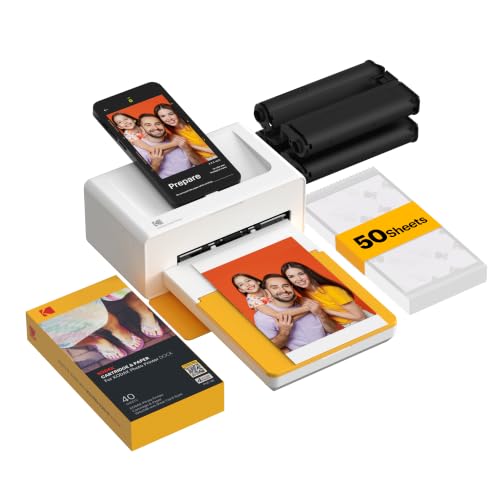
The Dock Plus is the runner-up for anyone who wants a 4x6 dye-sub printer in a smaller shape, and who is happy to reorder paper sooner.
Best for: a family that wants a small desktop dock and 4x6 keepsakes. Skip it if: you want a portable printer you can carry in a bag.
The Dock Plus prints the same 4x6 size as the Liene M100 using what KODAK calls its 4PASS process: three colour passes plus a laminate. The listed body is 3 x 4 x 7 in, which is markedly smaller than the M100's chassis, and the warranty is 1 year. Connection is Bluetooth to the KODAK Photo Printer app on iOS or Android, and KODAK says the dock is designed to sit plugged in to a wall outlet on a desk rather than travel.
Two things pull it below the M100 for a first-time buyer. The starter pack is 50 sheets, half what the M100 gives you. And the Dock Plus is Bluetooth-only, so pairing runs through your phone every session rather than through a printer-side hotspot. That is fine once you know the routine, but it is one more first-day friction point.
Choose it if desk space is tight and you want 4x6 dye-sub prints in the smallest body this set offers. Choose the M100 if you would rather not think about reordering paper for a month.
Pros:
- 4x6 dye-sublimation with a laminate finish per KODAK
- Smaller body than the M100 at 3 x 4 x 7 in
- Bluetooth pairing to the KODAK app
- 1-year warranty
- Designed for stable plugged-in desktop use per KODAK
Cons:
- 50-sheet starter pack, half of the M100
- Bluetooth-only, no built-in hotspot
- Not portable
- Only one seller listed
3. KODAK Step Instant Smartphone Photo Printer — Best for beginners
The Step earns the beginner label on this list because it is the smallest, lightest and simplest printer in the set, provided you accept 2x3 stickers instead of 4x6 photos.

Best for: a phone-first user who wants peel-and-stick prints with almost no setup. Skip it if: you want 4x6 keepsake prints on glossy paper.
Two facts do the work here. Weight is 2.4 oz. Print technology is ZINK zero-ink, which means the dye is baked into the paper, so there is no ribbon and no cartridge to buy. You load a stack of sticky-back sheets, pair over Bluetooth or NFC, and print. There is nothing else to learn. KODAK dates the model at 2021 and covers it with a 1-year limited warranty.
The prints are 2x3 in with a peel-off back. That is a sticker for a journal, a laptop lid or a scrapbook page, not a photo for a frame. KODAK says the ZINK sheets resist moisture and tearing, which matches how these prints are meant to be handled.
Two honest weaknesses. The starter pack is 5 sheets, so plan on ordering ZINK paper on day one. And ZINK prints do not hit the tonal depth of a dye-sublimation print, which is the trade-off you accept for a printer that fits in a coat pocket. If simplicity is the priority and the print size fits your plans, this is the easiest first printer here.
Pros:
- Palm-sized at 2.4 oz
- Zero-ink ZINK paper, no cartridges to match
- Bluetooth or NFC pairing per KODAK
- Peel-and-stick prints for journals and crafts
- 1-year limited warranty
Cons:
- Only 5 sheets in the box
- 2x3 prints, not 4x6
- ZINK cannot match dye-sub tonal range
- Bluetooth-only, no hotspot
4. Nelko PP01 Photo Printer — Best budget pick
The Nelko PP01 is the cheapest option in this set and the one buyers here choose most often, but it is the pick with the least verifiable technology story.

Best for: a scrapbooker or teen who wants 2x3 stickers at the lowest position in this set. Skip it if: you need dye-sublimation durability or Wi-Fi.
The PP01 prints 2x3 in sticky-backed sheets and connects to iOS or Android over Bluetooth. Nelko says the printer uses inkjet technology on premium sticky-backed photo paper, and the app supports frames and edits. The body measures 107x128x43mm on the box and 2.64 x 8.15 x 5.47 in in the listing. Warranty is 1 year.
Read that spec sheet carefully. Nelko describes inkjet technology in the feature bullets, which is unusual in a pocket printer this size. The listing does not publish weight, ink cartridge details, or a per-print cost, and there is one seller. This is where the beginner audience needs to go in with clear eyes: the printer is inexpensive and the sales rank inside this set is the lowest number of the five, so plenty of people are buying it. It also carries the least documented specification story of any pick here.
Against the KODAK Step, the trade-off is real. You save on the purchase for a similar print size, and you give up ZINK's ribbon-free story and KODAK's disclosed weight and dimensions. Buy it as a starter craft printer, not as a long-term photo archive tool.
Pros:
- Lowest price position in this set
- 2x3 sticky-backed prints for scrapbooks
- Bluetooth app pairing
- Frame and edit options per Nelko
- Sells faster than the rest of this set
Cons:
- Inkjet claim in a pocket printer is unusual and lightly documented
- No published weight
- Only one seller listed
- No Wi-Fi
5. Liene Amber M110 Bluetooth Photo Printer — Best premium
The Amber M110 earns the premium slot because it is the only pick in this set that prints both 4x6 photos and 3x3 stickers from one dual-tray body.

Best for: someone who wants both 4x6 photos and 3x3 stickers from one machine. Skip it if: you only ever plan to print one size.
The M110 uses the same thermal dye-sublimation technology as the M100, which means glossy laminated prints in the 4x6 keepsake size. What sets it apart is the dual paper tray: Liene includes 60 sheets of 4x6 paper, 20 sheets of 3x3 sticker paper and two cartridges in the box, and the printer switches between the two formats without a swap. That means one machine covers both the framed-photo use case and the stick-it-in-a-journal use case.
It weighs 2.87 lb, the warranty is 12 months, and the connection is Bluetooth with what Liene calls a 13-second pairing time. The Liene app handles Polaroid-style borders, filters and contrast.
Two honest trade-offs. This is the most expensive pick in the set and its sales rank number is the highest of the five, meaning it sells more slowly than the others here. If you are certain you only want one print size, the M100 gives you more sheets in the box for a lower price position, and the KODAK Step covers stickers alone at a much smaller size and weight.
Pros:
- Dual 4x6 and 3x3 paper trays
- Thermal dye-sublimation on both sizes
- Bundle of 60 photo sheets, 20 sticker sheets and 2 cartridges
- Bluetooth pairing in around 13 seconds per Liene
- 12-month warranty
Cons:
- The most expensive pick in this set
- Slowest seller of the five here
- Only one seller listed
- No Wi-Fi hotspot, unlike the M100
How to read the beginner label on this category
Amazon's search returns these five when a shopper asks for a beginner-friendly instant photo printer, but the modifier is doing less work than it looks. None of these listings publishes a "beginner mode" or a simplified UI. What they publish are specifications, and a few of those specifications matter more than others when you have never owned a printer of this kind before.
Here is the beginner checklist that actually maps to the data on offer:
- How many prints in the box. 100 sheets on the Liene M100, 50 on the KODAK Dock Plus, 5 on the KODAK Step. A bigger starter pack buys you time to learn.
- Whether pairing goes through your home Wi-Fi or the printer's own hotspot. The M100 has its own hotspot. Every other pick here pairs over Bluetooth to your phone.
- Whether the paper needs a matched cartridge. All three 4x6 dye-sub picks do. The two 2x3 picks do not, in the ZINK case, or use a different consumable model in the Nelko case.
- Warranty length. Every pick here lists 1 year. That is your baseline, not a differentiator.
- Print size. The single largest driver of whether you keep using the printer, treated separately in the section above.
Read those five in order and the beginner label sorts itself out.
How many prints does a starter bundle actually cover?
A rough way to think about it, using only the sheet counts in the listings:
- Liene M100 ships with 100 sheets, so a family taking one 4x6 print a day gets around three months of use before reordering.
- Liene Amber M110 ships with 60 4x6 sheets and 20 3x3 sticker sheets. Same daily-print math gives roughly two months on the 4x6 tray.
- KODAK Dock Plus ships with 50 sheets, so about seven weeks at a print a day.
- KODAK Step ships with 5 sheets. That is one evening.
- Nelko PP01 does not list an included sheet count in the specifications, so plan on buying paper alongside the printer.
The point is not the exact week count, it is the shape. Two of these five printers include enough paper to actually enjoy them out of the box. The other three assume you will place a second order immediately.
What owning one really involves
Before you buy, know what you are signing up for. The picks in this best instant photo printer for beginners guide all need three things from you over time.
- Paper reorders. The larger the print, the more each pack costs, and dye-sub packs are sold as paper-plus-ribbon sets. ZINK is sold as paper only.
- App installs. Every pick here uses a brand-specific app: the Liene app, the KODAK Photo Printer app or the Nelko app. Editing filters, borders and contrast live inside those apps, per the manufacturers.
- Phone pairing. Bluetooth on four of five picks, Wi-Fi hotspot on the Liene M100. Neither is complicated once done, and neither is zero-effort the first time.
Nothing here is a mystery, but a first-time buyer who expects a plug-in-and-print experience closer to a home inkjet will feel the friction. Pick the model whose ongoing costs and setup you can live with, not the one with the prettiest sample print.
The verdict
For a beginner buying their first instant photo printer, the Liene M100 is the right default. It prints the 4x6 size most people actually want to keep, it ships with 100 sheets and three cartridges so the first month is not spent reordering, and its built-in Wi-Fi hotspot removes the single fiddliest setup step. The 1-year warranty matches every other pick in this set. It is the pick that gets the most people through their first month of ownership without regret.
Two conditions flip the recommendation. If the print is going into a scrapbook, a journal or onto a laptop, buy the KODAK Step, because a 4x6 print in a sticker use case is the wrong tool. And if you want one machine that switches between framed-photo prints and sticker prints without swapping hardware, the Liene Amber M110 is the only pick in this best instant photo printer for beginners set that does both, at the highest price position here.
The KODAK Dock Plus stays close behind the M100 for anyone whose desk cannot fit the larger Liene chassis, and the Nelko PP01 is the entry-price shortcut for buyers who understand the trade-offs on published detail.
FAQ
Is a 4x6 instant photo printer worth it for a beginner?
Is a 4x6 instant photo printer worth it depends on what you plan to do with the print. If you want to frame it, put it in an album or hand it to a relative, 4x6 dye-sublimation like the Liene M100 or KODAK Dock Plus is worth the extra footprint. If the print is going into a journal, a 2x3 sticker printer is the better tool.
What is the best instant photo printer for beginners who only use a phone?
The best instant photo printer for beginners who only use a phone is the Liene M100. Its built-in Wi-Fi hotspot means the printer sets up its own connection to your phone, so you do not have to add it to your home router. The other four picks all pair over Bluetooth from the phone, which works but adds a pairing step at every session.
KODAK Step or Nelko PP01: which 2x3 printer suits a first-timer?
KODAK Step or Nelko PP01 comes down to documentation and paper model. The Step uses ZINK zero-ink, so there is no cartridge, and KODAK publishes weight, dimensions and connection details clearly. The PP01 sits at a lower price position and sells faster inside this set, but its specification page is thinner. First-timers who want a documented product should start with the Step.
How much does it cost to run an instant photo printer?
How much it costs to run depends on the paper model. Dye-sublimation printers like the Liene M100, KODAK Dock Plus and Liene Amber M110 use matched paper-and-ribbon sets, so every print carries a paper cost and a ribbon cost. ZINK printers like the KODAK Step use paper only. Sheet counts in the starter bundles range from 5 to 100 across this set.
Can you print stickers and 4x6 photos from one printer?
Can you print stickers and 4x6 photos from one printer, yes, and the Liene Amber M110 is the only pick in this set that does. It carries a dual paper tray for 4x6 photo paper and 3x3 sticker paper and switches between them without swapping hardware. It sits at the highest price position in this set and is the slowest seller of the five listed here.
Instant photo printing is one of those categories where the first purchase either becomes a hobby or ends up in a drawer, and the difference is almost always about matching the print size to the use case rather than chasing the sharpest sample photo. Start with the size question: framed keepsakes or stickers. Then use the sheet counts to work out which starter bundle carries you past the first week. For most beginners, the Liene M100 lands on both counts, which is why it wins this best instant photo printer for beginners roundup and stays the safest default even after you learn what you actually like printing.