Best Hunting Thermal Monocular for Night Predator Work

Five thermal monoculars ranked for hunters, from a 2.47 oz entry pick to a 384×288 Pulsar. Sensor size, refresh rate and warranty settle it.

By Sam BaileyUpdated 14 min read
On this page
- Best hunting thermal monocular at a glance
- Who this guide is not for
- How I cut the field down to five
- 1. TOPDON TS004 Thermal Imaging Monocular — Best overall
- 2. AGM Global Vision Taipan V2 10-256 — Best warranty
- 3. GOYOJO G210 Thermal Monocular — Best budget pick
- 4. RIX Pocket K3 Thermal Monocular for Hunting — Best upgrade
- 5. Pulsar Axion XQ19 Compact Thermal Monocular — Best premium
- What actually decides a hunting thermal monocular?
- Sensor resolution: is 256×192 enough for hunting?
- Refresh rate, detection range and warranty length
- Who should skip a thermal monocular entirely?
- The verdict
- FAQ
The best hunting thermal monocular for most buyers is the TOPDON TS004, a 2.47 oz 256×192 unit with a 50Hz refresh rate and a claimed 11-hour battery. If you want a sharper 384×288 sensor and a five-year warranty, the Pulsar Axion XQ19 is the better call. Everything else in this roundup slots between those two poles by sensor, size and warranty length.
Best hunting thermal monocular at a glance
| Pick | Sensor | Refresh / Warranty | Price |
|---|---|---|---|
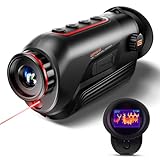
Best overall TOPDON TS004 |
256×192 | 50Hz Manufacturer warranty |
Check Price |
Best warranty AGM Taipan V2 10-256 |
256 (12μm) | Not listed 5-year warranty |
Check Price |
Best budget pick GOYOJO G210 |
256×192 | 25Hz claim 1-year warranty |
Check Price |
Best upgrade RIX Pocket K3 |
384×288 | 50Hz 5-year warranty |
Check Price |
Best premium Pulsar Axion XQ19 |
384×288 (17μm) | Not listed 5-year warranty |
Check Price |




Who this guide is not for
Before we get into picks, a quick honest note. If you hunt exclusively at dawn and dusk on legal daylight-only species, a good binocular and a headlamp will serve you better than any thermal on this list. Thermal earns its keep in true darkness, on hogs, coyotes, raccoons and other predators where local law permits night hunting. Check your state regulations first. Some jurisdictions restrict thermal to specific species or landowner-permission scenarios, and a monocular that sits in a drawer because it is illegal to use is a bad purchase at any price band.
Rifle-mounted work is also outside this scope. Every product here is a handheld scanning tool, not a weapon sight. If you want to shoot through thermal, you need a dedicated thermal riflescope with rated recoil tolerance, and that is a different roundup.
How I cut the field down to five
Three cuts, in order. I started with roughly forty thermal monocular listings pulled from the same two Amazon categories, Night Vision Monoculars and the wider Monoculars shelf under Binoculars & Scopes.
First cut: no listing without a stated thermal sensor resolution survived. A thermal monocular that will not publish its detector size is either hiding a very small one or has been recycled from a night-vision listing that is not thermal at all.
Second cut: pistol-grip and rifle-sight form factors got dropped. This roundup is about scanning tools you can hold to your eye and sweep across a field. A weapon-mounted scope is a different tool with different failure modes.
Third cut: I lined up the published specifications side by side, and the five picks below covered the useful range from entry-tier 256×192 sensors up to a 384×288 Pulsar with sub-18mK sensitivity. Anything that duplicated another pick's specification profile without offering something distinct got dropped in favour of the stronger listing.
1. TOPDON TS004 Thermal Imaging Monocular — Best overall
A 2.47 oz thermal monocular with a 50Hz refresh, an 11-hour battery claim and phone-streaming, at an entry-tier price the rest of this set cannot match on features per dollar.
Best for: hunters who want long runtime and phone streaming on a modest budget. Skip it if: you need a 384-class sensor for longer identification distance.
The TS004 wins the best hunting thermal monocular slot because of what it hits at its price position. The sensor is 256×192, standard for this tier, but the 50Hz refresh rate matches the two premium picks and doubles the 25Hz the budget GOYOJO claims. That matters when you are scanning a treeline for movement, because a slower refresh smears fast-moving heat sources into blur. TOPDON says the 5000mAh battery runs up to 11 hours, the longest claim on this list. At 2.47 oz it is also the lightest here by a wide margin, roughly a fifth the weight of the GOYOJO. The 13mm lens carries a claimed detection range of 410 metres, with detail visibility inside 100 yards, and the silicone housing is rated IP67 with a 2-metre drop claim.
The trade-off is real. This is a 256×192 sensor, not a 384. For identifying species at distance rather than just detecting heat, the Pulsar and the RIX pull ahead. The published warranty is also just "Manufacturer Warranty" with no year attached, against five years on three others here.
Pros:
- Lightest of the set at 2.47 oz
- 50Hz refresh matches premium picks
- Claimed 11-hour runtime, longest here
- TopInfrared app for live phone streaming
- IP67 rating with 2-metre drop claim
Cons:
- 256×192 sensor, not 384-class
- Warranty length not published
- 13mm lens narrower than the Pulsar's 19mm
2. AGM Global Vision Taipan V2 10-256 — Best warranty
A 256-sensor monocular with a sub-35mK thermal detector, 16GB of onboard recording and a five-year warranty that outlasts every entry-tier pick here.

Best for: hunters who want a five-year warranty and 16GB onboard recording. Skip it if: you want the highest sensor resolution on this list.
The Taipan V2 sits in the middle of this roundup by price and earns its keep on two axes. First, the warranty: AGM publishes a 5-year manufacturer warranty, matching the two premium picks and standing well above the TOPDON's generic wording and the GOYOJO's single year. For a hunting tool that lives in a pack and gets dropped on rocks, warranty length is a spec, not a bonus. Second, AGM says the sensor is a high-sensitivity sub-35mK 12μm detector, which is a finer pixel pitch than the Pulsar's 17μm and matters in low-contrast conditions.
Runtime is a claimed 7 hours on a replaceable rechargeable battery, with a tilt sensor that dims the display when the unit hangs at your chest. Onboard storage is 16GB with photo and video capture, and there is Wi-Fi with the AGM Connect app for real-time streaming. The dimensions come out at 2.4 × 6.23 × 2.2 in, so it pockets easily.
The weakness is that AGM does not publish a refresh rate or a weight in the listing, which for a category where 50Hz versus 25Hz genuinely changes hunting performance is a gap you have to accept.
Pros:
- 5-year manufacturer warranty
- Sub-35mK 12μm thermal detector claim
- 16GB onboard recording built in
- Tilt sensor for battery saving
- Wi-Fi with app control
Cons:
- Refresh rate not published
- Weight not published in the listing
- 256 sensor, not 384-class
3. GOYOJO G210 Thermal Monocular — Best budget pick
The cheapest entry point into thermal here, with a 256×192 sensor and a 10mm lens, but the shortest warranty and the slowest claimed refresh rate.

Best for: first-time thermal buyers testing the category before spending more. Skip it if: you plan to hunt fast movers at range.
The G210 is the cheapest of the five and works as a category-entry tool. The sensor is 256×192 with a 12μm infrared detector, and the 10mm focal lens sits at the wider, shorter-range end of this set. GOYOJO says the unit runs at 25Hz, which is where the compromise shows: for stationary scanning of a bait pile or a fenceline it is fine, but panning across moving hogs at 60 yards will produce visible smear compared to the 50Hz picks. The body measures 4.33 × 9.44 × 5.51 in and weighs 2.2 lb, making it the heaviest here by a very wide margin.
Warranty is one year, the shortest in the set, and the listing describes weather resistance without a specific IP rating. That is the honest picture: you are buying entry-level thermal, and it is priced accordingly. What GOYOJO offers is real thermal imaging with app connectivity for the money, and for a hunter who wants to find out whether thermal fits their scouting habits before spending five times more, that has value.
Pros:
- Cheapest of the five
- 256×192 sensor with 12μm detector
- Multiple display modes
- App-based thermal image sharing
Cons:
- 25Hz refresh, half the premium picks
- Heaviest here at 2.2 lb
- 1-year warranty is the shortest
- No IP rating published
4. RIX Pocket K3 Thermal Monocular for Hunting — Best upgrade
A 384×288 sensor in a 7.52 oz pocket body, with 50Hz refresh, electronic image stabilisation and a five-year warranty.

Best for: hunters upgrading to a 384×288 sensor in a pocket-sized body. Skip it if: you need a wider field of view than 17.5°.
The K3 is the sensible upgrade from any 256-class thermal monocular. The jump to 384×288 gives you roughly twice as many thermal pixels to work with, which translates into cleaner identification of an animal against a background of similar temperature. RIX pairs that sensor with a 15mm objective lens, a 50Hz frame rate, and what they describe as electronic image stabilisation to reduce hand-shake blur during offhand scanning. There is also RET image enhancement processing that RIX says lifts contrast within a 384-resolution sensor's ceiling.
Handling is where this pick earns its slot. The K3 measures 2.9 × 4.9 × 1.8 in and weighs 7.52 oz. That is genuinely pocketable, small enough to ride in a jacket cargo pocket during a stand hunt and pull out when a heat signature shows up on your peripheral vision. The published warranty is five years, matching AGM and Pulsar.
What it trades against the Pulsar is field of view. RIX publishes a 17.5° horizontal field of view with 2x base magnification, which is tighter than the Pulsar's wider 1.5x setting. If your hunting style is fast sweeps across large open ground, the Pulsar suits you better.
Pros:
- 384×288 sensor, higher than any 256 pick
- 50Hz refresh with electronic image stabilisation
- 7.52 oz pocket format
- 5-year warranty
- RET image enhancement processing
Cons:
- 17.5° field of view is narrow for open country
- Refresh matches but does not beat the TOPDON
- Premium price band without a Pulsar-level sensitivity spec
5. Pulsar Axion XQ19 Compact Thermal Monocular — Best premium
The most expensive pick here, with a 384×288 sensor, sub-18mK thermal sensitivity claim, an AMOLED display and a 19mm f/1.0 lens.

Best for: serious hunters who want the finest thermal sensitivity of this set. Skip it if: your budget sits closer to entry-tier pricing.
The Axion XQ19 is the most expensive of the five and the reference point for the category. Pulsar publishes a 384×288 uncooled sensor with a stated NETD below 20mK, and elsewhere in the listing under 18mK, which is finer thermal sensitivity than anything else here quotes. In practice that translates to seeing weaker heat differentials, the kind of thing that separates a deer bedded down at range from surrounding ground temperature in humid or damp conditions. The 640×400 AMOLED display is a genuine spec advantage over LCD-based competitors: deeper blacks, sharper contrast, and Pulsar says it stays responsive in extreme temperatures.
The 19mm f/1.0 lens is the widest aperture in the group, with a 1.5x base magnification and a 6x digital zoom. That combination gives you both wide scanning and useful reach. The unit weighs 0.55 lb, or 8.8 oz, and measures 2.8 × 5.3 × 1.5 in, so it slots into the same pocket class as the RIX. The five-year limited warranty matches the AGM and the RIX.
The trade-off is straightforward: this is the highest price position of the five for what is still a compact scanning monocular, not a range-finding thermal or a riflescope. If you cannot use its sensitivity advantage regularly, you are paying for headroom you will not touch.
Pros:
- 384×288 sensor with sub-18mK NETD claim
- 640×400 AMOLED display
- 19mm f/1.0 lens, widest aperture here
- 5-year limited warranty
- 8.8 oz pocket format
Cons:
- Highest price position of the five
- Refresh rate not published in the listing
- Export-controlled, which limits secondary-market resale
What actually decides a hunting thermal monocular?
Most guides lead with detection range. That is not what decides it. Detection range tells you the distance at which a thermal will show you that something warm exists. It does not tell you whether you can identify what that something is, which is the actual hunting question.
Two things decide identification distance. First, sensor resolution: a 384×288 sensor gives you roughly twice the pixel count of a 256×192 sensor across the same field of view, so heat signatures resolve into recognisable shapes further out. Second, thermal sensitivity, published as NETD in millikelvins. A lower NETD number means the sensor picks up smaller temperature differences, which matters in wet, humid, or foggy conditions where a warm-blooded animal blends more closely with the background.
Refresh rate is the third factor and it decides usability more than optical performance. A 25Hz refresh is fine for static scanning. A 50Hz refresh keeps moving animals sharp during a pan, and once you have used one, dropping back is noticeable.
Sensor resolution: is 256×192 enough for hunting?
Yes, with a condition. A 256×192 thermal sensor is enough for detection and short-to-medium-range identification of medium and large game. If you are scanning a food plot, a fenceline, or timber inside 100 yards for hogs, coyotes, or deer, a 256 sensor from the TOPDON or the AGM will show you what you need. Three of the five picks here use 256-class sensors, and they cover the bulk of realistic hunting distances.
Where 256 falls short:
- Species identification beyond about 150 yards, where a coyote and a dog become hard to distinguish on a small sensor
- Small game like raccoons or foxes in cover at distance
- Situations where a shot is being considered at longer range, and you need to be certain before you commit
For those cases, step up to a 384×288 sensor: the RIX Pocket K3 or the Pulsar Axion XQ19. The pixel count difference does real work in the field.
Refresh rate, detection range and warranty length
Three numbers, ranked by how much they should influence your decision.
- Refresh rate. 50Hz on the TOPDON, the RIX and (by inference from Pulsar's motion claims) the Axion. 25Hz on the GOYOJO. AGM does not publish this figure. This one is worth paying for.
- Warranty length. Five years on the AGM, the RIX, and the Pulsar. One year on the GOYOJO. The TOPDON says "manufacturer warranty" without a length. On a device that lives outdoors and takes knocks, five years matters.
- Detection range. TOPDON claims 410 metres with a 13mm lens. Detection is the easy number. Identification is where sensor resolution takes over from raw detection distance, so a bigger detection figure on a 256 sensor does not beat a shorter figure on a 384.
Who should skip a thermal monocular entirely?
Two groups. First, hunters whose local regulations restrict night hunting or thermal use for the species they pursue. Rules vary by state and by species, and buying thermal before checking is expensive regret.
Second, hunters whose primary need is longer-range identification for a shot rather than scanning and locating. If you want to identify a coyote at 300 yards and take the shot, a handheld monocular is the wrong tool: you want a dedicated thermal riflescope with recoil rating, and you probably want to spend more than the top pick here to get one worth using. A monocular's job is to find the heat, then hand off to a different optic to make the shot.
The verdict
The TOPDON TS004 wins best hunting thermal monocular because it packs 50Hz refresh, an 11-hour battery claim, app streaming and IP67 durability into the lightest body here at 2.47 oz, and does it at an entry-tier price. For most hunters scanning inside 150 yards, that is the right default.
Two conditions flip the recommendation. If you need to identify game beyond about 150 yards, or in humid, low-contrast conditions, the Pulsar Axion XQ19 earns its premium price with a 384×288 sensor, a sub-18mK NETD claim and a 640×400 AMOLED display. The RIX Pocket K3 sits between the two: 384×288 in a 7.52 oz body with a five-year warranty, at a price below the Pulsar. If warranty length is your priority above all, the AGM Taipan V2 gives you five years on a 256-class sensor with 16GB of onboard recording, though its unpublished refresh rate is a real gap. The GOYOJO G210 makes sense only as a category-entry test at the lowest price position, and its 25Hz refresh and 1-year warranty tell the honest story.
FAQ
Is a thermal monocular worth it for hunting?
A thermal monocular is worth it for hunting if you pursue nocturnal species where night hunting is legal, or if you scout deer and hogs at dawn and dusk. It replaces guesswork with visible heat signatures, cutting time spent glassing empty cover. If you only hunt legal daylight hours on daylight species, a good binocular does more per dollar than any thermal on this list.
What sensor resolution should a hunting thermal monocular have?
Sensor resolution should be at least 256×192 for hunting inside 150 yards on medium and large game. That covers the TOPDON, AGM and GOYOJO here. Step up to 384×288 (the RIX Pocket K3 or Pulsar Axion XQ19) if you need to identify species at longer range or work in humid, low-contrast conditions. A 384 sensor roughly doubles the thermal pixel count across the same field of view.
How does the TOPDON TS004 compare to the Pulsar Axion XQ19?
The TOPDON TS004 compares to the Pulsar Axion XQ19 as an entry-tier tool against a premium one. TOPDON offers a 256×192 sensor, 50Hz refresh, 11-hour battery claim and 2.47 oz weight at entry pricing. Pulsar offers a 384×288 sensor, sub-18mK sensitivity, a 640×400 AMOLED display and a 19mm f/1.0 lens at the highest price position here. Sensor and sensitivity decide it.
Does refresh rate really matter on a hunting thermal monocular?
Refresh rate really matters when you are scanning moving game or panning across cover. A 50Hz sensor, like the TOPDON TS004 and the RIX Pocket K3, keeps a running hog sharp during a sweep. A 25Hz sensor, like the GOYOJO G210, will smear that same movement into blur. For stationary scanning of a bait pile or a fenceline, 25Hz is adequate. For active hunting, 50Hz earns its cost.
What is the biggest mistake buyers make choosing a thermal monocular?
The biggest mistake buyers make is overweighting quoted detection range and underweighting sensor resolution and thermal sensitivity. A 410-metre detection claim on a 256×192 sensor does not beat a shorter detection figure on a 384×288 sensor with sub-18mK NETD, because identification (not detection) is the hunting question. Buy for the pixels and the sensitivity, then check that refresh rate and warranty length match how you will actually use it.
Take your pick against the field you actually hunt. If it is timber and food plots inside a hundred yards, the TOPDON TS004 gives you a light, long-running, 50Hz thermal for entry-tier money and covers the honest majority of hunting situations well. If it is open country, longer identification distances, or damp low-contrast nights where a lesser sensor will fail you, the Pulsar Axion XQ19 is the tool that will not run out of headroom the first hard season. Whichever way you go, check your state and county regulations on thermal and night hunting before the box arrives, not after.