Best Full Frame Telephoto Camera Lens: Tamron 70-300 Wins

Five full-frame telephoto zooms compared on weight, reach and mount, from a 1.2 lb Tamron travel pick to a 500mm reach lens and an f/2.8 L-series option.

By Sam BaileyUpdated 14 min read
On this page
- Best full frame telephoto camera lens at a glance
- How I screened the shortlist down to five
- What actually decides a full-frame telephoto
- 1. Tamron 70-300mm F/4.5-6.3 Di III RXD — Best overall
- 2. Tamron 150-500mm f/5-6.7 Di III VC VXD — Runner-up
- 3. Panasonic LUMIX S 70-300mm F4.5-5.6 Macro O.I.S. — Best for beginners
- 4. Canon RF 75-300mm f/4-5.6 Compact Telephoto Zoom — Best budget pick
- 5. Canon RF 70-200mm F2.8 L IS USM — Best premium
- How much reach do you really need?
- Which mount fits your camera?
- What more money buys across this set
- The verdict
- FAQ
The best full frame telephoto camera lens for most Sony FE shooters is the Tamron 70-300mm F/4.5-6.3 Di III RXD, because it puts a proper telephoto range in a 1.2 lb body with a 6 year manufacturer warranty. If your subject sits further out than a 300mm zoom can reach, the Tamron 150-500mm f/5-6.7 Di III VC VXD is the better buy, at the cost of carrying 4.14 lb.
Best full frame telephoto camera lens at a glance
| Pick | Reach | Weight | Price |
|---|---|---|---|
Best overall Tamron 70-300mm F/4.5-6.3 Di III RXD |
70-300mm Sony FE |
1.2 lb | Check Price |
| 150-500mm Sony FE |
4.14 lb | Check Price | |
Best for beginners Panasonic LUMIX S 70-300mm |
70-300mm L-mount |
1 lb | Check Price |
Best budget pick Canon RF 75-300mm f/4-5.6 |
75-300mm Canon RF |
1 lb | Check Price |
Best premium Canon RF 70-200mm F2.8 L IS USM |
70-200mm Canon RF |
2.64 lb | Check Price |



How I screened the shortlist down to five
I started with what a full-frame telephoto actually has to do: cover a real telephoto range on a full-frame mirrorless body, stay light enough to hand-hold, and come from a maker that publishes a warranty. From there I cut anything that duplicated another pick's role. That left five lenses across three mount systems, ranging from 70mm at the wide end to 500mm at the long end.
Three questions did the cutting:
- Does the lens mount on a full-frame mirrorless body from a mainstream maker?
- Is the reach useful enough to justify a second lens in the bag?
- Does the published weight let a normal person shoot it handheld?
Two picks come from Tamron, two from Canon, and one from Panasonic. Two are entry price band, two are premium, and one has no price data published in this set. Weights run from 1 lb to 4.14 lb, a range wide enough that the lightest and heaviest picks are not really the same class of tool.
One note on the search itself: the query "best full frame telephoto camera lens" is broad, and the results across mount systems mean no single pick will suit every camera. I have called each lens's mount out in the table and in each section, so you can filter fast.
What actually decides a full-frame telephoto
Most buyers compare maximum focal length. That is the number that sells the lens, and it is not what decides the purchase. What decides it is the pair of numbers next to focal length: weight and aperture at the long end.
A 500mm reach is only useful if you can hold the lens steady long enough to focus. The Tamron 150-500mm f/5-6.7 Di III VC VXD reaches further than anything else here, and it weighs 4.14 lb. The Canon RF 75-300mm f/4-5.6 reaches almost as far in daylight terms and weighs 1 lb. A lens you leave at home has an effective focal length of zero.
Aperture matters for a second reason: light. An f/2.8 lens like the Canon RF 70-200mm F2.8 L IS USM lets you shoot indoor sports and evening events where an f/6.7 lens forces the ISO up until noise eats the image. That is why the RF 70-200mm sits at the premium end of this set despite the shortest reach.
The trick is to pick the shortest reach that actually covers your subject, then choose the widest aperture and lightest body inside that reach. Reach past what you need is weight you carry for nothing.
1. Tamron 70-300mm F/4.5-6.3 Di III RXD — Best overall
A 1.2 lb Sony FE telephoto with a 6 year manufacturer warranty is the default choice for most full-frame shooters here.
Best for: Sony FE shooters who carry the lens all day Skip it if: you need reach past 300mm
This Tamron does the job most people buy a telephoto for. It covers 70-300mm on Sony FE, which handles portraits at the wide end and sports or wildlife at the long end. It weighs 1.2 lb and measures 3 x 5.8 x 3 in, so it fits a small camera bag alongside a body. Released in 2020, the model number is AFA047S700 and it ships with a 6 year manufacturer warranty, the longest in this set by a wide margin.
Tamron says the optical formula runs 15 elements in 10 groups, and lists a moisture-resistant construction and close-focus distances of 31.5 in wide and 59.1 in tele. Those are the maker's claims, but the weight and warranty are hard figures, and they are what put this lens in front of the others for a general-purpose full-frame telephoto.
The trade-off is aperture. At f/4.5-6.3 it is a daylight lens. If you shoot indoor sports or evening events, you will hit the ISO ceiling faster than you will with an f/2.8 lens.
Pros:
- 1.2 lb, the lightest telephoto zoom here
- 6 year manufacturer warranty, the longest in the set
- Sony FE mount fits full-frame and APS-C bodies
- Compact 3 x 5.8 x 3 in body
- Tamron claims moisture-resistant construction
Cons:
- f/4.5-6.3 aperture struggles in low light
- 300mm caps the reach for distant wildlife
- Only Sony FE, no L-mount or RF option
2. Tamron 150-500mm f/5-6.7 Di III VC VXD — Runner-up
The only lens in this set that reaches 500mm, at the cost of carrying 4.14 lb.

Best for: wildlife and distant sports on Sony FE Skip it if: you want a lens under 2 lb
If 300mm is not enough, this is the lens. The Tamron 150-500mm f/5-6.7 Di III VC VXD is the only pick here that gets past 400mm, and it does so on Sony FE full-frame bodies. It weighs 4.14 lb and measures 3.7 x 8.3 x 3.7 in, which is more than three times the weight of the best full frame telephoto camera lens I named as overall winner. Released in 2021, the model number is AFA057S700, and Tamron publishes a six-year limited USA warranty on authorised imports.
Tamron claims VC image stabilisation for handheld shooting at 500mm and a high-speed VXD autofocus motor. Both are the maker's claims. What is not a claim is the reach: 500mm is the number that puts this lens on the shortlist for birds, motorsport and stadium sports.
The weight is the honest trade. A 4.14 lb lens is a lens you plan around. It also sits at the premium price band, so you pay for the reach twice: once at the till, once in the bag.
Pros:
- 500mm reach, the longest here
- Sony FE full-frame mount
- Six-year limited USA warranty on authorised imports
- Tamron claims VC image stabilisation for handheld work
- 2021 release, the newest optical design in the set
Cons:
- 4.14 lb, by far the heaviest pick
- f/5-6.7 aperture is dim at the long end
- Premium price band with no cheaper alternative in this reach
3. Panasonic LUMIX S 70-300mm F4.5-5.6 Macro O.I.S. — Best for beginners
The only L-mount pick, and the only one that doubles as a half-life-size macro lens.

Best for: L-mount owners who also want half-life-size macro Skip it if: you shoot Sony or Canon RF
For anyone on a Panasonic, Leica or Sigma full-frame body, this is the obvious full-frame telephoto. It is the only L-mount lens in the set. It weighs 1 lb and measures 3.31 x 5.83 x 3.31 in, so it is on par with the Tamron 70-300mm for size and slightly lighter on the scale. It sits in the entry price band and was released in 2021, with a 1 year manufacturer warranty on model S-R70300.
Panasonic says the lens offers 0.5x maximum magnification at 300mm, which is the strongest close-focus claim in the set, and 5.5-stop image stabilisation. The company also describes a dust, splash and freeze-resistant design. Those are the maker's claims; treat them as such. The published spec that matters is the L-mount fit and the 1 lb weight, both of which put this lens in front of a beginner without overreaching.
The trade-off is the warranty. One year is the shortest published here, and it is a real gap next to the six-year Tamron cover.
Pros:
- 1 lb, tied for lightest here
- Only L-mount pick in the set
- Panasonic claims 0.5x macro magnification at 300mm
- Panasonic claims 5.5-stop image stabilisation
- Entry price band
Cons:
- 1 year warranty, shortest here
- No use to Sony or Canon RF shooters
- f/4.5-5.6 aperture limits low-light work
4. Canon RF 75-300mm f/4-5.6 Compact Telephoto Zoom — Best budget pick
The cheapest way onto a Canon RF full-frame body with real telephoto reach.
Best for: Canon RF owners after light reach on a tight budget Skip it if: you need a published warranty or weather sealing
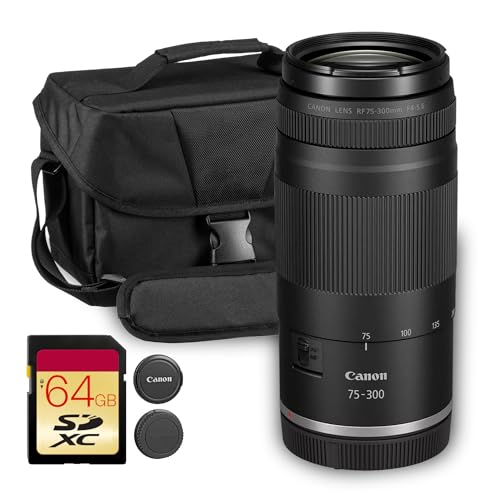
This is the cheapest lens in the set by price rank, and it is the only Canon RF option in the entry band. It weighs 1 lb and measures 3 x 4 x 3 in, which is the smallest body here. Canon says it covers 75-300mm on RF-mount full-frame and APS-C, and the bundle includes a bag and a 64GB SDXC card, per the listing.
Canon also claims a 4.9 ft minimum focus distance with 0.25x maximum magnification and a Super Spectra Coating on the optics. Those are the maker's claims. What is provable from the data is the reach, the mount and the compact size. Only one seller lists it, so availability is thinner than the two-seller picks.
The honest catch is what the listing does not publish: no warranty term, no weather-sealing statement, no release year. It is a straightforward starter telephoto for RF, not a lens for professional work.
Pros:
- The cheapest of the five, entry price band
- 1 lb, tied for lightest here
- 3 x 4 x 3 in, the smallest body in the set
- Canon RF mount for full-frame and APS-C bodies
- Bundle adds a bag and a 64GB SDXC card
Cons:
- No published warranty
- No sealing statement in the listing
- Only one seller stocks it
- Fewer published specifications than the other picks
5. Canon RF 70-200mm F2.8 L IS USM — Best premium
The only f/2.8 lens in the set, and the answer for indoor and evening work on Canon RF.

Best for: Canon RF portrait, event and indoor sports shooters Skip it if: you want to travel light or spend little
This is the premium Canon RF pick, and the only lens here with an f/2.8 aperture across its full zoom range. It weighs 2.64 lb and measures 5.7 x 3.5 x 3.5 in, so it is heavier than the 70-300mm picks but well short of the 4.14 lb Tamron 150-500mm. Released in 2019, the model is 3792C002, with a 1 year manufacturer warranty.
Canon claims optical image stabilisation with up to 5 stops of shake correction, dual Nano USM autofocus, and a 2.3 ft minimum focusing distance. Attribute those to the maker. What is measurable is the aperture and the weight, and the pair is what makes this lens the right choice for weddings, indoor sports and portrait work on RF full-frame bodies.
The trade-off is reach and price. 200mm is the shortest maximum focal length in the set, and this pick is in the premium price band. You are paying for light, not distance.
Pros:
- f/2.8 across the zoom, unmatched here
- L-series build for Canon RF full-frame
- Canon claims 5 stops of image stabilisation
- Canon claims dual Nano USM autofocus
- 2019 release with a settled optical design
Cons:
- 200mm caps the reach short of the 300mm and 500mm picks
- 2.64 lb, heavier than the 70-300mm options
- Premium price band
- 1 year warranty against Tamron's six
How much reach do you really need?
Reach is the number every buyer looks at first, and it is where most people overspend. Here is the honest split across the five picks:
- 70-200mm covers portraits, events and half-court basketball. The Canon RF 70-200mm F2.8 L IS USM fits here, and its f/2.8 aperture matters more than the missing 100mm at the long end.
- 70-300mm and 75-300mm cover portraits, most outdoor sports from the sideline, and casual wildlife in good light. Three of the five picks land here: the Tamron 70-300mm on Sony FE, the Panasonic LUMIX S 70-300mm on L-mount, and the Canon RF 75-300mm on Canon RF.
- 150-500mm covers birds, motorsport from the stands, and distant wildlife. Only the Tamron 150-500mm reaches this far in the set, and it weighs 4.14 lb for the privilege.
The mistake is buying 500mm because it sounds decisive, then leaving the lens at home because 4.14 lb is heavy. If your subject fits inside a 300mm frame most of the time, buy inside 300mm and put the weight saving in the bag as a second body or a wider lens.
Which mount fits your camera?
The best full frame telephoto camera lens for you is decided by the mount on your body, before anything else. This set covers three:
- Sony FE: the Tamron 70-300mm F/4.5-6.3 Di III RXD and the Tamron 150-500mm f/5-6.7 Di III VC VXD. Both list Sony FE mount and both cover full-frame and APS-C bodies.
- L-mount: the Panasonic LUMIX S 70-300mm F4.5-5.6 Macro O.I.S. Panasonic says it works across the LUMIX S series, which covers Panasonic, Leica and Sigma full-frame bodies on L-mount.
- Canon RF: the Canon RF 75-300mm f/4-5.6 and the Canon RF 70-200mm F2.8 L IS USM. Both list RF mount for Canon full-frame and APS-C mirrorless bodies.
There is no Nikon Z pick in this set. If you shoot Z, none of these lenses will fit your body without an adapter, and adapters bring their own compromises. Buy inside your mount first, then optimise for reach, aperture and weight in that order.
What more money buys across this set
Prices are not printed here, but the price bands tell you what each tier gets you.
At the entry band, the Panasonic LUMIX S 70-300mm and the Canon RF 75-300mm give you a real full-frame telephoto range in a 1 lb body. Neither has the longest warranty, and the Canon lens does not publish one at all. The Panasonic makes up ground with a stronger claimed macro capability at 0.5x magnification.
At the premium band, the Canon RF 70-200mm F2.8 L IS USM and the Tamron 150-500mm f/5-6.7 Di III VC VXD do two different jobs. The Canon buys you light, at f/2.8 across the zoom. The Tamron buys you reach, at 500mm. Neither buys you the other, and that is why they cost roughly the same tier.
The Tamron 70-300mm F/4.5-6.3 Di III RXD sits between them in role: it is the general-purpose Sony FE telephoto, and its six-year warranty is the strongest published cover in the set. That warranty is the quiet reason it wins overall.
The verdict
If you shoot Sony FE and want one telephoto that does the job for most subjects, the Tamron 70-300mm F/4.5-6.3 Di III RXD is the pick, at 1.2 lb with a six-year manufacturer warranty. The cutoff is reach. Below 300mm of subject distance, the 70-300mm wins on weight and warranty. Above 300mm, the Tamron 150-500mm f/5-6.7 Di III VC VXD is the right buy, at the cost of 4.14 lb and a premium price band.
If you shoot Canon RF, the choice is between light and reach. For indoor sports, weddings and portraits, the Canon RF 70-200mm F2.8 L IS USM is the answer, because an f/2.8 aperture is the only thing that solves low light. For daylight reach on a budget, the Canon RF 75-300mm f/4-5.6 does the job at 1 lb, with the caveat that the listing publishes no warranty term.
L-mount shooters have one pick here, the Panasonic LUMIX S 70-300mm F4.5-5.6 Macro O.I.S., and it earns the slot with a 1 lb body, an L-mount fit and Panasonic's 0.5x macro claim.
FAQ
What is the best full frame telephoto camera lens for beginners?
Best full frame telephoto camera lens for beginners depends on your body's mount. On L-mount, the Panasonic LUMIX S 70-300mm F4.5-5.6 Macro O.I.S. is the pick, at 1 lb in the entry price band, with Panasonic's claimed 0.5x macro at 300mm. On Canon RF, the Canon RF 75-300mm f/4-5.6 fills the same role, also at 1 lb.
Is a 70-300mm full frame telephoto worth it over a 70-200mm?
A 70-300mm worth it question hinges on your subject. If you shoot indoor sports or weddings, no: the Canon RF 70-200mm F2.8 L IS USM at f/2.8 handles low light better. If you shoot outdoor sports, casual wildlife or travel, yes: the extra 100mm of reach on the Tamron 70-300mm F/4.5-6.3 Di III RXD matters more than the aperture gap.
What weight can I hand-hold on a full-frame telephoto?
Weight I can hand-hold varies by shooter, but the numbers in this set are a useful guide. The 1 lb and 1.2 lb picks, like the Tamron 70-300mm F/4.5-6.3 Di III RXD, are comfortable for full-day handheld work. The 2.64 lb Canon RF 70-200mm F2.8 L IS USM is manageable for sessions. The 4.14 lb Tamron 150-500mm rewards a monopod on longer shoots.
Tamron 70-300mm or Tamron 150-500mm for wildlife?
Tamron 70-300mm or 150-500mm splits on subject distance. For garden birds, deer at a park distance and larger mammals, the Tamron 70-300mm F/4.5-6.3 Di III RXD is enough, at 1.2 lb. For distant birds, raptors in flight or motorsport from the stands, the Tamron 150-500mm f/5-6.7 Di III VC VXD is the right buy, at 4.14 lb and a premium price band.
What should I avoid when buying a full-frame telephoto?
Avoid when buying a full-frame telephoto: chasing the biggest number on the barrel. A 500mm lens you leave at home because of the 4.14 lb weight is worse than a 300mm lens you carry every day. Check the mount, then the weight at the long end, then the aperture. Only then compare reach. The best full frame telephoto camera lens is the one you actually take out.
The next step is simple: check the mount on your camera, pick the reach that covers your usual subject, then open the lens that matches on Amazon and compare the published specs against the section above. For most Sony FE shooters, the Tamron 70-300mm F/4.5-6.3 Di III RXD is the right default because it settles the two arguments that matter most in this category, weight at 1.2 lb and a six-year manufacturer warranty, before it asks you to pay for reach you may not need. Buy inside the range you actually shoot, and the lens earns its place in the bag.