Best Compact RGB LED Video Lights for Travel Kits

Runtime, not brightness, decides which pocket panel earns a slot in your bag. Seven compact RGB panels ranked by published battery life, colour accuracy, weight and what each tier of spending actually buys you.

By Sam BaileyUpdated 19 min read
On this page
- Best compact rgb led video light at a glance
- How I sorted these seven picks by buyer type
- Why runtime beats brightness in a compact rgb led video light
- 1. SmallRig RM120 RGB LED Video Light Panel — Best overall
- 2. SmallRig RM 40C Portable RGB LED Video Light — Best premium
- 3. IVISII G2 Pocket RGB Camera Light — Best warranty
- 4. simorr SmallRig P96L RGB Video Light — Most versatile
- 5. NEEWER Basics RGB Video Light — Best minimal setup
- 6. PICTRON VIJIM VL120 RGB Video Light — Best upgrade
- 7. ULANZI VL49 RGB Video Lights LED Camera Light — Best budget pick
- What does more money actually buy here?
- How do you read a lux figure on a listing?
- What the listings leave out
- The verdict
- FAQ
The best compact RGB LED video light is the SmallRig RM120, which pairs a 5000mAh battery rated for 180 minutes at maximum brightness with a 7.2 oz body only 0.61 in thick. If you need a pocket panel to work as a key light rather than a fill, the SmallRig RM 40C moves up to a claimed 40W and 145 LED beads instead.
Spending in this category splits into three clear tiers. The entry tier buys you colour and a magnet. The middle tier buys you a thinner body, an OLED readout and a published warranty. The top tier buys you real wattage and a diffuser that clips on magnetically.
Best compact rgb led video light at a glance
| Pick | Runtime claim | Colour accuracy claim | Price |
|---|---|---|---|
Best overall SmallRig RM120 RGB LED Video Light Panel |
180 min at max 5000mAh |
CRI 98+ claim 2500-8500K |
Check Price |
Best premium SmallRig RM 40C Portable RGB LED Video Light |
55 min at max 4800mAh |
CRI 96+ claim 2500-10,000K |
Check Price |
Best warranty IVISII G2 Pocket RGB Camera Light |
190 min at 100% 7200mAh |
CRI 97+ claim 2600-10,000K |
Check Price |
Most versatile simorr SmallRig P96L RGB Video Light |
60 min at max 12 hr at min |
CRI 96+ claim 2500-8000K |
Check Price |
Best minimal setup NEEWER Basics RGB Video Light SL90C |
113 min at full 4000mAh |
CRI 97 claim 2700-7500K |
Check Price |
Best upgrade PICTRON VIJIM VL120 RGB Video Light |
120 min at max 3100mAh |
CRI 95+ claim 2500-9000K |
Check Price |
Best budget pick ULANZI VL49 RGB Video Lights |
120 min at max 2000mAh |
60 LED beads 2500-9000K |
Check Price |


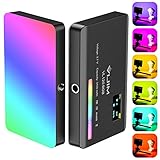

How I sorted these seven picks by buyer type
I started from the buyer, not the spec sheet. Seven panels in a category this crowded only make sense if each one answers a different question, so I mapped every pick to a person with a specific problem.
Four profiles came out of the listing data:
- The travelling shooter. Needs the panel to survive a full session without a top-up. Runtime claims and battery capacity decide it.
- The rig builder. Mounts the light on a cage or a gimbal arm, where 0.43 in of thickness versus 1.26 in changes the whole balance.
- The desk streamer. Never moves the light, so weight is irrelevant and beam softness matters more.
- The first-timer. Wants to find out whether coloured light is something they'll actually use before committing.
I ranked within those profiles using only what the listings publish: battery capacity, claimed runtime, colour temperature range, CRI claims, dimensions, weight and warranty term. Where a listing skips a figure, I did not fill the gap. That is why the ULANZI VL49 sits last despite being the cheapest of the seven. It publishes no CRI number, only a bead count.
One thing I could not screen for: the keyword's "compact" qualifier doesn't hold up as a hard cutoff. Every panel here fits a jacket pocket, but the widest measures 5.9 x 5.9 in and the thickest is 1.26 in deep. Compact is a range, not a category.
Why runtime beats brightness in a compact rgb led video light
Most guides to the best compact rgb led video light lead with lux. It's the easiest number to compare and the one manufacturers print largest.
It's also the least useful.
Lux figures are quoted at a distance the listing usually buries. The SmallRig RM120 claims 1580Lux. The PICTRON VIJIM VL120 claims 1250Lux at 0.5m. The ULANZI VL49 claims 800LUX. Those numbers are only comparable if the measurement distance matches, and on a pocket panel you're working close anyway, so a 300-lux gap between two units disappears the moment you move one six inches nearer.
Runtime at full brightness is the number that actually changes your day. A panel rated for 55 minutes at maximum output means you either shoot at half power or carry a power bank. A panel rated for 180 minutes means you clip it on and forget it.
Here's the trick with these ratings: they always assume maximum brightness, and you almost never shoot there. The simorr SmallRig P96L publishes both ends, 1 hour at maximum and 12 hours at minimum. That twelve-to-one spread tells you more about how a panel behaves than any single lux figure does.
So the order I'd read a listing in: runtime at full output first, colour temperature range second, CRI claim third, lux last.
1. SmallRig RM120 RGB LED Video Light Panel — Best overall
The RM120 is the only pick here that combines a three-hour runtime claim with a body under half an inch thick.
Best for: run-and-gun shooters who need three hours of colour on one charge Skip it if: you need more than 7W of output
That combination is rare. Most panels trade one for the other. At 0.61 x 4.92 x 2.96 in and 7.2 oz, the RM120 is thinner than the RM 40C and the NEEWER SL90C, yet its 5000mAh battery is the second-largest here. SmallRig rates it at 180 minutes of maximum brightness over USB Type-C, and only the IVISII G2 claims longer.
The colour claims are the strongest in the set on paper. SmallRig lists 98+ CRI and 98+ TLCI, a 2500-8500K range, 360° hue and 100-level saturation. Those are the manufacturer's figures, not independent measurements, but no other pick here claims a higher CRI. The listing also mentions a bundled dual cold shoe mount and diffuser, which matters because a bare pocket panel at close range is a hard, unflattering source.
The trade-off is power. 7W max is modest, and the premium RM 40C claims 40W with 145 beads. If you're lighting a face at four feet in a bright room, the RM120 runs out of headroom where the RM 40C doesn't. You're buying endurance and slimness, not raw punch.
Pros:
- 180 minute runtime claim at maximum brightness
- Slimmest body in the set at 0.61 in
- Highest published CRI and TLCI claims here
- Dual cold shoe mount and diffuser included
- 1 year manufacturer warranty
Cons:
- Only 7W maximum power, well below the premium pick
- 2500-8500K range narrower than the 10,000K panels
- Listing doesn't state the distance for its 1580Lux figure
- No stand included, unlike the IVISII G2
2. SmallRig RM 40C Portable RGB LED Video Light — Best premium
The RM 40C is the only pick that claims enough wattage to work as a key light rather than a fill.

Best for: solo interviews where a pocket panel is the key light Skip it if: you shoot long takes without a power bank
SmallRig lists 145 premium LED beads, a 40W figure, CRI≥96, TLCI≥99 and a 2500K-10,000K range. That upper limit is the widest here alongside the IVISII G2, and it's the difference between matching daylight through a window and getting close enough. There's a claimed intelligent cooling system that ramps up as output climbs, which is what you'd expect from a panel pushing this much power through a 1.26 x 5.04 x 3.15 in shell.
The magnetic diffuser is the detail I'd single out. SmallRig says it attaches and detaches in seconds, and on a panel this bright you'll want it on for anything involving a face. It also carries a 1 year manufacturer warranty and 36,000+ claimed colours.
Now the cost. The 4800mAh battery is rated for 55 minutes at full brightness, the shortest claim of all seven, and it's the most expensive pick here. That's the physics of the thing: more output drains more battery. It's also the thickest panel in the set at 1.26 in, so it sits proudest on a cage. You're paying more, carrying more and recharging more often to get output the other six can't reach.
Pros:
- 40W claim, far above the rest of this set
- Widest colour temperature range at 2500K-10,000K
- Magnetic diffuser attaches without tools
- 145 LED beads with CRI≥96 and TLCI≥99 claims
- PD fast charging on a 4800mAh cell
Cons:
- Shortest runtime claim in the set at 55 minutes
- Thickest body here at 1.26 in
- The most expensive pick, and the heaviest SmallRig option
- Cooling system implies audible fan behaviour the listing doesn't detail
3. IVISII G2 Pocket RGB Camera Light — Best warranty
The G2 carries the largest battery here by a wide margin and ships with a tripod stand in the box.
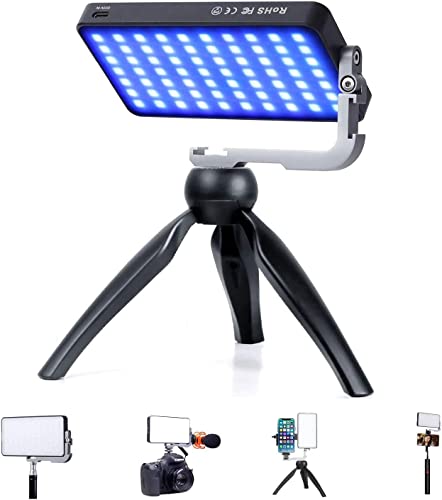
Best for: creators who want the light and a stand in one box Skip it if: you count every ounce in a carry-on
7200mAh is 44% more capacity than the RM120's 5000mAh cell, and IVISII rates it at 190 minutes at 100% output with a three-hour recharge over USB Type-C. That's the longest full-brightness claim of the seven. The bead layout is unusual too: 150 total, split as 80 bi-colour and 70 RGB, where most rivals blend everything into one array. IVISII claims CRI>97 and TLCI>99 across a 2600-10,000K range with nine light effects.
The bundle is the real argument. The listing includes a carrying bag, a 1/4 screw, a Type-C cable and an adjustable tripod stand, plus a 1 year warranty. Every other pick here expects you to already own a stand. For a creator setting up a first lighting kit, that's one fewer order.
The penalty is mass. At 0.71 lb it's the heaviest panel in this set, and its 0.59 x 5.59 x 2.83 in footprint is longer than the RM120's. It's also the only pick listed outside the on-camera lights category, which reflects how it's really meant to be used: on that stand, not on a hot shoe. Mount it on a small mirrorless body and you'll feel the imbalance.
Pros:
- Largest battery here at 7200mAh, 32Wh
- Longest runtime claim at 190 minutes at 100%
- Tripod stand, carrying bag and cable included
- Split array of 80 bi-colour and 70 RGB beads
- CRI>97 and TLCI>99 claims with nine effects
Cons:
- Heaviest pick in the set at 0.71 lb
- Longer 5.59 in body is awkward on a compact camera
- Sits in the premium price tier
- Aluminium body offers no weather protection the listing mentions
4. simorr SmallRig P96L RGB Video Light — Most versatile
At 0.43 in thick and 4.13 oz, the P96L is the lightest and thinnest panel here, which is exactly what a crowded rig needs.

Best for: gimbal and cage builds where thickness matters Skip it if: you shoot continuously for over an hour
Thickness is the spec people ignore until they're mounting three accessories on one camera. The P96L measures 0.43 x 4.25 x 2.36 in, which makes it 30% thinner than the RM120 and roughly a third the depth of the RM 40C. At 4.13 oz it's second-lightest, behind only the ULANZI VL49. simorr quotes 108 x 60 x 11mm and 117g in the feature copy, which lines up.
It also has the readout the cheaper panels lack. The listing describes a built-in OLED display for accurate readings, alongside HSI, CCT and scene modes, a CRI 96+ claim and a 2500-8000K range. Being able to see the exact Kelvin value rather than guessing from a dial is what makes matching two lights possible.
Runtime is where it gives ground. simorr publishes 1 hour at maximum and 12 hours at minimum, so a full-power session is short. The 2500-8000K ceiling is also the lowest here, which limits how cool you can push it against daylight. It sits in the middle of the pack on price, and it comes with a 1 year warranty but no stand or diffuser mentioned in the listing.
Pros:
- Thinnest panel in the set at 0.43 in
- Second-lightest at 4.13 oz
- OLED display for exact Kelvin and hue readings
- HSI, CCT and scene modes with CRI 96+ claim
- 12 hour runtime claim at minimum brightness
Cons:
- Only 1 hour of runtime claimed at maximum output
- 8000K ceiling is the lowest of the seven
- No stand or diffuser listed in the box
- No battery capacity figure published
5. NEEWER Basics RGB Video Light — Best minimal setup
The SL90C is the only square panel here, and a 5.9 x 5.9 in face is a softer source than any of the narrow rectangles.

Best for: desk streamers who want soft light with no rigging Skip it if: you need a slim panel for a tight camera cage
Shape does work that specs don't capture. Every other pick here is a rectangle roughly twice as wide as it is tall. The SL90C is 0.5 x 5.9 x 5.9 in, giving it the largest emitting area in the set, and a bigger source at the same distance means gentler shadow edges on a face. At 0.5 in it's the second-thinnest panel too.
NEEWER lists 45 warm, 45 cool and 48 RGB blended beads for up to 1090lux at 0.5m, a 2700K-7500K range, CRI97, 17 scenes and three modes: CCT, HSI and FX. The 4000mAh battery is rated for 113 minutes at full brightness and recharges from a car charger or laptop. There's a cold shoe adapter for hot shoe mounting and 1/4" holes for desk tripods, plus a 1 year manufacturer warranty. The listing dates it to 2026, making it the newest design here.
The Basics name is honest about what's missing. NEEWER describes the line as focused on essential functions without unnecessary extras, and the listing publishes no weight figure. The 2700K-7500K range is the narrowest at both ends of any pick, so warm-light matching and daylight matching are both tighter than on the SmallRig panels.
Pros:
- Largest emitting face at 5.9 x 5.9 in
- Second-thinnest body at 0.5 in
- 113 minute runtime claim on a 4000mAh cell
- 17 scenes across CCT, HSI and FX modes
- Cold shoe adapter and 1/4" mounting holes included
Cons:
- Narrowest colour temperature range at 2700K-7500K
- No weight published in the listing
- Square footprint is awkward on a tight camera cage
- Stripped-back product line drops accessories rivals include
6. PICTRON VIJIM VL120 RGB Video Light — Best upgrade
The VL120 packs 120 beads and a 3100mAh battery into an entry-tier panel, which is the best bead-per-dollar position in this set.

Best for: vloggers upgrading from a phone-mounted ring light Skip it if: you want a published warranty term
Doubling the bead count from the ULANZI VL49's 60 to 120 does two things: it raises peak output and it spreads the source, so the light is less punchy at close range. PICTRON claims 1250LUX at 0.5m with CRI 95+, a 2500-9000K range and full 0-360° hue with saturation control. That 9000K ceiling beats both the P96L and the SL90C.
The battery is 3100mAh, rated at two hours of maximum output with a two-hour recharge. The panel measures 2.6 x 4.17 x 0.59 in and PICTRON quotes 120g, which puts it in the same slim-and-light class as the P96L. HSI, CCT and scene modes are all listed. It's the second-cheapest pick here, and for someone stepping up from a clip-on ring light it's the biggest single jump in capability per dollar spent.
Two gaps stand out. The listing publishes no weight in the specification table and no warranty term at all, which is the only pick here missing both. It also lists no stand, diffuser or carrying bag. Compared against the RM120, you're giving up a documented warranty, a diffuser and 1000mAh of battery.
Pros:
- 120 LED beads at an entry-tier position
- 2 hour runtime claim on a 3100mAh cell
- 2500-9000K range beats both mid-tier picks
- Slim 0.59 in body with 1/4 screw mount
- HSI, CCT and scene modes all included
Cons:
- No warranty term published anywhere in the listing
- No weight figure in the specifications
- CRI 95+ is the lowest stated claim of any pick here
- No diffuser, stand or bag mentioned in the box
7. ULANZI VL49 RGB Video Lights LED Camera Light — Best budget pick
The VL49 is the lightest pick here at 3.53 oz and the only one with a magnet on the back.
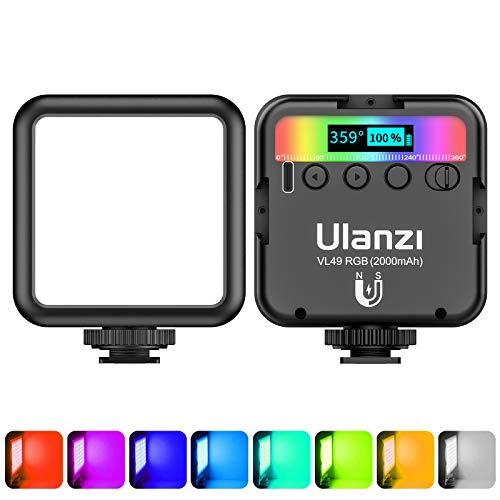
Best for: first-time buyers testing whether they'll use colour at all Skip it if: you need long shooting sessions at full brightness
That magnet is a genuinely different mounting idea. ULANZI describes a back-side magnetic design that sticks to most metal surfaces, so you can plant the light on a shelf bracket, a door frame or a light stand leg without threading anything. Add three cold shoes and a 1/4 screw and it becomes a hub other accessories hang off. At 3.53 oz it's the lightest of the seven and the cheapest, and only one seller lists it.
ULANZI claims 60 high colour rendering beads, 800LUX at 0.5m, a 120° illumination angle and a 2500K-9000K range with 0-359° hue and full dimming. The 2000mAh battery is rated for two hours at maximum and charges in about two hours.
The compromises are real and worth naming. 2000mAh is the smallest battery here, less than a third of the IVISII G2's cell. 60 beads is half the VL120's count and 800LUX is the dimmest claim in the set. The listing publishes no CRI figure and no warranty term, so you're taking colour accuracy on trust. Its 3.15 x 3.94 x 3.94 in cube shape is also chunkier than the flat panels. Buy it to find out whether coloured light earns a place in your workflow, then upgrade.
Pros:
- Lightest pick in the set at 3.53 oz
- Rear magnet mounts to metal with no hardware
- Three cold shoes plus a 1/4 screw thread
- The cheapest of the seven
- 120° illumination angle with 2500K-9000K range
Cons:
- Smallest battery here at 2000mAh
- Dimmest output claim at 800LUX
- No CRI figure and no warranty published
- 60 beads is half the count of the VL120
What does more money actually buy here?
Across these seven, spending more does not buy brightness in a straight line. It buys different things at each step.
- Entry tier. Colour control and a mount. The ULANZI VL49 and PICTRON VIJIM VL120 both give you 0-360° hue, CCT adjustment and a 1/4 thread. Neither publishes a warranty term. Neither includes a diffuser.
- Middle tier. Documentation and refinement. The simorr P96L adds an OLED readout and a 0.43 in body; the NEEWER SL90C adds a 5.9 in square face and 17 scenes. Both publish a 1 year warranty.
- Premium tier. Output or endurance, and you pick one. The SmallRig RM 40C buys 40W and a 10,000K ceiling at the cost of a 55 minute runtime. The IVISII G2 buys 190 minutes and a bundled stand at the cost of being the heaviest panel here.
The RM120 sits outside that ladder, which is why it wins. Its price position isn't published in the data I worked from, but its specification set reads like a mid-tier panel that borrowed the premium tier's battery.
What you're never paying for is a bigger jump in colour accuracy. The CRI claims run from 95+ to 98+ across the whole set, a spread narrow enough that no tier has a monopoly on it.
How do you read a lux figure on a listing?
Lux is a measurement of light falling on a surface, and it halves in a predictable way as you move the source further away. That single fact makes most listing comparisons meaningless unless the distance matches.
Check three things in order:
- The stated distance. The PICTRON VIJIM VL120 quotes 1250LUX at 0.5m. The ULANZI VL49 quotes 800LUX at 0.5m. Same distance, so that comparison holds. The SmallRig RM120's 1580Lux carries no distance in the listing, so it can't be lined up against either.
- Whether it's the RGB mode or the white mode. Coloured output is always dimmer than white output, and listings quote the higher figure.
- The bead count and the panel area. 145 beads across 5.04 x 3.15 in behaves differently from 60 beads in a 3.94 in cube, even at identical lux.
A practical rule for any compact rgb led video light: at typical vlogging distance, roughly arm's length, any panel here has enough output. Lux only starts mattering when you're lighting from four feet or fighting a bright window, and that's where the RM 40C's 40W claim earns its place.
What the listings leave out
Four things none of these seven listings tell you, and all four affect the buying decision.
Fan noise. The RM 40C mentions an intelligent cooling system that adjusts as power rises. Cooling implies a fan or an aggressive thermal ramp, and neither is described in enough detail to know whether a shotgun mic will hear it. No other listing addresses heat at all.
Runtime in RGB mode. Every runtime claim here is quoted at maximum brightness, which means white light. Pushing saturated colour draws differently, and not one of the seven publishes a figure for it.
Flicker at low dimming. Cheap drivers pulse visibly below about 20% output, which shows up as banding at high frame rates. No listing in this set gives a flicker-free rating or a supported frame rate range.
Where the CRI was measured. CRI claims run from 95+ to 98+ across these panels, all supplied by the manufacturer. A figure measured only at 5600K tells you nothing about how the panel renders skin at 3200K.
The gaps push me toward the picks that publish more rather than less. The RM120 states CRI, TLCI, lux, wattage, battery capacity, runtime, weight, dimensions and warranty. The VL49 states four of those nine.
The verdict
If you shoot away from mains power and you want one panel that handles a whole session, the SmallRig RM120 is the pick. 180 minutes at maximum brightness on a 5000mAh cell, in a 7.2 oz body 0.61 in thick, with the highest CRI and TLCI claims in this set. It's the only panel here that doesn't force a choice between endurance and slimness.
If you're lighting a face as the main source rather than filling a shadow, the SmallRig RM 40C is the better buy. Its claimed 40W and 145 beads reach where the RM120's 7W can't, and its 10,000K ceiling matches daylight more closely. You'll accept 55 minutes of full-power runtime and the thickest body here to get it.
The cutoff is your working distance. Inside about two feet, the RM120's output is plenty and its battery is the deciding advantage. Past three or four feet, or in a room with a bright window, wattage becomes the binding constraint and the RM 40C wins outright.
Two other flips are worth knowing. If you want a stand in the box, the IVISII G2's 7200mAh battery and bundled tripod make it the complete starter kit. If your camera cage is already full, the simorr P96L's 0.43 in profile fits gaps nothing else here will.
FAQ
Is a compact rgb led video light worth it over a bi-colour panel?
A compact rgb led video light is worth it if you want coloured accents, gels-without-gels, or scene effects like a fake TV glow. All seven picks here also do plain white across at least a 2700K-7500K range, so you're not giving up bi-colour work. If you only ever shoot neutral white, a bi-colour panel spends its budget on output instead.
Which compact rgb led video light gives the best value for the money?
The best value for the money here is the PICTRON VIJIM VL120. It sits in the entry tier at second-cheapest yet carries 120 LED beads, a 3100mAh battery rated at two hours of full output, a 2500-9000K range and a CRI 95+ claim. The gap versus mid-tier panels is a published warranty and an OLED readout, not raw capability.
How long does the battery last on these panels?
Battery life on these panels ranges from 55 to 190 minutes at maximum brightness. The IVISII G2 leads with a 190 minute claim on a 7200mAh cell, followed by the SmallRig RM120 at 180 minutes. The SmallRig RM 40C sits last at 55 minutes because it pushes far more power. Every one of these figures assumes full white output.
SmallRig RM120 or IVISII G2: which should I buy?
SmallRig RM120 or IVISII G2 comes down to weight against contents. The G2 claims 10 more minutes of runtime and includes a tripod stand, carrying bag and cable, but weighs 0.71 lb. The RM120 is 7.2 oz, 0.61 in thick, and claims higher CRI and TLCI. Choose the G2 for a desk kit, the RM120 for a camera bag.
What mistake do first-time buyers make with pocket lights?
The mistake first-time buyers make is using a bare pocket panel at close range with no diffusion. A 5-inch source a foot from a face throws hard-edged shadows and specular hot spots on skin. The SmallRig RM120 and RM 40C both include diffusers; the ULANZI VL49 and PICTRON VIJIM VL120 don't, so budget for one separately.
Start with the RM120 unless something in your setup argues against it. Three hours of runtime and a half-inch body cover the two problems that actually send people back to the store: a dead battery mid-shoot and a panel too bulky to keep mounted. Everything else in this category is a variation on that pair of constraints. If you're building a fixed desk setup rather than a travel kit, flip to the IVISII G2 for its stand or the NEEWER SL90C for its larger, softer face, and you'll have the same decision solved from the other direction.