Best Beginner Mirrorless Cameras by Video Spec

Six starter cameras compared on the specs that actually matter for filming yourself: sensor size, autofocus system, screen articulation and kit lens reach. The Canon EOS R50 leads, with three named conditions that flip the pick.

By Sam BaileyUpdated 17 min read
On this page
- Best beginner mirrorless camera for content creators at a glance
- How I screened this shortlist down to six
- Which spec actually decides a beginner mirrorless camera?
- 1. Canon EOS R50 Mirrorless Camera with 18-45mm Lens — Best overall
- 2. Sony ZV-E10 II APS-C Mirrorless Creator Camera with 16-50mm Lens — Best warranty
- 3. Canon EOS R10 Mirrorless Camera with RF-S 18-150mm Lens — Best premium
- 4. Nikon Z 30 Compact and Lightweight Mirrorless Camera with NIKKOR 16-50mm Lens — Most versatile
- 5. HolyEye 4K Vlogging Camera with Magnetic Mount — Best upgrade
- 6. LIYTIFOR 5K Digital-Cameras-for-Photography — Best budget pick
- Two of these six are not mirrorless cameras at all
- Canon EOS R50 vs Sony ZV-E10 II: which wins?
- What do the listings not tell you?
- The verdict
- FAQ
The best beginner mirrorless camera for content creators is the Canon EOS R50 kit, a 2 lb bundle that pairs an APS-C body with an 18-45mm lens, oversampled 4K and a vari-angle touchscreen. If you film yourself handheld all day, the Sony ZV-E10 II is the better buy at 0.88 lb for the body. What splits this field is not resolution. It's whether the screen flips forward and whether the autofocus can hold your face while you move. Two of the six here fail one of those tests outright.
Best beginner mirrorless camera for content creators at a glance
| Pick | Kit lens | Body weight | Price |
|---|---|---|---|
Best overall Canon EOS R50 with 18-45mm Lens |
RF-S 18-45mm | 2 lb kit | Check Price |
Best warranty Sony ZV-E10 II with 16-50mm Lens |
16-50mm F3.5-5.6 | 0.88 lb | Check Price |
Best premium Canon EOS R10 with RF-S 18-150mm Lens |
RF-S 18-150mm | 3 lb kit | Check Price |
Most versatile Nikon Z 30 with NIKKOR 16-50mm Lens |
NIKKOR 16-50mm | 3.11 lb kit | Check Price |
Best upgrade HolyEye 4K Vlogging Camera |
Fixed, 330° rotating | Not listed | Check Price |
Best budget pick LIYTIFOR 5K Digital Camera |
Fixed, 18X digital zoom | Not listed | Check Price |




How I screened this shortlist down to six
I set three criteria before looking at any listing, and I weighted them in this order.
- Autofocus that tracks a face. Weighted highest. A creator films alone. If the camera cannot hold focus on your eyes while you lean forward to grab something, every other spec is decoration.
- A screen you can see from in front of the lens. Weighted second. Without it, you're guessing at framing on every take.
- A lens mount with somewhere to go. Weighted third. A starter camera you outgrow in six months is a rental you paid for outright.
Why that order? Because the first two are what a beginner notices in week one, and the third is what they notice in year two. Megapixel counts did not make the list at all, which is why the highest published figure in this set belongs to the cheapest pick.
Four of the six clear all three bars: the Canon EOS R50, the Canon EOS R10, the Nikon Z 30 and the Sony ZV-E10 II. All four are APS-C bodies with interchangeable lenses and a screen that articulates forward. The other two are fixed-lens cameras, and I kept them for reasons I'll explain below rather than pretend they compete on the same terms.
Which spec actually decides a beginner mirrorless camera?
Most guides to the best beginner mirrorless camera for content creators lead with sensor resolution. That is the wrong number to lead with. Here's the proof, sitting in this very set: the LIYTIFOR listing claims 80MP, more than triple the roughly 26 megapixels Sony publishes for the ZV-E10 II sensor. Nobody would call the LIYTIFOR the better creator camera.
Resolution is cheap to print on a box. Autofocus is expensive to engineer.
What actually decides it is the autofocus system paired with the screen. Canon publishes Dual Pixel CMOS AF II on both the R50 and the R10, with face and eye detection. Nikon publishes Eye-Detection AF on the Z 30 that it says holds focus on people, dogs and cats. Sony publishes Real-time Eye AF on the ZV-E10 II covering humans, animals and birds. Those are the three autofocus families with a track record in this category, and all three appear here.
The second deciding factor is frame rate in 4K. Sony states up to 60 fps in 4K and 120 fps in Full HD for the ZV-E10 II. Canon states 4K 60p oversampled from 6K on the R10. The R50 listing says oversampled 4K without a frame-rate figure, which matters if you want slow motion.
Third, and least discussed: what the kit lens covers. An 18-45mm and an 18-150mm are very different cameras once you leave the house.
1. Canon EOS R50 Mirrorless Camera with 18-45mm Lens — Best overall
The R50 kit is the smallest sensible entry into Canon's RF-S system, and it arrives ready to shoot rather than half-assembled.
Best for: a first-time creator who wants photos and 4K video from one small kit Skip it if: you need reach past 45mm without buying a second lens
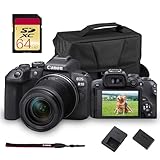
This is the one buyers choose most often in this set, by a wide margin over the other five. The bundle is what earns the top spot. Canon lists the R50 body, the RF-S 18-45mm lens, a shoulder bag and a 64GB UHS-I card, all from a Canon USA authorized seller. That's a complete first day of shooting with nothing else to order, which is not true of every pick here.
The whole kit lands at 2 lb, in a 6 x 8 x 7 in box. Among the four interchangeable-lens picks, that's the lightest published kit figure by a full pound over the R10 and over a pound versus the Nikon Z 30. Canon says the R50 records oversampled 4K with Dual Pixel CMOS AF II, and includes vertical video tools plus a Creative Assist mode aimed at people who don't know what aperture does yet. The vari-angle touchscreen swings out to the side, so a microphone in the hot shoe won't block your view of yourself.
The trade-off is reach. 18-45mm is a wide-to-normal range and nothing more. The R10 kit here covers 18-150mm for a higher price, and once you want a tighter shot of anything more than a few feet away, you'll feel that gap.
Pros:
- Lightest published kit weight of the four mirrorless picks
- Bundle includes shoulder bag and 64GB card
- Vari-angle touchscreen clears a hot-shoe microphone
- Vertical video tools built in, per Canon
- Sells faster than the other five here
Cons:
- 18-45mm gives no telephoto reach at all
- No warranty term published on the listing
- No 4K frame rate stated, unlike the R10 and ZV-E10 II
- Only one seller lists this bundle
2. Sony ZV-E10 II APS-C Mirrorless Creator Camera with 16-50mm Lens — Best warranty
At 0.88 lb this is the lightest body here by a wide margin, and it's the only pick publishing both a 4K frame rate and a slow-motion mode.

Best for: someone filming themselves handheld who wants the lightest body here Skip it if: you want the widest published zoom range in the kit
Weight is the whole argument. 0.88 lb, in a 2.65 x 2.9 x 4.52 in body. Hold a camera at arm's length for a two-minute take and the difference between this and a 3 lb kit is the difference between a steady shot and a shaky one. Released in 2024, it's the newest interchangeable-lens pick in this group.
Sony publishes the numbers other listings here leave out. Up to 60 fps in 4K, 120 fps in Full HD, and an S&Q mode Sony describes as 5x slow motion at HD 24p playback. The sensor is an APS-C back-illuminated Exmor R at approximately 26 megapixels. Real-time Eye AF covers humans, animals and birds, per Sony. There are 10 Creative Look presets for setting a mood in camera rather than in an editor, which is genuinely useful if you're posting daily and don't grade footage.
It carries a 1 year manufacturer warranty, and it's one of only three picks here with any warranty term published at all. Two sellers list it, the only pick in the set with more than one.
What you give up is the safety net of a bundle. There's no bag, no card and no accessories mentioned, and the 16-50mm covers less range than the Canon 18-150mm. It also sits in the upper price tier here, so the cost of entry into E-mount lenses starts high.
Pros:
- 0.88 lb, the lightest published body weight in this set
- 4K up to 60 fps and Full HD to 120 fps, per Sony
- 1 year manufacturer warranty published
- 10 Creative Look presets for in-camera grading
- Two sellers stock it, more than any other pick
Cons:
- No card, bag or extras included in the kit
- 16-50mm range is the second-shortest here
- Second-most expensive pick in this group
- Body-only weight makes kit comparison harder
3. Canon EOS R10 Mirrorless Camera with RF-S 18-150mm Lens — Best premium
One lens covering 18-150mm removes the single biggest frustration of a starter kit, and the R10 pairs it with the fastest published burst rate here.

Best for: a creator who shoots travel, sport and portraits with one lens Skip it if: you carry the camera all day and care about the 3 lb figure
The lens is the reason to buy this. RF-S 18-150mm spans wide-angle to telephoto in a single barrel, which means no lens swaps in a market, on a hike or at a kid's game. Compared with the R50's 18-45mm, you're getting more than three times the long end. For a creator shooting varied b-roll, that changes what you can film without planning ahead.
Canon publishes real video figures here too: 4K 60p oversampled from 6K, with Dual Pixel CMOS AF II. Stills shooters get up to 15 fps mechanical or 23 fps electronic, the fastest continuous shooting stated by any pick in this set. Wi-Fi and Bluetooth handle transfers and remote control through Canon's Camera Connect app.
The cost is bulk and money. The kit weighs 3 lb in a 6 x 11 x 7 in box, a pound heavier than the R50 and more than three times the ZV-E10 II body. It's also the most expensive pick here, and it's the slowest seller of the six by sales position. That combination tells you something: most beginners look at the price of the superzoom kit and take the smaller one.
Pros:
- 18-150mm covers wide to telephoto in one lens
- 4K 60p oversampled from 6K, per Canon
- Up to 23 fps electronic burst, fastest stated here
- Wi-Fi and Bluetooth for app transfer and remote
Cons:
- 3 lb kit weight, heaviest published figure here
- Most expensive pick in this group
- No warranty term published on the listing
- Slowest seller of the six
4. Nikon Z 30 Compact and Lightweight Mirrorless Camera with NIKKOR 16-50mm Lens — Most versatile
The Z 30 is built around long-form recording, with a stated runtime and a tally lamp that no other pick here mentions.

Best for: long-form talking-head video and streaming from a desk Skip it if: you want an electronic viewfinder for stills
Nikon's spec sheet reads like it was written by someone who films themselves talking. Over 2 hours of recording time, per Nikon. A red REC lamp on the front so you know you're rolling. A built-in stereo mic that's also external-mic ready. Live streaming support. Those four together make it the most complete sit-down recording camera in this set, and the Creator's Kit bundling adds accessories for the same job.
The sensor is 20.9MP with EXPEED 6 processing and a standard ISO range of 100-51200, which Nikon frames around low-noise indoor and night shooting. Eye-Detection AF holds focus on people, dogs and cats even while tracking, per Nikon. The vari-angle screen takes taps to reposition focus and adjust brightness while you're in front of it. Released in 2023, with a 1 Year Limited warranty published.
Two things hold it back. The body has no electronic viewfinder, so bright outdoor stills mean squinting at a screen. And the kit weighs 3.11 lb, the heaviest published figure in this group, even though the body itself measures a slim 2.9 x 2.4 x 5.1 in. It's also the second-slowest seller here, which is a fair signal that the Canon and Sony bodies get the attention.
Pros:
- Over 2 hours recording time, per Nikon
- Red REC tally lamp, unique in this set
- 1 Year Limited warranty published
- External mic ready with built-in stereo mic
- ISO 100-51200 stated range
Cons:
- 3.11 lb, the heaviest kit weight here
- No electronic viewfinder
- 20.9MP is the lowest stated sensor figure in the set
- Second-slowest seller of the six
5. HolyEye 4K Vlogging Camera with Magnetic Mount — Best upgrade
A magnetic mount and a 330° rotating lens reach angles no mirrorless body can, which makes this a second camera rather than a first one.

Best for: a second camera for angles a big body cannot reach Skip it if: you expect interchangeable lenses or a real warranty
Be clear on what this is. It sits in the action camera category, not among mirrorless bodies, so it does not belong in the same shortlist as the Canon, Nikon and Sony picks on capability. It earns its place because of what it does that they cannot.
The magnetic mount is the point. Stick it to a fridge for a cooking shot, a bike frame, a car dash. HolyEye says the 330° rotating lens covers low-angle, overhead and selfie positions without repositioning the whole camera. There's AI face tracking to keep you centred while filming solo, plus creative filters and composition guides. Wi-Fi handles transfers and the built-in battery is stated at 2400mAh. It's the second-cheapest pick here.
Now the honest part. The warranty is 30 days from the manufacturer, the shortest term in this set by a factor of twelve against the Nikon and Sony. No weight or dimensions are published, so you cannot compare its size to anything. The lens is fixed, so there's no upgrade path whatsoever. Sensor size is not stated either, and sensor size is what separates usable low-light footage from mush.
Pros:
- Magnetic mount opens angles a mirrorless body can't reach
- 330° rotating lens for overhead and low shots
- AI face tracking for solo filming, per HolyEye
- 2400mAh battery stated
- Second-cheapest pick in this group
Cons:
- 30 days warranty, shortest term in this set
- Fixed lens, no upgrade path
- No sensor size, weight or dimensions published
- Sits in the action camera category, not mirrorless
6. LIYTIFOR 5K Digital-Cameras-for-Photography — Best budget pick
The cheapest way to find out whether you actually enjoy filming, with a front screen the mirrorless picks don't have.
Best for: a teenager or complete beginner testing whether they enjoy filming Skip it if: you plan to grow into better lenses
This is a point-and-shoot, not a mirrorless camera, and I've placed it last for that reason. But it's the cheapest of the six by a clear margin, and there's a real case for it: buying a first camera you might abandon in a month is a worse decision than buying a cheap one and finding out.
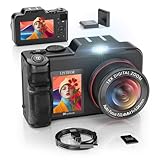
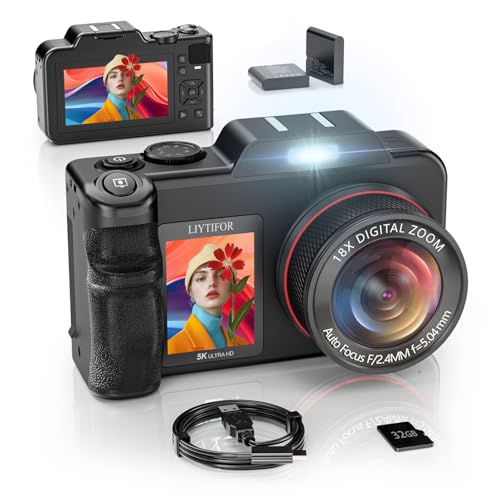
LIYTIFOR lists a 3.5" HD main screen plus a 2" front screen, which is the one genuine advantage it holds over every other pick here. A dedicated front display beats a flipped-out side screen for judging your own framing. There's 18X digital zoom, a 360° rotating filter dial and a 12 months warranty, which is longer than the HolyEye's term and matches Nikon's and Sony's. The USB-C cable doubles as a webcam connection, per the listing, and the kit arrives ready to shoot.
The claims need reading carefully. 5K and 80MP autofocus are the listing's words, and the sensor size behind those figures is not published. Digital zoom is a crop, not optics: 18X of it will look soft. The lens is fixed, the model is an LR1 with no released date given, and no weight or dimensions appear anywhere on the listing.
Pros:
- Cheapest pick of the six
- 2" front screen plus 3.5" main screen
- 12 months warranty published
- USB-C doubles as webcam connection, per the listing
- Complete ready-to-shoot kit
Cons:
- 18X zoom is digital, not optical
- Sensor size never stated behind the 80MP claim
- Fixed lens, no upgrade path
- Point-and-shoot category, not mirrorless
- No weight or dimensions published
Two of these six are not mirrorless cameras at all
Amazon's results for the best beginner mirrorless camera for content creators mix in fixed-lens cameras, and you need to spot that yourself before you buy. The LIYTIFOR sits under Point & Shoot Digital Cameras. The HolyEye sits under Sports & Action Video Cameras. Neither is a mirrorless camera, and neither can claim to be one.
Three practical differences follow from that:
- No lens changes. The four mirrorless picks accept new glass. A 50mm prime for interviews, a wide for room tours. The other two are stuck with what they ship with, forever.
- Sensor size is unpublished. Canon, Nikon and Sony all state APS-C. The two fixed-lens picks state neither sensor size nor sensor type. A high megapixel count on a small sensor produces noisy footage indoors.
- No hot shoe mentioned. Nikon publishes external mic support on the Z 30. Neither fixed-lens listing mentions a microphone input, and audio is what separates watchable content from unwatchable content.
If you want a cheap camera, buy one knowingly. Just don't buy one believing it's a mirrorless body that will grow with you.
Canon EOS R50 vs Sony ZV-E10 II: which wins?
These two are the real decision for most people, so here's the split.
The R50 wins on completeness and cost. Canon's bundle includes the body, the 18-45mm lens, a shoulder bag and a 64GB card, from an authorized seller, at a lower price position than the Sony. For a first camera, that matters more than most spec sheets admit. It's also the pick buyers here choose most often, by a large margin over every other option in this group.
The Sony wins on two hard numbers. 0.88 lb for the body against 2 lb for the whole Canon kit, and published video specs the Canon listing simply doesn't state: 4K up to 60 fps, Full HD to 120 fps, 5x slow motion in S&Q mode. Sony also publishes a 1 year manufacturer warranty where the Canon bundle publishes none.
The cutoff is how you shoot. If most of your footage is handheld at arm's length, or you want slow motion, take the Sony and accept buying a card separately. If you're shooting a mix of stills and video from a tripod or a table, the R50 bundle gets you further for less.
What do the listings not tell you?
Four gaps worth knowing before you commit.
Battery life is stated once. Only Nikon publishes a runtime figure, at over 2 hours. Canon and Sony state nothing about battery on these listings, and HolyEye gives a 2400mAh capacity without a runtime. Budget for a spare battery on any of them.
Half the picks publish no warranty. Both Canon bundles list no warranty term. Nikon states 1 Year Limited, Sony states 1 year manufacturer, LIYTIFOR states 12 months, HolyEye states 30 days.
Weight figures are not comparable. Canon and Nikon publish kit or shipping weights: 2 lb, 3 lb, 3.11 lb. Sony publishes 0.88 lb, which reads as a body figure. Compare across those and you'll draw the wrong conclusion.
Storage is usually extra. Only the R50 bundle and the LIYTIFOR kit mention a card or a complete kit. Assume you're buying a UHS-I card for the others.
The verdict
At the entry tier, the LIYTIFOR is a way to test the hobby, not a camera to build on. Fixed lens, unpublished sensor, digital zoom. It gets you a front screen and a 12 months warranty for the least money, and if the camera ends up in a drawer you've lost little. The HolyEye sits alongside it as a specialist: brilliant magnetic angles, a 30 days warranty, and no path forward.
In the middle tier, the Canon EOS R50 is the default and the winner. A 2 lb kit with an 18-45mm lens, a bag, a 64GB card and Canon's Dual Pixel CMOS AF II covers a beginner's first year without a single extra purchase. It's the pick buyers here reach for most, and I'd start there unless something specific pushes you elsewhere. The Nikon Z 30 takes the middle tier if your content is long sit-down video: over 2 hours of recording, a tally lamp and external mic support are built for exactly that.
At the premium tier the choice is between reach and weight. The Canon EOS R10 gives you 18-150mm in one lens plus 4K 60p and a 23 fps burst, at 3 lb. The Sony ZV-E10 II gives you 0.88 lb, 4K 60 fps, 120 fps Full HD and a published 1 year warranty, with a shorter 16-50mm lens. Handheld creators take the Sony. Travel and sport shooters take the R10.
FAQ
Is a beginner mirrorless camera worth it over a phone?
A beginner mirrorless camera is worth it if you want shallow depth of field, an external microphone and lenses you can change. Phones now shoot good 4K. What they can't do is take a 50mm prime, or an 18-150mm zoom like the Canon EOS R10 kit. If your content is talking-head video with a static frame, a phone may be enough.
Which is the best value pick in this group?
The best value pick in this group is the Canon EOS R50 bundle, because of what comes in the box. You get the body, an RF-S 18-45mm lens, a shoulder bag and a 64GB UHS-I card from an authorized Canon USA seller. Buy the Sony ZV-E10 II and you're adding a card and a bag separately, on top of a higher price position.
What lens should a beginner mirrorless camera for content creators come with?
The lens a beginner mirrorless camera for content creators comes with sets what you can film in month one. 16-50mm and 18-45mm cover wide to normal, which suits room tours and arm's-length selfie video. The RF-S 18-150mm on the Canon EOS R10 adds real telephoto reach, useful for travel and sport, at a pound of extra kit weight.
Canon EOS R50 or Nikon Z 30 for streaming?
Between the Canon EOS R50 and Nikon Z 30 for streaming, Nikon publishes more of the relevant specs. The Z 30 states live streaming support, over 2 hours of recording time, a built-in stereo mic that's external-mic ready, and a red REC lamp. Canon lists oversampled 4K and vertical video tools instead. For fixed-position long recordings, the Z 30 is the stronger fit.
Do megapixels matter when buying a beginner camera?
Megapixels matter far less than autofocus and sensor size. The cheapest pick here claims 80MP, roughly triple Sony's approximately 26 megapixels on the ZV-E10 II, and nobody would call it the better creator camera. High resolution on an unpublished small sensor produces noisy indoor footage. Look for a stated APS-C sensor and a named eye-detection autofocus system instead.
Pick the camera that matches how you actually film, not the one with the biggest number on the box. Sit-down video from a desk points at the Nikon Z 30. Handheld arm's-length shooting points at the Sony ZV-E10 II. Filming a market, a match and a portrait on the same afternoon points at the Canon EOS R10 and its 18-150mm lens. For everyone else, and that's most people buying their first camera, the Canon EOS R50 bundle at 2 lb is the sensible default: it arrives complete, it's the one buyers here choose most often, and nothing in it will hold you back for a year.